
Mathematical Modeling 3 - The Abstract

Suppose you have finished a modeling project: several subproblems, equations, experiments, and the carefully labeled figures from the previous lesson. A reviewer will first see a title and a short abstract. Can that tiny space tell them what you actually decided, what evidence supports it, and what remains uncertain? Before reading any writing rule, jot down your project’s one-sentence question and its two strongest results.
An abstract is not the place to promise that a method is “novel” or “accurate” without evidence. We will draft one from a result table, trace each claim back to a body figure, and cut every sentence that describes a procedure but never tells the reader what happened. I will show the edits as I would explain them to a teammate sitting beside me: why this number belongs, why that technical detail can wait, and why a limitation sometimes makes the result more trustworthy.
The abstract is a compressed version of the entire modeling argument. A judge should learn what was modeled, how it was solved, what was found, and why the answer is credible without searching the body.
One distinction will save you many revisions: an introduction earns the reader’s attention and develops the background, literature, and problem motivation; an abstract reports the whole argument after it has been completed. If you copy the introduction’s first paragraph into the abstract, the results may vanish. If you copy only the conclusion into it, the method and evidence chain may vanish. The abstract must contain enough of both ends to stand alone. Think of it as telling a classmate what we tried, what changed, what we checked, and what we would do now—all before they have seen the full report.
If a contest template leaves very little abstract space, shorten the background before deleting the result. Keep one concrete sentence about the decision, one about the model chain, and at least one measured comparison and one boundary. If several subproblems are required, give each a result slot rather than spending half the space explaining software. The exact page or word limit depends on the applicable template, but the reasoning principle does not: a reader needs evidence more than ceremony. Read the compressed version against the body once more, because every removed qualifier is a chance to turn a conditional number into an unconditional claim by accident.
The five-part architecture
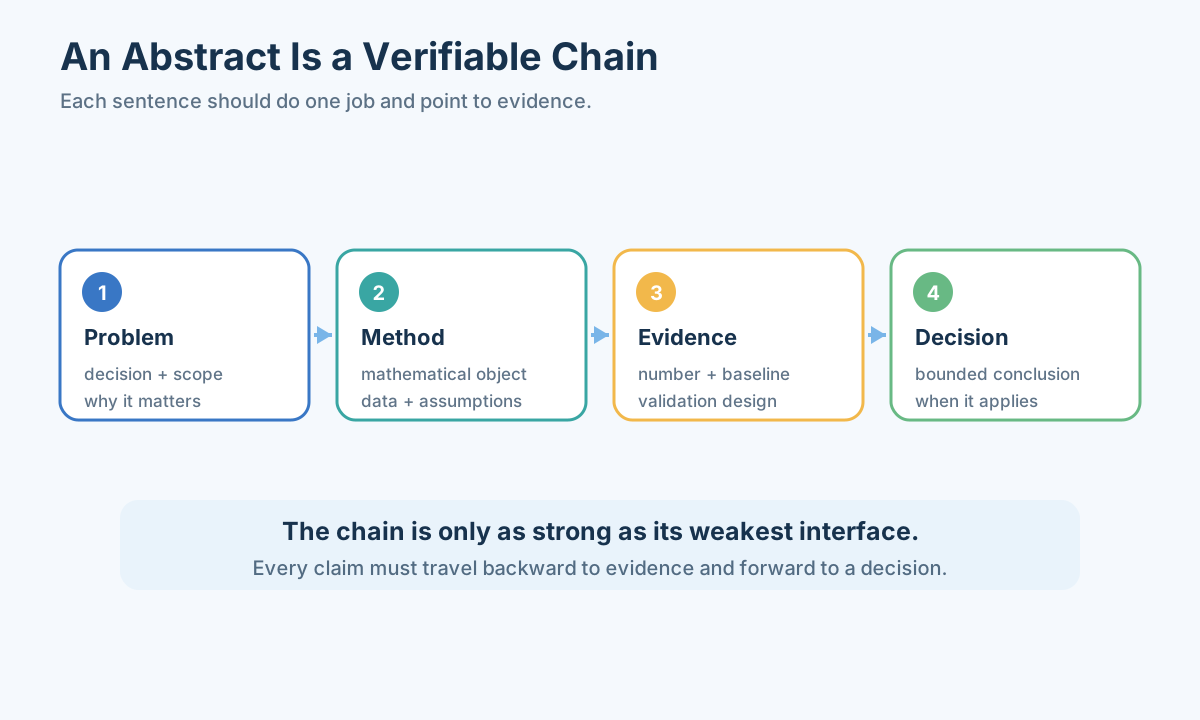
An effective abstract contains:
- Problem and setting: one or two sentences, not a rewritten prompt.
- Overall strategy: the decomposition linking the subproblems.
- Model and method: named precisely, with the important adaptation.
- Quantitative results: numbers, rankings, errors, or decisions.
- Validation and implication: robustness, sensitivity, comparison, and use.
Avoid a chronological diary such as “first we read the data, then we used Python.” Describe logical dependencies instead.
Write for a reader who has one minute
Imagine you are the reviewer. You have dozens of papers, and the first page of one says, “With the development of artificial intelligence and society, mathematical modeling is increasingly important. We employed advanced methods to solve the problem and achieved excellent results.” At this point, what do you know? Almost nothing. You do not know the decision, data, measured result, baseline, or condition under which the claim holds. The paragraph may sound formal, but it has spent the reader’s scarce minute without transferring information.
Try a different first sentence from our basin problem: “We estimate when a restaurant’s hot-water basin falls below its declared temperature threshold as successive cold plates are washed.” You immediately know the setting, changing quantity, and target. A second sentence could say that a one-step energy balance updates water temperature after each plate. A third could report that, under the explicitly illustrative 20-kg basin and identical-plate assumptions from lesson one, the threshold is first crossed after plate 205. A fourth must say that cleanliness may force replacement sooner. This tiny argument contains a conditional result, not a blanket hygiene recommendation.
An abstract is often written last because the results need to be stable before we can summarize them truthfully. But the question and logical chain can be sketched early. I would make a temporary six-line card while modeling: decision, inputs, baseline, proposed method, evidence slot, and limitation. As the project progresses, fill the evidence slot with real values and delete methods that did not matter. The card helps the team see what it still owes the reader, even though the final polished abstract waits until the end.
What is a result as opposed to a method? “We used a Kalman filter” is a method phrase. “The fused trajectory has a reported RMSE of 0.6301 m” is a result phrase. “We used a binary program” is a method phrase. “We scheduled 27 tasks under the stated constraints” is a result phrase. Both kinds may belong, but the method must explain how the result was obtained, and the result must help answer the original question. A paragraph of methods with no results reads like a shopping list; a paragraph of numbers with no definitions reads like a scoreboard.
What is a limitation as opposed to apologizing? If the basin model ignores dirtiness, saying so protects the manager from treating a thermal result as a sanitation rule. If a robot’s alignment error is tiny only because one attachment has no noise, saying “under noise-free conditions” explains why that number cannot be generalized to field sensors. A limitation names the boundary of a claim. It often makes a paper more useful, because it tells the reader where the recommendation needs additional evidence.
Now take a blank sheet and write your own one-minute version of a simple project: “We address ___ for ___; using ___, we estimate or choose ___; compared with ___, the result is ___ in ___ units; the recommendation holds when ___ and should be reconsidered if ___.” You may not fill every blank today. Do not invent values to make the paragraph look complete. Mark missing evidence as a task for the project, and return when you have measured it. This is how an abstract becomes the smallest honest model argument.
An abstract is not a miniature table of contents. Once we know the overall five-part shape, we have to decide which result from each task belongs in its few sentences and which implementation detail can wait until the body.
Summarize each subproblem as a result
For each requested task, use a three-part sentence:
To estimate target, we construct model with defining feature; it produces quantitative result and interpretation.
For example:
To align two asynchronous trajectories, we minimize a continuous-time least-squares residual over temporal offset and spatial bias; the corrected tracks reduce median position error from 0.42 m to 0.08 m.
This sentence is informative because it contains the purpose, model, and evidence. “We used least squares and obtained good results” contains none of them.
Name the mathematical object
Use specific language. State whether the work uses a linear program, mixed-integer model, state-space model, constrained nonlinear least squares, Monte Carlo simulation, or multi-criteria evaluation. If the method was modified, state the modification and its purpose:
- a smoothness penalty to prevent abrupt schedules;
- robust constraints to handle demand uncertainty;
- rolling-origin validation to respect time order;
- a two-stage search combining global exploration with local refinement.
The abstract should not contain a catalog of every library or algorithm tried.
If you are just beginning, some method names may sound like passwords. A linear program chooses numerical decisions under linear rules. For the snack factory, boxes of A and B are decisions, ingredient supplies are linear constraints, and profit is a linear objective. A mixed-integer or binary model adds choices that must be whole or yes/no, such as whether a task is scheduled or a worker is assigned. In an abstract, these names help a reader understand the kind of mathematical choice being made. They do not replace the sentence saying what was chosen or why.
A state-space model describes a changing hidden state and the noisy observations that give us clues about it. For the moving robot, position, speed, and acceleration form a state; sensors observe position with errors. A Kalman filter is one way to update an estimate as readings arrive under declared linear and noise assumptions. A backward smoother uses later readings to refine earlier state estimates after the full record is available. If a report needs a real-time decision, you should not quietly present the backward-smoothed path as something the robot could have known at the earlier moment. The abstract can name the filter and smoother, but the body must say what time information each used.
Least squares means choosing parameters to make a collection of squared disagreements small. In sensor synchronization, one such parameter is the time shift; another may be a spatial offset. “Continuous-trajectory least squares” tells the reader that we did not simply pair raw samples by identical printed timestamps. It still leaves important details for the body: how the continuous path was interpolated, what common time window was compared, and whether large residuals were handled separately.
BIC, the Bayesian information criterion, is a model-selection score that rewards fit while penalizing added parameters. A fixed spatial bias can always make an in-sample residual a little smaller if you allow extra offset parameters, even when the improvement is noise. The course case reports only a 0.054% RMS improvement and a larger BIC with bias, so the extra correction is not retained. The abstract needs the decision and its main evidence; it does not need to derive the BIC formula there. The body must explain the candidate models and why a larger score counts against the added bias in the chosen convention.
Monte Carlo simulation means evaluating a model repeatedly under sampled or constructed uncertain inputs. For reservoir operation, it can test drought and demand scenarios. If the report says 1,860 out of 2,000 scenarios were feasible, the abstract may give that count, but the body must tell us whether scenarios came from historical variability, a calibrated distribution, or deliberately severe stress cases. Otherwise a reader may mistake a simulation fraction for a real probability.
Here is the language test I would use with a first-time teammate. Replace every method name in the abstract with a short plain-English description. Does the story still make sense? “We align clocks, reconstruct a noisy path, test a suspected fixed bias, then schedule feasible tasks” should be understandable before “least squares, Kalman filter, BIC, integer program” appears. Put the names back only where they tell a mathematically trained reader something useful about that plain story. Jargon that obscures the story has not earned its space.
Put evidence in the abstract
Useful evidence includes:
- prediction error on held-out periods;
- improvement over a baseline;
- confidence or prediction intervals;
- optimal objective and resource use;
- sensitivity ranges under parameter perturbation;
- stability of rankings under alternative weights.
Use units and enough context to interpret a number. “Error is 0.12” is incomplete; “mean absolute percentage error is 12% on the final six weeks” is testable.
Practice on the basin we already know
Take the restaurant problem from lesson one and its threshold plot from lesson two. We know the question: when should one hot-water basin be replaced on thermal grounds? We know the model: a one-step energy balance updates water temperature after each plate, assuming mixing, no heater, and identical incoming plates. We know the illustrative result: with 20 kg of water initially at
A first draft might say, “We build a novel heat model to solve a dishwasher problem. The model accurately predicts 205 plates and can be widely applied to restaurants.” Stop. Nothing in the teaching calculation proves novelty, accuracy against measurements, or wide applicability. The plate number is conditional on assumptions and illustrative parameters. “Dishwasher problem” also sounds as if we modeled a machine; the example is a basin used by a worker. The language is smooth, but it outruns the evidence.
A corrected version could read: “We estimate the thermal plate capacity of a restaurant’s hot-water basin by updating mixed-water temperature after each incoming cold plate with an energy balance. Under an illustrative 20-kg basin, initial temperature of
What if we later collect observations? Suppose the measured water temperatures after plates 50, 100, and 150 agree closely with the model, but the basin becomes visually dirty after plate 90. The abstract should report the observed thermal agreement using a defined metric and recommend replacement before 90 if cleanliness is the governing rule. It would be wrong to keep the 205-plate recommendation merely because the recurrence fit temperature well. The evidence may validate one component while changing the operational conclusion.
What if the measured temperatures are much lower than the model prediction? Ask whether the heater was off, whether cold rinse water entered the basin on each plate, and whether plates were heavier than assumed. Do not write “model error = 4 degrees” without saying how many observations, which plate numbers, and whether the discrepancy is systematic. A result sentence gains meaning from its evaluation conditions. The abstract can carry the headline discrepancy; the body must diagnose it.
Try this on another project. Write an abstract from only four items: question, method, one supported result, and one failure condition. Then compare it with a draft written from the method names alone. The first should let a reader decide whether the paper might help them; the second may only tell them that you know some tools. This exercise is especially important when your model sounds impressive enough to tempt you into claims the data cannot support.
Avoid unsupported adjectives
Words such as excellent, accurate, reasonable, and robust must be earned. Replace them with evidence:
- “accurate”
“outperforms the seasonal-naive baseline by 18% MAE”; - “robust”
“the selected plan remains unchanged under demand perturbations”; - “efficient”
“solves 50,000 scenarios in 14 seconds.”
Do not claim causality from correlation, or generalization from an in-sample fit.
Let us practice replacing four seductive words. Accurate compared with what? In the reservoir workshop, “MAE 5.9 ML/day on the final twelve weeks, versus 8.7 for the seasonal-naive rule” tells us the metric, evaluation window, and baseline. If the town normally needs to decide whether to order five or fifty megalitres more, we also have to ask whether that error is small enough for the decision. A percentage improvement can sound impressive while both errors remain operationally unacceptable. An abstract can report the comparison and, when space allows, the decision-relevant scale.
Robust to which disturbances? A production plan might remain unchanged when demand changes by
Optimal under which formulation? A linear program solved to global optimality can support an exact mathematical claim for its declared objective and constraints. It does not prove that its assumptions about demand, worker availability, or costs were correct. For task scheduling, an exact optimum over generated feasible candidate windows is not automatically an optimum over every action a robot could physically perform. Name the mathematical scope if it matters: “optimal among the generated task windows under the stated non-overlap and angle rules” is stronger in honesty than “globally optimal task plan” when the candidate set is restricted.
Causes or merely predicts? Suppose a regression finds that roads with longer yellow intervals have fewer reported incidents. Those roads may also differ in traffic volume, speed, geometry, or enforcement. A scatter plot and fitted line can show an association; they cannot by themselves isolate a causal effect of timing. An abstract that says “longer intervals caused fewer incidents” needs a design capable of supporting that counterfactual claim. If the study only modeled association, say “is associated with” or “predicts” and tell the reader what was controlled.
Significant is another word with two meanings. A statistical test may reject a zero coefficient with a tiny
Do not solve these problems by deleting every adjective and leaving a string of numbers. The point is to let the result earn its description. If a drought policy remains feasible in 1,860 of 2,000 scenarios, you can describe its tested scenario coverage but must say how those scenarios were created. If a trajectory fit has an error near zero only on noiseless synthetic records, say that. If a schedule completes 27 tasks, say which resource and geometry rules were respected. Plain evidence gives the prose its confidence without asking the reader to trust your enthusiasm.
Keywords and title
The title should identify the problem and the central modeling contribution. Keywords should be searchable technical concepts, not generic words already in every paper. A useful set mixes domain and method, such as urban mobility, robust optimization, demand forecasting, sensitivity analysis.
Let us test titles with our two cases. “An Excellent Study on a Complex Problem” tells the reviewer no domain, decision, or model. “Mathematical Modeling of Water” narrows the domain but still says little about the action. “Forecast-Informed Reservoir Releases under Drought Scenarios” tells us what is chosen and what uncertainty matters. You could make it shorter if the contest has a strict title format, but you should not replace meaning with grandeur.
For the robot case, “Research on Multi-Source Data” is similarly vague. “Clock-Aligned Robot Localization and Resource-Constrained Task Scheduling” identifies the two central linked jobs. It does not claim a revolutionary algorithm; it gives the reader a map of the paper. If the main contribution were a new alignment method rather than scheduling, the title might foreground synchronization instead. The title is a promise about what the body and abstract will actually deliver.
Keywords are signposts for search and indexing, not a second abstract. Choose a domain phrase, a model phrase, and perhaps an evaluation phrase that a future reader might type. For the reservoir, examples include reservoir operation, seasonal demand forecasting, drought scenarios, and release optimization. “Mathematics,” “research,” and “solution” are too broad to distinguish the paper. For the robot, multisensor localization, time alignment, Kalman filtering, and task scheduling point to concrete content. Do not include a fashionable phrase merely because it attracts attention if the method is absent from the work.
Imagine a teammate proposes the title “AI-Based Optimal Robot Scheduling,” but the only machine-learning component is a classical state estimator and the task schedule is solved on generated candidates. Ask two questions: Is “AI-based” a truthful summary of the central method? Is “optimal” an exact guarantee for the complete physical problem, or only for a constrained candidate set? If we cannot defend both, revise the title now. The title often catches inflated claims before they spread into the abstract and conclusion.
You can perform a quick title exercise on any strong paper you read. Cover its title, write your own from the decision and most important model, then compare. Ask which version lets a stranger predict the paper’s results and limitations more accurately. This practice is useful because concise writing starts at the top of the page, not after the abstract paragraph is already finalized.
Final abstract test
Highlight every method in one color, every result in another, and every validation claim in a third. If one color is absent, the abstract is incomplete. If half the abstract has no color, it is probably background that belongs elsewhere.
Do the color test on the robot paragraph. “Continuous-trajectory least squares” and “filter and backward smoother” are method phrases. The offsets, bias vector, RMSE, and 27 tasks are result phrases. The BIC increase and tiny RMS improvement are diagnostic evidence for a decision not to correct. If you only find method color in the first three sentences, move a measured result forward. If you only find numbers, add the one method phrase that shows how those numbers relate. If no sentence explains why a field-bias correction was rejected, the reader will miss a key modeling judgment.
Now do the same with the reservoir paragraph. Demand MAE belongs to forecast evidence; shortage reduction belongs to decision evidence; feasibility fraction belongs to stress-test evidence. It would be a mistake to label all three simply “accuracy.” Ask a teammate to name the units and target of each result. If they call 93% a forecast accuracy, the abstract’s wording has not made the task chain clear enough. Revise the sentence so scenario feasibility cannot be confused with prediction error.
One of the best tests is to read only the final sentence. Does it offer an action or bounded implication, or does it say “the model can provide reference for future research”? A manager facing tomorrow’s reservoir release cannot act on that vague promise. A qualified action—use the tested release rule inside the declared scenario range, switch to an emergency rule beyond it—speaks to the original decision. If the project did not establish an emergency rule, the final sentence should instead name the unresolved boundary and what observation would trigger a review.
The color exercise is not a strict law that every sentence must contain a number. A setting sentence can be plain; a method sentence can make a dependency clear before any result appears. It is a diagnostic for the whole paragraph. The goal is that by the end, a stranger can find the question, the chain of models, the most important evidence, and the condition limiting the claim. If one is missing, the abstract is not yet the paper’s smallest complete argument.
The abstract is written last, after results are stable. It is then revised as a standalone decision memo: concise, quantitative, and consistent with the body.
What if your modeling project is not finished yet?
Suppose our dining-hall team from lesson one has only a capacity baseline, not measured waiting times. Sixty customers are expected during a half-hour peak. Two workers can serve about fifty in that period; three can serve about seventy-five at payment. The team has not yet modeled food preparation, recorded lunchtime bursts, or tested a staffing change on held-out days. Can it write an abstract today? It can write a working abstract, but it must not report a reduction in average wait that nobody measured.
A safe working statement is: “We formulate a half-hour staffing decision for a campus dining hall under a fixed labor budget. A demand-capacity baseline indicates that two payment workers are overloaded at the illustrative peak of 60 arrivals per half hour, whereas three provide nominal average spare capacity. Because arrivals may cluster and other stations may become bottlenecks, we will evaluate queue distributions and the full service chain before recommending a schedule.” This is not a final competition abstract, but it accurately names the known result and the missing evidence. It helps the team prioritize its next experiment.
The dishonest version would be: “Our optimized plan reduces student waiting by 50% and has excellent robustness.” No wait-time model or observation supports that number. The temptation may come from confusing capacity with wait: raising payment capacity from 50 to 75 customers per half hour is a 50% capacity increase, but it does not imply a 50% wait reduction. If the bottleneck moves to preparation, total wait might barely change. Writing the abstract forces us to separate input capacity, modeled queue, and decision outcome.
Suppose the team later performs a simulation on measured arrival timestamps. It compares the current schedule and proposed one under the same days, rules, and random seeds. If median wait falls from eight to six minutes while 90th-percentile wait remains twenty minutes, the abstract should report both if reliability is part of the question. “Median wait falls by two minutes” is supported; “waiting is solved” is not. If food preparation becomes overloaded, the conclusion should name the new bottleneck. This is how a working abstract grows into a finished one as evidence arrives.
There is a useful authoring rule here: leave result slots, not invented result values. Write “[held-out median wait]” in your team draft if the test is unfinished, with a person assigned to fill it from a result table. Do not publish the bracketed slot in a finished blog or report; either complete the test or revise the claim to the evidence you do have. In the robot example earlier, we replaced empty bracketed values with quantities actually present in the supplied report and explicitly refused to invent a missing baseline. The final reader should never have to decode placeholders or guess which numbers are hypothetical.
One more question I would ask you: if your abstract becomes hard to write because every stage is still “in progress,” can you build a smaller complete version? For the dining hall, a complete baseline can say something defensible about overload under declared rates, even if it cannot yet claim shorter waits. Report the smaller result accurately, then extend the model. A modest truthful abstract beats an ambitious false one, and it tells the team where the next hour of work is needed.
We have talked about evidence and wording separately. Now we will draft from an actual set of results, so that every claim in the abstract can be traced back to a number, figure, or limitation rather than to an adjective.
Write an abstract from real results
Imagine a problem with three tasks: forecast weekly water demand, design a reservoir release policy, and test the policy during drought. The final results are: seasonal-naive MAE
The values in this reservoir workshop are illustrative teaching results. “ML” here means megalitres (one million litres), not machine learning. Let us make the problem concrete before writing a polished abstract. A town draws water from a reservoir. Every week a manager chooses how much to release while keeping enough storage for later and enough water in the river for ecology. Demand changes with weather and season. The manager wants to limit shortages, especially during drought. What must the paper answer? It must produce a release decision and explain how that decision behaves when both demand and inflow are uncertain.
The three tasks have a natural order. First estimate future demand using only information available when the weekly decision is made. Second use demand scenarios, inflow scenarios, storage capacity, and minimum ecological-flow rules to choose releases. Third test the resulting policy under stressful drought scenarios. The forecast does not become the final recommendation by itself; it is an input to the optimization. The optimizer does not become evidence of safety by itself; its policy is an input to the scenario test. The abstract should make these arrows visible in ordinary language.
Let us calculate what the reported values mean. Mean absolute error, or MAE, is the average absolute difference between predicted and observed demand on a specified evaluation period. Lower is better. A seasonal-naive rule—perhaps using demand from the comparable week last season—has
The shortage numbers concern the policy. The original policy has an expected shortage of
Finally,
I would ask the team to write four evidence cards before drafting: a forecast card with metric, units, baseline, and holdout period; a shortage card with old and new policy under matched scenarios; a feasibility card with scenario construction and count; and a failure card describing the simultaneous low-inflow/high-demand corner. Those cards prevent numbers from floating loose in sentences. If any card lacks a source table or figure, the abstract cannot honestly use the number yet.
Convert tasks into a logical chain
Do not write “For Problem 1 we used X; for Problem 2 we used Y.” Explain why the outputs connect. The demand forecast generates inflow and demand scenarios; those scenarios enter the release optimization; simulation evaluates the chosen policy. This chain is the intellectual contribution.
A useful first sentence is: “We develop a forecast–optimization–simulation framework for weekly reservoir operation under seasonal demand and uncertain drought severity.” It identifies the object, time scale, decision, and uncertainty without retelling the prompt.
State methods at the correct resolution
“We use machine learning” is too vague. “We use a gradient-boosted tree” may be too detailed if the method is not central. Choose the resolution that explains the role: “A seasonal forecasting model with weather covariates generates demand scenarios, which feed a two-stage release optimization.” Libraries, hyperparameter searches, and routine preprocessing belong in the body.
Attach a number to every important claim
An evidence-rich result paragraph might say:
On the final 12-week holdout, the demand model achieves an MAE of 5.9 ML/day, compared with 8.7 for the seasonal-naive baseline. The optimized release policy lowers expected shortage from 14.2 to 4.6 ML/day while satisfying storage and ecological-flow constraints. In 2,000 drought scenarios, 93% remain feasible; the principal failure mode is a simultaneous 20% inflow decline and peak-demand increase.
Notice what is absent: “excellent,” “high accuracy,” and “very robust.” The numbers perform that work.
End with a bounded recommendation
The final sentence should answer what the decision maker should do and when the answer might change: “We recommend the optimized policy while weekly inflow remains within the calibrated drought envelope; below its 5th-percentile threshold, the emergency conservation rule should be activated.” This is more useful than “Our model provides theoretical guidance.”
A fill-in scaffold
Draft the abstract in six sentences:
- context and decision;
- integrated modeling framework;
- first task and quantitative evidence;
- second task and quantitative evidence;
- validation, sensitivity, or failure boundary;
- recommendation and operating condition.
Then delete repeated prompt language and any method that never affects a result. Check every number against the final table and every claimed method against the equations. Ask a teammate who has not read the paper to identify the problem, models, main results, validation, and recommendation using only the abstract. Any missing item reveals the next revision.
Watch one abstract improve in three passes
Here is the kind of first draft I often see from beginners: “Water resources are very important in modern society. The town faces many complicated challenges. We use machine learning, optimization, and Monte Carlo simulation. The methods show excellent accuracy and robust performance, giving practical suggestions for the future.” Do not feel embarrassed if you would write something similar. It sounds like an abstract because it has formal nouns. But cover the methods and ask what decision was made; you cannot tell. Underline “excellent” and “robust” and ask for the supporting numbers; none are attached.
In a second pass, replace the opening with the question and connect the modules: “We design weekly reservoir releases to reduce shortages under uncertain demand and drought. A seasonal demand forecast generates scenarios for a release optimization, which we test under simulated drought conditions.” This is already better. The first sentence names the decision and objective. The second gives the dependency order. It is still incomplete because a reviewer does not know what changed relative to a simple policy or where the method fails.
In the third pass, add checkable evidence from the cards above: “On a held-out period, demand MAE falls from 8.7 ML/day for a seasonal-naive baseline to 5.9 ML/day. Under matched scenarios, expected shortage falls from 14.2 to 4.6 ML/day while storage and ecological-flow rules are respected. The release plan remains feasible in 1,860 of 2,000 declared drought scenarios; failures concentrate when inflow falls and demand rises together.” We now have a forecast metric, decision metric, feasibility test, and a failure corner. If those values were from real data, the body would need to show their computation; in our classroom example they remain explicitly illustrative.
Now add a bounded implication: “We recommend the proposed release rule within the scenario range used for evaluation and activate a separate emergency conservation plan beyond its low-inflow boundary.” This sentence tells the manager what to do and when not to trust the normal plan. You could revise its exact wording after the town defines an emergency threshold. You should not invent a 5th-percentile rule just to make the sentence sound precise if the policy never used such a threshold.
Read the third-pass abstract aloud. The language is not more ornate than the first draft; it is more informative. Every number has units. A baseline appears. The failure condition is named. The logical words “generates,” “feeds,” and “test” show why the three models belong together. That is the style we are aiming for: a short argument that a person can challenge, not a collection of impressive-sounding terms.
You can apply this process to your own work. First circle words that merely announce importance. Second draw arrows between subproblem outputs. Third place one defensible result or comparison on each arrow or at its end. Fourth add a condition that limits the recommendation. The revised abstract may have fewer words than the first draft, while giving the reader far more to verify. That is what “reading the textbook thin” should mean in writing: remove empty words, not evidence.
Full worked example: four tasks, one abstract
Suppose a prompt asks a team to align two asynchronous location sensors, fuse noisy tracks, determine whether a systematic spatial bias exists, and schedule as many camera or shooting tasks as possible. A weak abstract lists four algorithms. A strong abstract exposes their dependency chain.
First understand the four requests as one journey
Picture a mobile robot moving across a flat test area. One positioning device records a point at one moment; another records a point at a different moment. If their internal clocks are offset, comparing the two raw points at the same printed timestamp is not comparing the robot at the same physical instant. Suppose the first device also has random noise and the second is consistently shifted a few metres east. What would a manager ultimately need? A trustworthy path and a feasible schedule of tasks along that path. Sensor alignment is therefore not a side quest; it is the foundation for deciding where and when the robot can act.
The prompt’s first request is deliberately easier: the two recorded paths have no random noise but different starting times. Can we estimate the clock shift? We represent each sampled path as a continuous trajectory so we can compare positions even when devices sampled at different instants. We shift one path in time until their position disagreement is minimized. The supplied course example reports a shift of
The second request adds random noise and fixed spatial bias. Moving one path on the time axis alone cannot explain a sensor that always reports, say, three metres too far right. The course example jointly estimates a clock shift of
The third request asks whether a fixed bias exists in field measurements. This is not the same as assuming the known fixed bias in the second dataset. Noise and interpolation error can create a nonzero average residual even when no engineering-relevant bias is present. In the supplied report, the candidate bias magnitude is
The fourth request uses the reconstructed path to schedule tasks. At each candidate task time, the robot needs a preparation window in which distance, speed, and acceleration conditions hold. Shooting tasks use one resource and photography another; they have their own non-overlap rules. The course example reports 25 shooting tasks and two photography tasks, 27 total, under its candidate and geometry constraints. The count belongs in the abstract because it answers the requested decision. The exact solver package name does not. But we must not say “globally optimal in the world” merely because a binary program optimized the generated candidate set. The guarantee depends on which candidates were generated, which constraints were included, and whether solving terminated with an exact optimum for that formulation.
Can you now see the arrow chain? Clock alignment makes readings comparable. Bias and noise treatment make the shared path credible. The path determines feasible task windows. The windows are inputs to schedule optimization. The final task count depends on all three upstream stages. If the clock shift is wrong, a task could be declared feasible at the wrong location; a beautiful schedule plot cannot repair it. The abstract needs those dependency words because a four-method list would not reveal why errors propagate.
Take a moment to choose what to leave out of the abstract. The report’s body should explain interpolation comparisons, filter matrices, BIC calculation, target geometry, and scheduling constraints in detail. The abstract has room for only the methods that connect the arrows and results that answer the four requested parts. If you spend six sentences naming libraries and search heuristics, the task count and bias decision may disappear. If you spend six sentences praising “high precision,” the reader cannot check whether the claim refers to idealized or noisy data. Compression is a selection problem, not a contest to remove all mathematics.
First define the shared problem: heterogeneous sensors observe the same moving platform at different sampling rates and with possible clock and spatial offsets. Then state the contribution at the right resolution: continuous-trajectory least-squares alignment estimates clock shift; a constant-acceleration Kalman filter and backward smoother produce a 10 Hz track; residual diagnostics and an information criterion decide whether bias correction is warranted; interval scheduling and a binary program allocate feasible tasks.
The abstract must report results. Reserve grammatical slots for estimated clock shift, fused-position error, improvement over a single-sensor baseline, detected bias magnitude, number of scheduled tasks, and sensitivity range. Replace every empty adjective with one of those quantities before submission.
Example abstract skeleton
We reconstruct a moving robot’s trajectory from two asynchronous positioning systems and schedule feasible shooting and photography tasks on that trajectory. For the noise-free records, continuous-trajectory least squares estimates a clock offset of 198.4317 s and produces 7,004 points at 10 Hz; the reported maximum alignment error is
m under that noise-free setup. For records with noise and fixed spatial bias, joint alignment estimates a 50.4156 s offset and a m bias; a six-state constant-acceleration filter and backward smoother yield a trajectory RMSE of 0.6301 m. On field measurements, a candidate bias of 0.2090 m improves RMS by only 0.054% and increases BIC, so we do not apply a fixed-bias correction. The resulting path supports 25 shooting and 2 photography tasks under their respective timing and geometry rules. These reported quantities belong to the supplied course example; before claiming superiority to another method, the team would need a matched baseline and a clearly defined evaluation set.
This tells the reader what was built, how modules connect, what the supplied example actually reports, and what remains bounded. We deliberately do not invent an improvement over a baseline absent from the provided abstract, or call the schedule robust over an unspecified perturbation range. Exact numbers are valuable only when their source and meaning are honest.
How I would cut the supplied course abstract
The supplied report’s abstract is rich but long. It explains the four requests separately and reports many exact values. That is useful as a source of evidence; it is not a command to repeat every detail in a short summary. I would first mark its indispensable findings: the clock offset in the idealized case, the noisier fused-path error, the field-bias rejection, and the completed-task count. Those correspond to the four requested outputs. I would then ask which numbers are supporting details: 7,004 and 6,898 trajectory points, for example, show the output size but may not be the most decision-relevant facts unless a sampling-resolution requirement is central to the prompt.
Next I would draw the four arrows on paper. The second sensor’s clock must be corrected before the two position streams can be compared. The corrected streams feed a trajectory estimate. A diagnostic decision about fixed bias changes that estimate. The estimated path feeds candidate task windows. If the abstract says “first we do X, next we do Y” four times, replacing some of those labels with output-input links gives the reader a reason for the order. “Using the synchronized path…” does more explanatory work than “For Problem 4…” when the reader does not have the prompt beside them.
The idealized alignment error of
The task count of 27 is memorable, but it needs its scope. It is the number scheduled under the example’s generated windows, resource rules, and angle constraints. A short abstract can say “25 shooting and two photography tasks” so the total can be checked by addition. It need not include every target coordinate or interval length. Those details belong in the schedule table and method section where someone can verify feasibility.
I would then check the report’s final praise language. Phrases like “clear structure” or “strong engineering value” may reflect the authors’ confidence, but a short abstract can use its space better by naming one demonstrated strength and one boundary. For example, rejecting unnecessary bias correction is demonstrated by the residual and BIC evidence. Adaptability to additional sensors might be a plausible future extension, but unless tested it should be phrased as possible, not proven.
Finally, I would read the short version against the original PDF, not just against my memory. Did I change which dataset had which time offset? Did I accidentally turn 25 shooting tasks into 25 total tasks? Did I call 0.054% an error reduction rather than an RMS improvement from applying a candidate bias? Did I turn the reported trajectory RMSE into a claim about all future robots? Each question is a concrete consistency check. Compression is dangerous when it drops qualifiers; we want to remove repetition while keeping the conditions that make a number true.
This exercise illustrates why the abstract is a form of modeling. We choose a boundary around the story, retain states and decisions that answer the purpose, and test whether the compressed representation preserves the important mechanism and evidence. Too little information makes it vague; too much unorganized detail makes it hard to see the chain. The best short version is not the one with the fewest symbols but the one a careful reader can reconstruct without guessing.
Sentence-level compression
Each sentence should define the setting, state a model, state a result, justify a choice, or bound a conclusion. Combine repeated setup. Prefer “We estimate the time offset by minimizing continuous-trajectory disagreement” over “First we processed the data. Then we interpolated the data. Next we used least squares.”
Keep mathematical nouns but remove implementation debris. “Six-state constant-acceleration Kalman filter” is informative; “Python code using a package” is not. “A BIC test rejects unnecessary bias correction” communicates model selection; “the model is intelligent and effective” communicates nothing.
Let us edit an actual sentence. A student writes, “First, our team collected the different location data and put them into Python, and after some processing we adopted an effective time alignment method.” Read it as a reviewer. Which location data? What processing? What time shift? How does the method relate to the task? We can compress the sentence to “We estimate the sensors’ clock offset by minimizing disagreement between continuous trajectories.” It is shorter, yet it says what is estimated and how. If the abstract needs the result, append “yielding 198.4317 s for the noise-free records.”
Another student writes, “After obtaining the trajectory, we used a special algorithm for the next part of the question and maximized the number of tasks.” The phrase “next part” is a diary label; “special algorithm” is not a mathematical description. Replace it with “Using the fused path to generate feasible preparation windows, we schedule 25 shooting and two photography tasks under separate resource and angle constraints.” Now the dependency—path to windows to tasks—is visible, and the result is in the same sentence. The body can explain interval scheduling and the binary formulation in full.
What about a sentence that has too many mathematical names? “We used cubic splines, least squares, a Kalman filter, RTS, BIC, greedy search, and binary programming to comprehensively solve the problem.” Even if every name is true, this is not an argument. A reader cannot tell which method supports which output. Break it by purpose: “Continuous-trajectory least squares aligns the sensor clocks; a motion-state filter and backward smoother reconstruct the noisy path. Residual and BIC diagnostics decide whether fixed bias is retained; feasible task windows then feed separate scheduling models.” Methods are now organized by the object they produce.
There is a subtle difference between removing detail and removing evidence. “The filter uses a six-state constant-acceleration model” may be important if the motion assumption determines the path and task windows. “We used version 1.2.3 of a Python package” usually belongs in a reproducibility note, not the abstract. “The reported field-bias correction was rejected because RMS improved only 0.054% and BIC increased” is evidence, not clutter. I would keep the last sentence even if it makes the abstract slightly longer, because it protects the reader from assuming every dataset had the same fixed bias.
Try a reading-aloud test with your own abstract. At the end of each sentence, ask a classmate to say which job it did: setting, decision, method, result, validation, or limitation. A sentence can do two related jobs, such as method plus result. If it only says “this problem is important” after the opening, it may be spending precious space on atmosphere. If it combines three unrelated jobs with “and,” split it or decide which claim deserves the abstract.
Compression is not about sounding robotic. A human reader benefits from rhythm: a clear problem sentence, a sentence showing how pieces connect, one or two measured results, and a bounded recommendation. We can be plain without being dull. What makes the paragraph interesting is the actual modeling move—rejecting an unnecessary bias, protecting a drought policy against bad inflow, finding an invariant in a commuter puzzle—not a parade of adjectives.
Result traceability
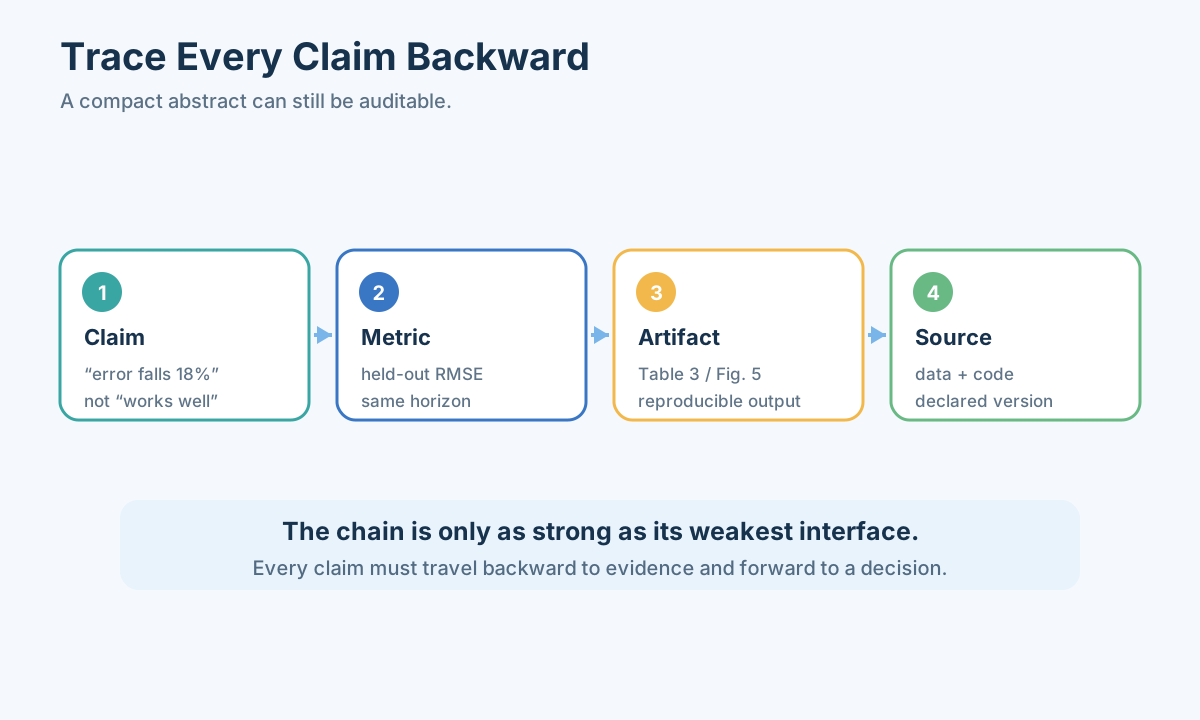
Create this table before drafting:
| Prompt requirement | Method phrase | Result slot | Evidence in paper |
|---|---|---|---|
| estimate time offset | continuous least-squares alignment | objective curve and held-out alignment | |
| reconstruct track | Kalman filter + RTS smoother | RMSE … | trajectory and residual plot |
| test fixed bias | residual/BIC decision | diagnostic table | |
| maximize tasks | interval + binary optimization | count and resource use | schedule plot |
Every major result should point to evidence in the body. If a number cannot be traced to a table, figure, or calculation, verify or remove it. If a required subproblem has no row, it has probably disappeared from the narrative.
Trace one sentence all the way to its source
Suppose the abstract says, “The fused robot trajectory has an RMSE of
Take the reported 27 tasks. The trace goes from the abstract count to a schedule table, then to the candidate-task generator and its preparation-window tests. Are 25 shooting and two photography tasks distinct? Are their resource conflicts checked? Does the 27 include a task that barely meets a distance or angle threshold? If the schedule table contains 27 rows but one violates a rule, the count is an implementation error. A traceable result is not simply a number repeated in several places; it is a number whose construction can be inspected.
Now trace a negative result: “No field-bias correction is retained.” The abstract may cite candidate magnitude
The reservoir result offers another kind of trace. “MAE fell from 8.7 to 5.9 ML/day” should lead to predictions and observed demand for the same held-out dates, then to the MAE calculation. If the model’s 5.9 was computed on training dates but the naive baseline’s 8.7 on future dates, the improvement is not a matched comparison. “Expected shortage fell from 14.2 to 4.6 ML/day” should lead to the same scenario set evaluated under both policies, not to two different drought assumptions. The word compared with silently promises experimental fairness.
This tracing habit changes how I draft. I start with the traceability table, not with a polished paragraph. The table can have columns for claim, source artifact, metric definition, baseline, units, and operating condition. Once those cells are filled, the sentence almost writes itself. If a cell is empty, write a question mark in the draft instead of an unsupported adjective. That missing cell is work for the team, not a place for creative prose.
Finally, use one source of truth for final numeric results. When a data correction changes RMSE, update the result table or generated artifact first, then refresh the abstract, figure caption, and conclusion. Do not manually change one paragraph and leave the old value in another. A reviewer should never have to decide which of your three “final” numbers is the real one.
After compressing a complete multi-part case, read the draft as a skeptical reviewer would. If a sentence sounds impressive but you cannot point to its source in the body, it needs repair; the examples below show how.
Failure modes and repairs
- Background-heavy opening: reduce the domain story to one sentence and spend the saved words on the contribution.
- Method shopping list: use dependency words such as “after alignment” and “using the fused state.”
- No result values: report one quantity per subproblem and one baseline comparison.
- Absolute claims: replace “proves optimal” with the exact guarantee or empirical budget.
- Unexplained novelty: state what changed relative to a baseline and which failure it repairs.
- Inconsistent numbers: verify the abstract, tables, figures, and conclusion from one final result file.
Let us repair a method shopping list from the robot example. The bad version says, “We use least squares, interpolation, Kalman filtering, BIC, greedy optimization, and integer programming to solve all problems.” It asks the reader to infer which tool did what. The repair begins with the task chain: “We first synchronize two sensor clocks and reconstruct a 10-Hz path; diagnostic tests decide whether a fixed spatial bias should be retained. The resulting path generates feasible preparation windows, which feed separate scheduling models for shooting and photography.” Now each stage produces the next stage’s input. We can add measured values after the stages, instead of letting names perform the job of results.
Repair an absolute claim next. “Our algorithm proves the robot can complete exactly 27 tasks under all conditions” is far stronger than the supplied example supports. The path is an estimate, candidate windows are generated under stated motion constraints, and schedule optimization uses a specific candidate set. A defensible result says that the course example schedules 27 tasks within its modeled windows and resource rules, and it reports the sensitivity or failure cases actually tested. If the author wants a guarantee under sensor errors, that requires additional uncertainty analysis; the abstract should not borrow that guarantee from the mere presence of an optimizer.
Repair an unearned novelty claim. “We propose a novel multisensor fusion method” tells us nothing about what changed relative to standard filtering. If the actual contribution is a careful sequence—joint clock and spatial-bias estimation, filter and smoother, then a BIC check that prevents false correction—say that. It may be a strong application even if none of its component algorithms was invented by the team. The contribution can be a coherent, tested workflow. Calling familiar tools “novel” without naming a new mechanism does not make the paper stronger.
Repair a background-heavy opening. “In the modern era, the development of intelligent robots has become an indispensable part of technological progress…” could lead into almost any robotics paper. A one-sentence setting is enough: “Two positioning systems observe the same moving robot at different sampling times and with possible noise and bias.” The next sentence should tell us what the paper estimates or decides. A reviewer already knows technology matters; they need to learn why this particular data conflict and task schedule require a model.
Repair a missing-result abstract. If it says only “The filter improves accuracy and the optimization improves task completion,” ask for the trajectory metric, reference, baseline when available, and task count. In the supplied example, we can report RMSE
An abstract’s failure often reveals a failure in the project itself. If you cannot say what constitutes a “better” release policy, perhaps the objective is unclear. If you cannot locate the comparison period for forecast errors, perhaps the evaluation was not designed. If you cannot explain why bias was rejected, perhaps the selection rule is missing. Editing therefore becomes a diagnostic tool: a sentence that cannot be made precise may be pointing to unfinished modeling work, not merely weak prose.
I want to end with a very ordinary example, because abstract writing can feel unnecessarily grand. Suppose a student team studies whether a campus shuttle should leave every fifteen minutes or every twenty minutes. Its draft abstract says, “We establish an advanced model of shuttle operations and achieve significant improvement.” This sounds like a complete sentence, but it tells the reader nothing testable. Improvement in what: waiting, operating cost, missed classes, or seats left empty? Over which days? Compared with which schedule? The adjectives are standing in for answers the team has not yet supplied.
The first repair is not to search a thesaurus. Ask the team what a student experiences. Imagine the team has recorded stop-level arrivals on ten school mornings and compared the existing twenty-minute timetable with a proposed fifteen-minute timetable in a simulation. If the model includes vehicle capacity and travel time, say so briefly. If it does not, do not imply it does. A plain skeleton might read: “Using stop-level arrival counts from ten school mornings, we simulated passenger waits under twenty- and fifteen-minute dispatch intervals, with the observed vehicle capacity.” That sentence identifies the data, comparison, and main mechanism. It still needs a numerical result before we can call it a result-bearing abstract.
Suppose the team measured a mean wait of 11.2 minutes under the current policy and 8.1 minutes under the proposed timetable on the same simulated arrivals. We could write, “Mean simulated wait fell from 11.2 to 8.1 minutes.” The reduction is 3.1 minutes, not an abstract “significant improvement.” But I would next ask about vehicle-hours and peak crowding. If the extra departures require another bus or an unreported cost, a shorter wait is only one side of the decision. The abstract might add, “This reduction required two additional morning vehicle-hours,” provided that number comes from the schedule calculation. Then the reader can see a trade-off, not merely a victory claim.
The final question is scope. Ten mornings might not include exam weeks or storms. A simulated comparison is not proof of the effect after students learn the new timetable and change their arrival behavior. We could conclude: “The proposed interval is promising for mornings resembling the recorded sample; weekend and high-absence patterns were not evaluated.” Notice how a limitation can be quite specific without swallowing the entire abstract. It names the population and behavior for which we do not yet have evidence.
Now compare the stages. The original draft offered “advanced” and “significant” but no data or result. The repaired version follows a student problem, the timetable choice, the matched comparison, the wait reduction, the vehicle-hour price, and the boundary of the evidence. It also points toward the body: arrival data, capacity rule, simulation validation, wait and cost table, and limitations. If one of those sections does not exist, the abstract has shown the team what is missing. That is the real purpose of compression here. A short text should force the model’s argument to become visible, not make unfinished work sound finished.
This same logic works for the more technical robot case. A newcomer may not know what a Kalman smoother is, but they can understand why two asynchronous sensor records must be aligned before a path and task schedule can be trusted. We introduce the technical object only when it answers that need. The abstract is therefore a small lesson to the reader: it should carry them from an understandable conflict to a measured response in just a few steps. When those steps connect naturally, the reader has a reason to continue into the paper.
The abstract is only the front door. The next lesson opens the model behind it: each named result must follow from an explicit module, assumption, and interface that another person can inspect.
- Title: Mathematical Modeling 3 - The Abstract
- Author: Gavin0576
- Created at : 2026-09-14 20:00:14
- Updated at : 2026-09-15 07:06:54
- Link: https://jiangpf2022.github.io/blog/2026/09/14/Mathematical-Modeling-03-The-Abstract/
- License: This work is licensed under CC BY-NC-SA 4.0.