
LLM 3 - Decoding, Prompting, and Applications

Welcome back. In LLM 2 we opened the Transformer and followed information through embeddings, attention, feed-forward blocks, BERT, and GPT. Today we begin at the point where that architecture has already produced a vector of scores for the next token. A surprisingly large part of an LLM application’s behavior is determined by what happens next: how those scores become a token, how a prompt supplies the task, how examples change the model’s local behavior, and how an external program checks and uses the answer.
This is the bridge from language model to language-model system. We will first study decoding precisely enough to explain greedy search, beam search, sampling, temperature, and hallucination. Then we will build prompts as structured interfaces rather than clever sentences, examine in-context learning and reasoning patterns, and finish with tools, post-processing, LangChain, and LlamaIndex. The aim is not to memorize a bag of prompting tricks. It is to understand which component is responsible for which behavior, so that when an application fails you know where to look.
From Representations to Generated Text
Reusing a Pretrained Model
A pretrained Transformer is useful because its internal representations can be reused. An encoder such as BERT can supply a contextual vector for every token or a sequence-level representation. A downstream system may freeze those vectors and train a small classifier on top, or fine-tune part or all of the pretrained network. The same encoder can therefore support sentence classification, question answering, named-entity recognition, or token tagging with different output heads.
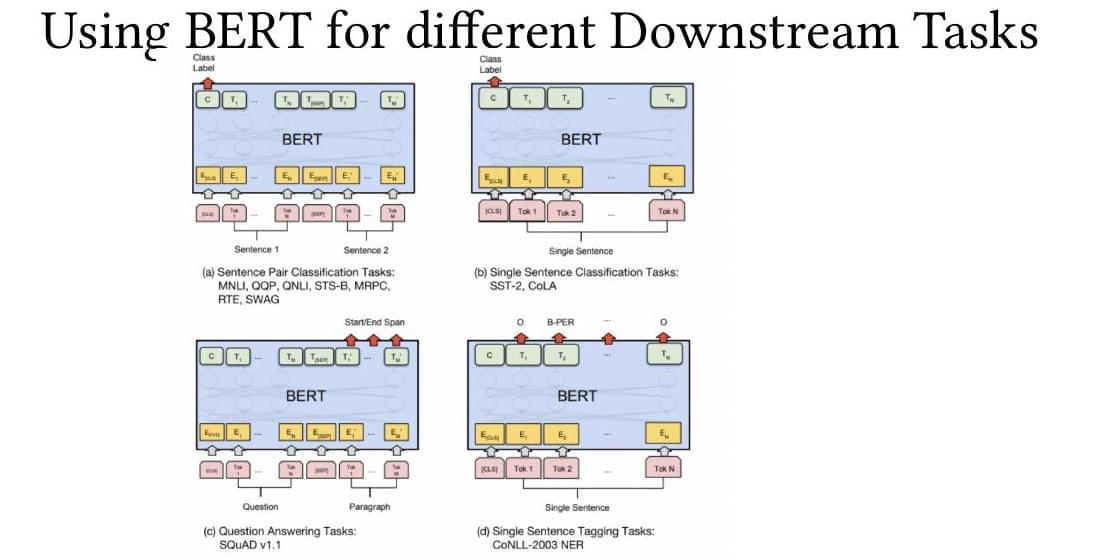
A decoder-only model exposes a different interface. Given a prefix
The model never emits a whole paragraph in one operation. At step
Probability Is Not Truth
Suppose the vocabulary at one step contains only three continuations with probabilities
This gives us a clean definition of hallucination at the system level: the model generates content that is unsupported, incorrect, or inconsistent with the available evidence. Decoding can make low-probability continuations more or less likely, but decoding cannot turn a probability model into a truth oracle. Factual applications need grounding, retrieval, tools, constraints, or verification in addition to a good decoder.
Deterministic Decoding
Greedy Search
The simplest decoder chooses the most likely token at every step:
This is greedy decoding. It is fast, deterministic when ties are resolved consistently, and often appropriate when variability is undesirable. But it optimizes each local decision, not the probability of the complete sequence. A slightly less probable first token may open a path whose later tokens are collectively much more probable. Once greedy search chooses the first branch, it never returns to compare the alternative.
The ideal maximum-a-posteriori sequence would be
but enumerating every possible sequence is impossible: with vocabulary size
Beam Search
Beam search keeps the best
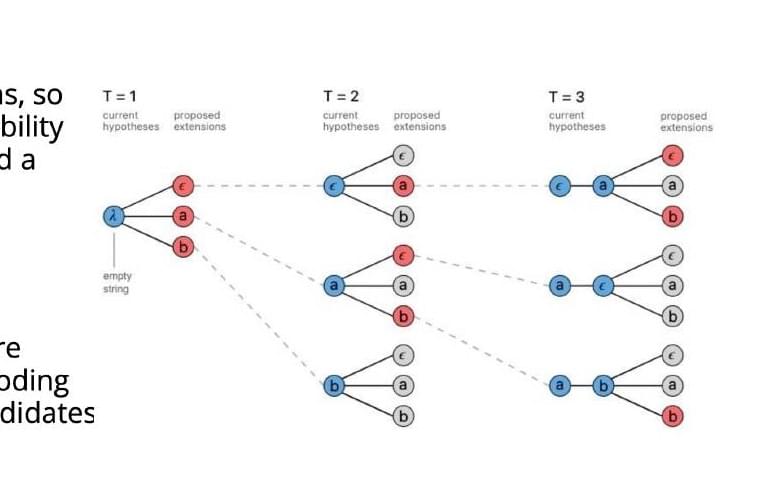
We score in log space because products of many probabilities become numerically tiny:
Every log probability is non-positive, so a raw sum often favors short outputs: extending a sequence adds another negative term. Systems therefore use an end-token policy and often a length-adjusted score such as
where
Why the Highest-Probability Answer Is Not Always Best
Mode-seeking is useful for tasks with a narrow expected answer, but natural language often has many valid continuations. The global mode can be bland, repetitive, or generic because safe phrases collect probability mass across many contexts. Increasing the beam can even worsen open-ended text by searching more thoroughly for that generic mode. Diverse beam search deliberately discourages beams from collapsing onto nearly identical candidates; stochastic beam variants introduce randomness while retaining search structure.
For translation or constrained generation, beam search remains useful because fidelity matters and the output space is comparatively focused. For storytelling or brainstorming, sampling is usually a better match. “Best decoder” is therefore not a model-wide property. It depends on whether the task rewards reproducibility, coverage, creativity, factuality, or exact constraint satisfaction.
Sampling and Distribution Control
Ancestral Sampling
Instead of taking an argmax, ancestral sampling draws
at every step. Sampling respects the model’s distribution and can produce diverse outputs from the same prompt. It also exposes the long tail: a modern vocabulary may contain tens of thousands of tokens, and many receive tiny but nonzero probability. Over a long sequence, repeatedly allowing the entire tail creates opportunities for incoherent or unsuitable choices.
Truncated sampling removes part of that tail and renormalizes the remaining probabilities:
- Top-
sampling keeps exactly the highest-probability tokens. - Top-
or nucleus sampling keeps the smallest set whose cumulative probability is at least . - Epsilon sampling keeps tokens whose individual probability is at least a threshold
.
Top-
Temperature
Temperature transforms logits before softmax:
For
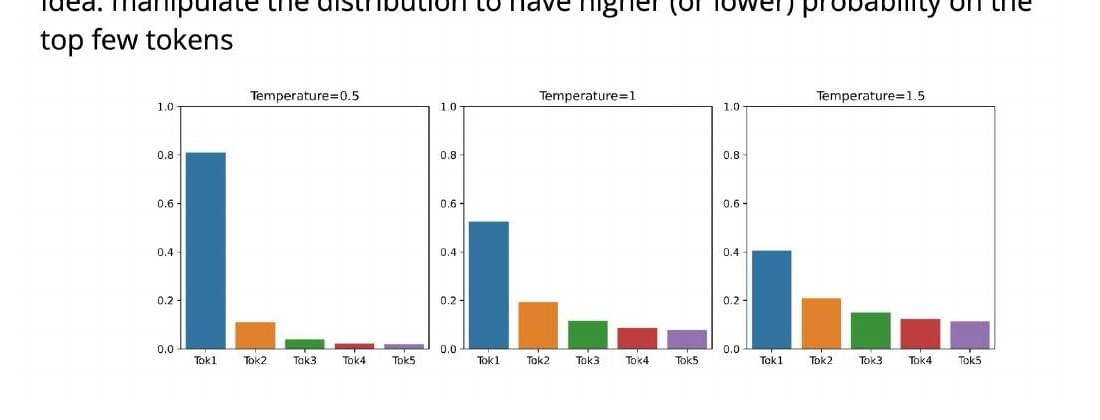
A practical policy follows from the task. For extraction, classification, or code that must satisfy a schema, use low randomness and validate the output. For ideation, use moderate sampling and ask for several candidates. If factuality matters, do not rely on temperature alone: retrieve evidence and verify claims.
Contrastive Decoding
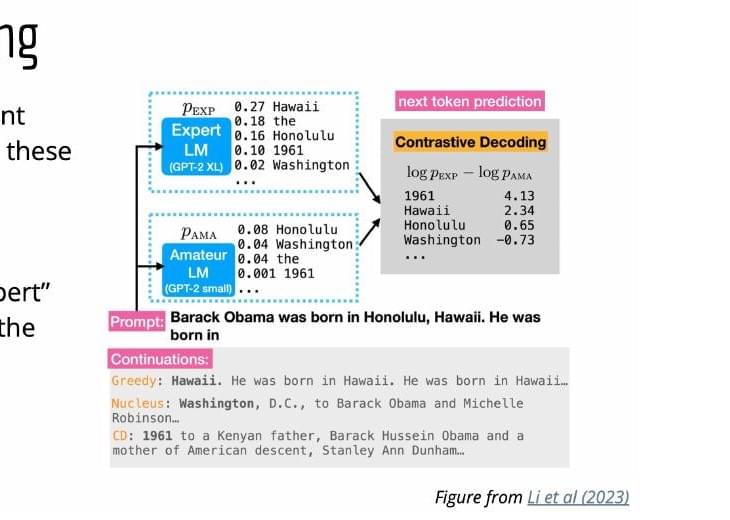
Contrastive decoding compares two models: an expert that represents the desired distribution and a weaker amateur that helps expose generic or locally tempting continuations. A candidate can be rewarded for high expert likelihood and penalized when it is also too likely under the amateur. A schematic score is
subject to a plausibility filter so that the method does not choose bizarre tokens merely because the smaller model dislikes them. Exact formulations vary. The central idea is comparative: prefer text that the stronger model supports beyond what a weaker model already explains.
Prompts as Model Interfaces
What a Prompt Actually Contains
A prompt is the information presented to a model to specify the current task. Good prompts often contain several distinct components:
- Instruction: what operation the model should perform.
- Input data: the document, question, table, or record to process.
- Context: background facts and definitions needed for the task.
- Examples: demonstrations of desired input–output behavior.
- Role or persona: the perspective or expertise relevant to the response.
- Output contract: format, tone, length, fields, and constraints.
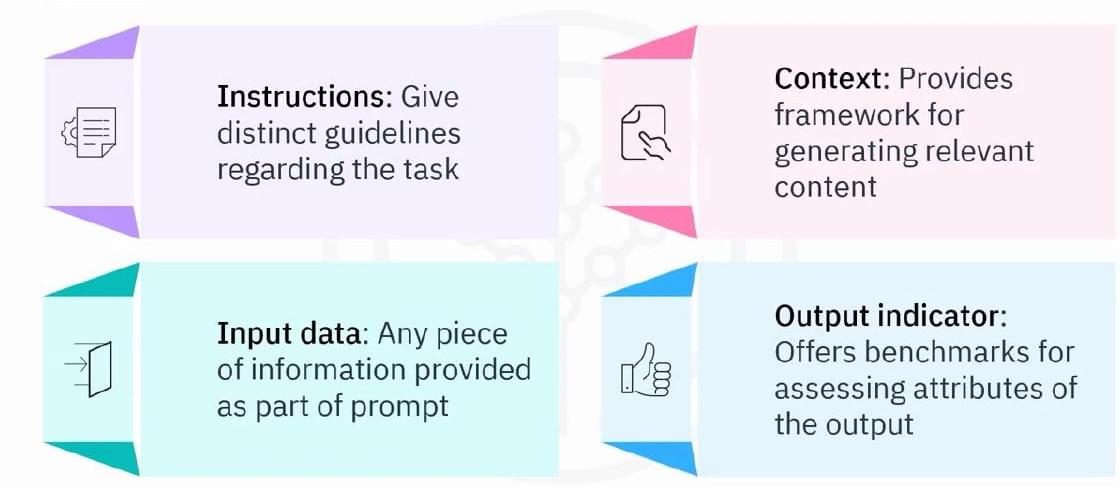
Not every prompt needs all six. A simple rewrite may need only text, audience, and tone. A legal-document extractor may need definitions, the document, a JSON schema, and a rule for missing values. The principle is to make hidden assumptions visible. “Summarize this” leaves audience, purpose, length, and treatment of uncertainty unspecified; the model must guess.
Prompting is also distinct from fine-tuning. A prompt changes the context for this inference call. Fine-tuning updates parameters across calls. Retrieval adds external information. Decoding chooses from the resulting token distribution. Keeping these mechanisms separate makes debugging much easier.
System, User, and Assistant Messages
Chat APIs typically organize a conversation into roles. The system message establishes application-level behavior and constraints. The user message contains the current request and data. Previous assistant messages can demonstrate style or preserve conversational history. Internally, the interface serializes these messages into a token sequence using special boundary markers; the model still receives tokens, not abstract chat bubbles.
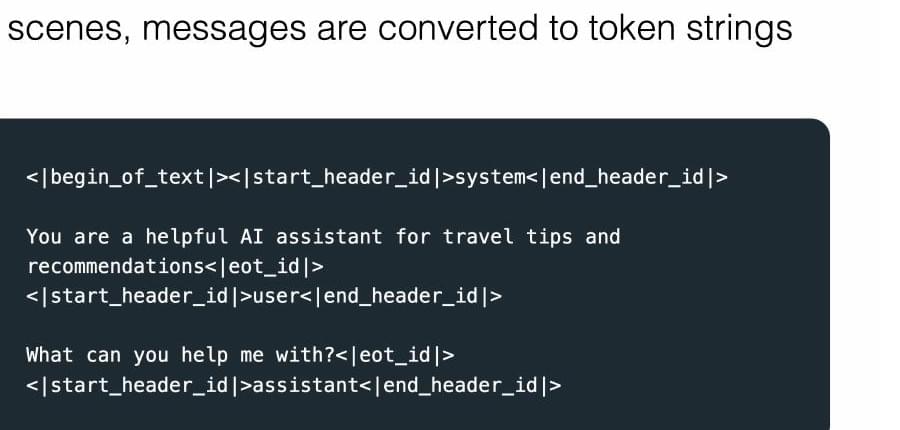
Role separation is useful for application design, but it is not a perfect security boundary. Untrusted text inside a document may contain instructions that compete with the intended task. A robust system labels data as data, limits available tools, validates arguments, and enforces authorization outside the model.
Templates and Answer Prediction
A prompt template separates stable instructions from variables:
1 | Task: Classify the support ticket. |
Templates improve consistency and make prompts testable. They also reveal which values require escaping or delimiting. Answer prediction begins the output with a structure the model should continue—for example, {"label":—which can reduce formatting drift, though it does not replace parsing or schema validation.
Building and Evaluating Prompts
An Iterative Engineering Loop
Prompt engineering is an experimental loop, not a one-time wording contest. First define the goal and acceptance criteria. Write a baseline prompt. Test it on representative cases, including difficult and adversarial ones. Inspect failures. Change one relevant element, then test again on the same evaluation set. Record the prompt version, model, decoding settings, and results.
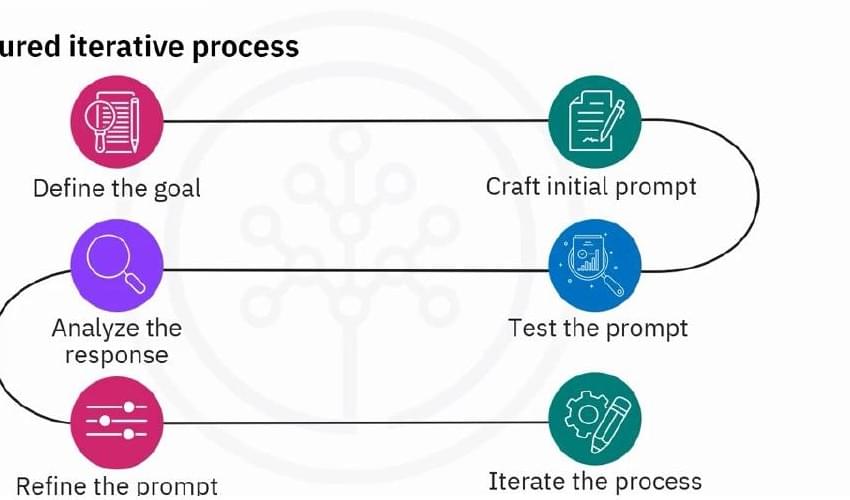
“Good” is task-specific. For extraction, measure field accuracy and invalid JSON. For summarization, check coverage, attribution, length, and unsupported claims. For code, run tests. For customer communication, review tone and policy compliance. A polished answer to one hand-selected example is not evidence of reliability.
Context and Constraint Design
Use direct language and place essential information where it is easy to associate with the task. Delimit long input documents. Specify what to do when evidence is absent. Ask for a format that the program can validate. Replace vague constraints such as “be concise” with operational ones such as “use at most five bullets, one sentence each.” If the task has a rubric, include it.
A useful pattern is:
1 | Goal |
The order is not sacred. What matters is that the model can distinguish instructions from data and that the application can judge the result. Long prompts are not automatically better: irrelevant detail competes for attention, consumes context, and can introduce conflicting cues.
The Interview Pattern
Sometimes the user has not supplied enough information for a responsible answer. The interview pattern explicitly asks the model to collect missing requirements before solving:
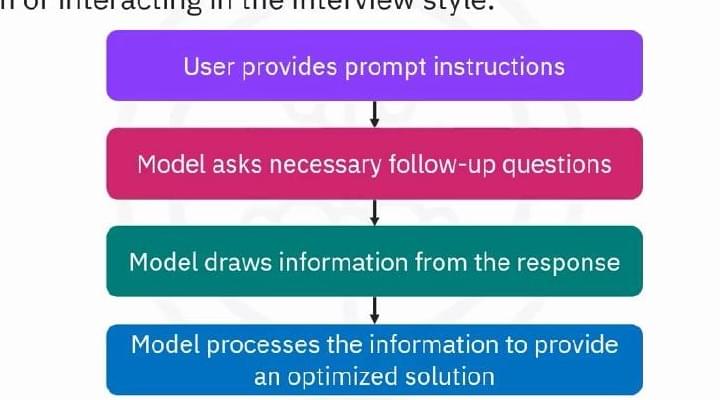
For example: “Ask one question at a time about the audience, budget, deadline, and required output. When enough information is available, summarize the requirements and propose a plan.” This is valuable when missing constraints would change the answer. It is unnecessary when the task is already precise or when delay is costly. The deeper lesson is that uncertainty about the problem definition should be resolved before optimizing the response.
In-Context Learning
Zero-, One-, Few-, and Many-Shot Prompts
In-context learning (ICL) means eliciting task behavior through examples placed in the prompt, without updating the model’s weights. A zero-shot prompt provides instructions but no demonstration. One-shot gives one example. Few-shot gives a small set. Many-shot uses a much larger set, made possible by long context windows.
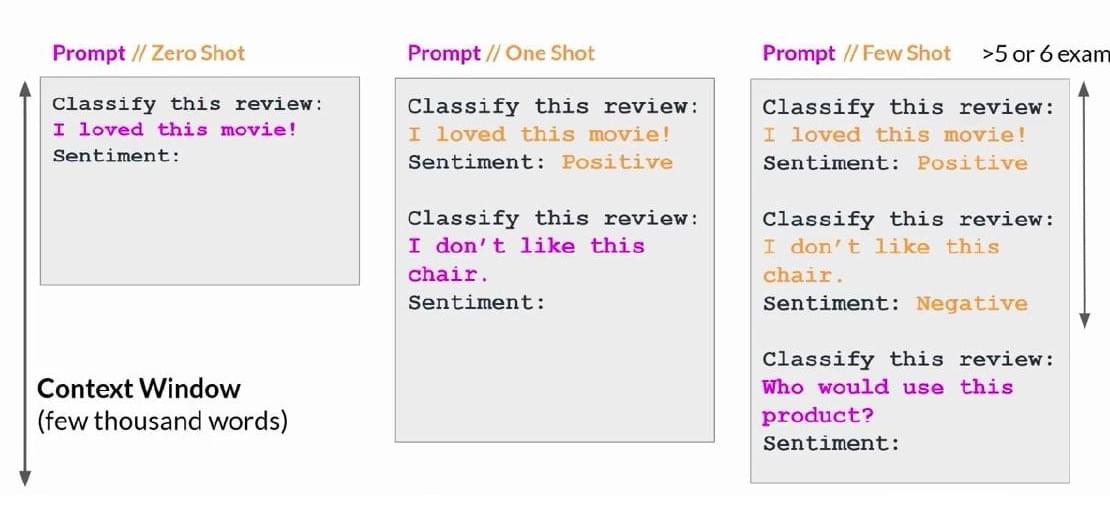
Examples can teach label names, output format, edge-case policy, and the kind of reasoning expected. If you want positive, neutral, and negative rather than free prose, demonstrations make that contract concrete. But a demonstration is also data. A wrong label, inconsistent format, or misleading example can steer the model in the wrong direction.
More Examples Are Not Automatically Better
Many-shot studies show that longer contexts can continue to improve performance on some difficult tasks, especially when the examples are diverse and informative. Yet repeating the same example mostly adds tokens, not new evidence. Distinct demonstrations tend to be more valuable because they cover more of the task’s variation.
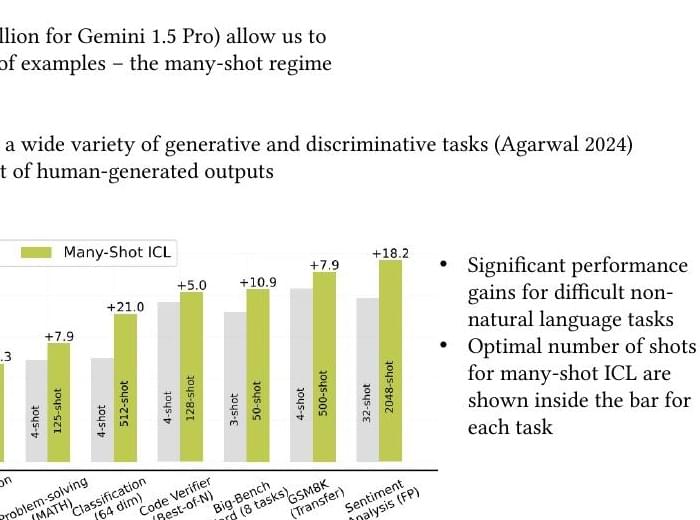
Too many examples can also hurt. Irrelevant or contradictory demonstrations add noise; a long prompt may obscure the current query; and compute cost grows with context length. The correct question is not “How many examples can fit?” but “Which examples most clearly define the behavior needed for this input?” Retrieval can help select demonstrations similar to the current case.
Ordering, Balance, and Coverage
ICL can be surprisingly sensitive to presentation. The order of examples may change the answer. An imbalanced prompt may bias the model toward the majority label. Omitting a label entirely can make it harder for the model to emit that label, even if the instruction lists it. Abstract or deliberately flipped labels reveal another influence: the model enters the prompt with prior associations from pretraining, and the demonstrations must overcome them.
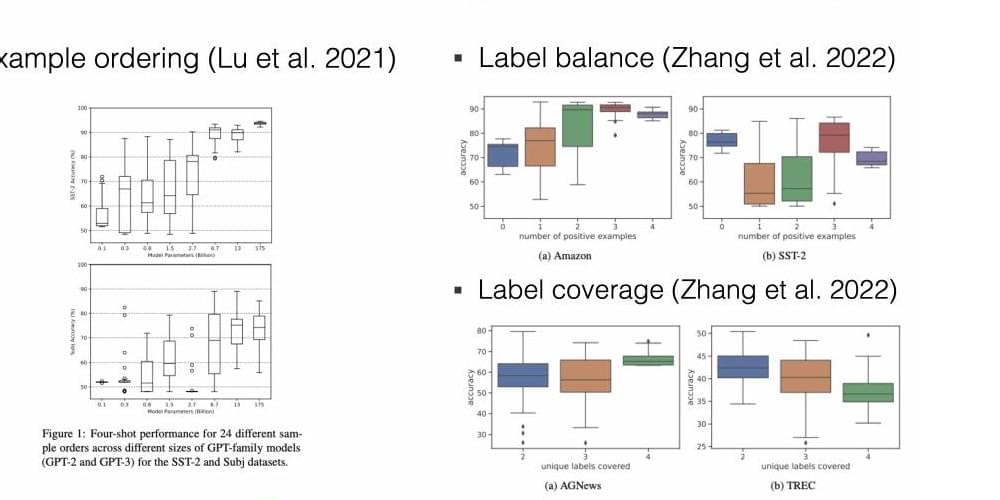
Therefore build an ICL set as carefully as a small training set: verify labels, cover important classes and edge cases, avoid accidental shortcuts, and test multiple orders. Keep an untouched evaluation set. If performance changes drastically under harmless reordering, the prompt is not yet robust.
Reasoning Patterns
Chain-of-Thought Prompting
Some tasks benefit when the model produces intermediate steps before an answer. Few-shot chain-of-thought (CoT) prompting includes demonstrations with worked reasoning; zero-shot CoT uses a cue such as “work through the problem step by step.” The additional tokens can help the model decompose arithmetic, symbolic, or multi-hop tasks that are difficult to solve in one jump.
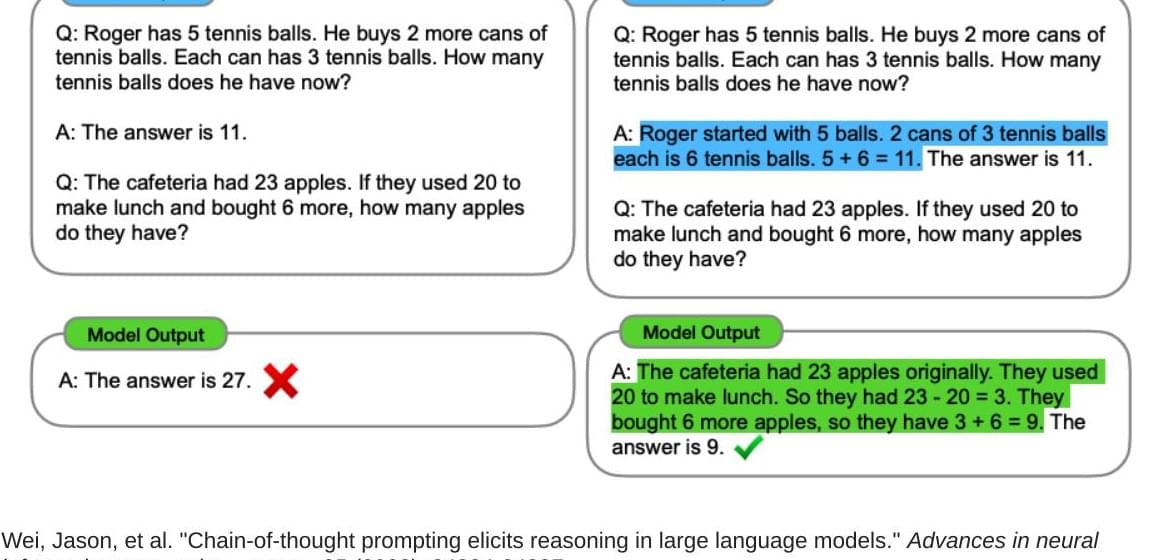
CoT is not a proof of correctness. A model can write a fluent but invalid derivation, or reach the right answer through a mistaken argument. In production, prefer checkable intermediate artifacts: equations that a symbolic tool can verify, citations that can be opened, code that can be tested, or a structured plan whose constraints can be evaluated.
Automatic Chain-of-Thought
Hand-authoring diverse reasoning demonstrations is expensive. Auto-CoT groups questions into clusters, selects representative questions, and uses a model to generate candidate rationales for those representatives. The resulting demonstrations are then used for other questions. Clustering aims to cover different reasoning patterns rather than selecting near-duplicates.
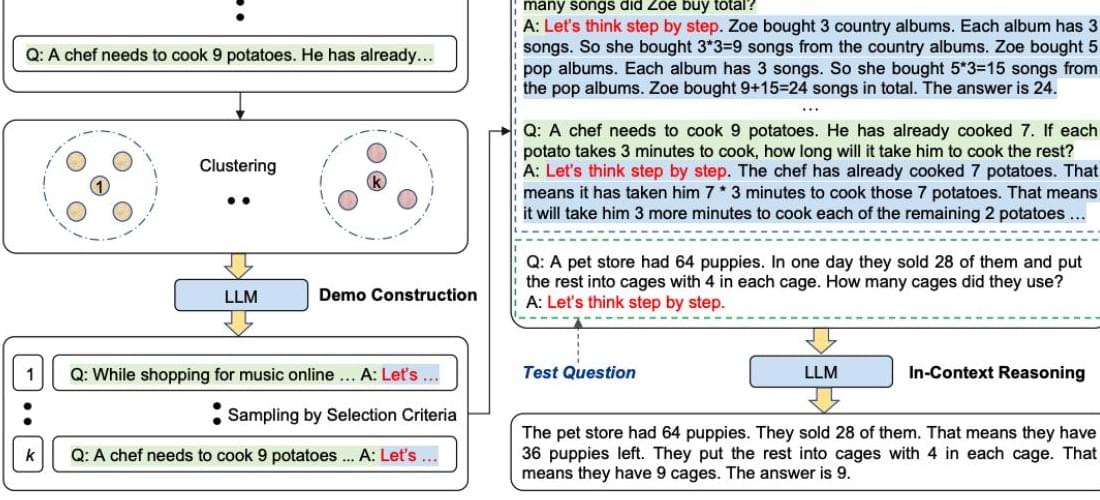
Automatically generated rationales must still be filtered. A confident error becomes a reusable bad example. Correct final answers, valid intermediate steps, and coverage should all be checked before the demonstrations enter a prompt library.
Tree of Thoughts
A single chain commits to one continuation at every reasoning step. Tree of Thoughts (ToT) keeps multiple candidate states, evaluates them, and explores promising branches. A problem is represented by states, possible next “thoughts,” a search policy, and an evaluator. Breadth-first search, depth-first search, or a beam-like policy can traverse the tree.
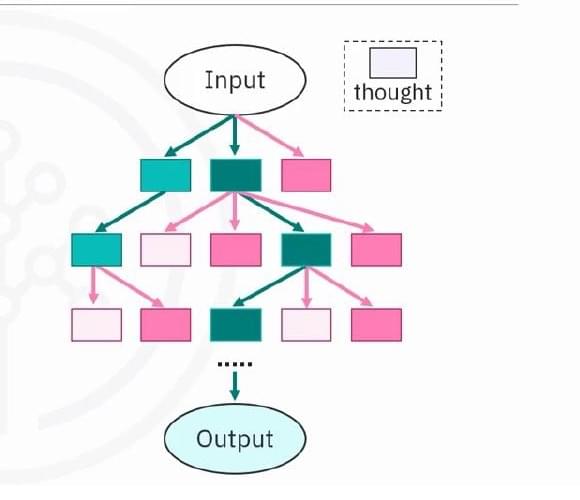
ToT can help with planning, puzzles, or tasks where early choices are reversible and can be scored. It costs more model calls and depends heavily on the evaluator. If the evaluator cannot recognize progress, additional branches merely multiply plausible mistakes. “Multiple experts deliberate” is a related prompting pattern: generate independent proposals, compare them, revise, and aggregate. Independence and a clear selection rule matter more than theatrically assigning expert names.
ReAct, Tools, and Reliable Workflows
Interleaving Reasoning and Action
ReAct interleaves reasoning with actions in an external environment. The model may decide that it needs evidence, issue a search or database action, receive an observation, and continue. This closes a loop that ordinary prompting leaves open:
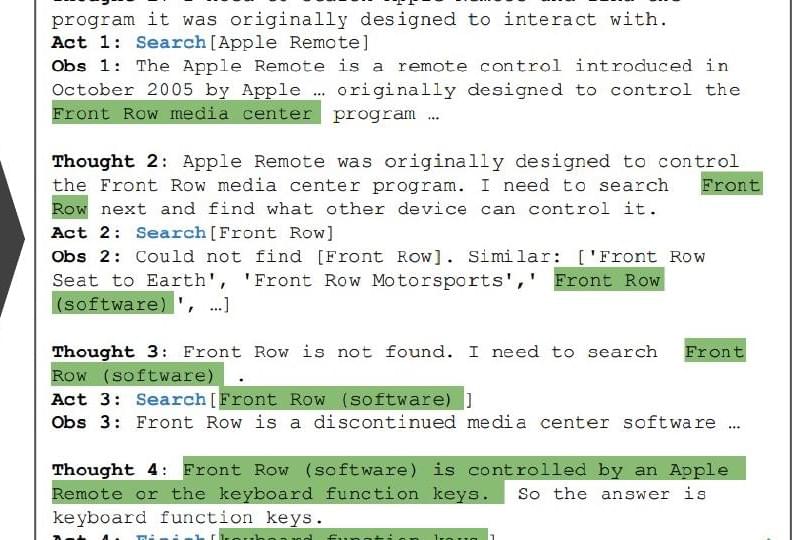
Tools are valuable because some operations should not be approximated in language. A calculator should multiply
Function calling gives the model a schema for available actions and asks it to return a function name plus arguments. The application must validate the arguments, enforce authorization, execute the function, and decide what result is safe to return. Never let generated arguments bypass normal security rules. Tool availability expands capability and risk at the same time.
Post-Processing Is Part of the System
An answer may be used as-is, formatted for display, reduced to selected fields, or mapped to an application action. Each path needs post-processing. Markdown and code require safe rendering. Classification needs an allowed-label check. Regression needs numeric parsing and range validation. Entity extraction needs a schema and a policy for missing values. A function call needs type checks, permissions, retries, and error handling.
Suppose the model should emit
1 | {"priority":"high","team":"billing"} |
The program should parse JSON, reject extra or missing fields, verify that both values belong to allowed sets, and ask for a repair or route to review if validation fails. A prompt that requests JSON improves the probability of valid output; a parser determines whether the output is actually valid.
This is also where factual checks belong. Retrieval can attach source passages; a verifier can require every claim to be supported; business rules can refuse impossible values. Reliability emerges from the composition of model, decoder, tools, validators, and fallback behavior.
Common Application Patterns
Writing, Translation, and Revision
Drafting an email is a useful small example because the user usually knows the facts but wants help with expression. A strong request supplies the recipient, purpose, required details, relationship, tone, and desired length. The model can then produce a draft that the user reviews. It should not invent a meeting time, promise, or policy. The boundary is clear: the model transforms supplied intent into language; the user remains responsible for factual and interpersonal commitments.
Translation has a similar structure but a different evaluation problem. The prompt should identify source and target languages, audience, domain, terminology rules, and whether the goal is literal fidelity or natural localization. Names, code, citations, and product terms may need to remain unchanged. For important text, back-translation is not enough to establish correctness; use a fluent reviewer or a domain glossary, and compare meaning at the sentence and document levels.
Proofreading should be separated from rewriting. “Correct grammar and punctuation without changing meaning or voice” asks for conservative edits. “Rewrite for a nontechnical executive audience” authorizes structural change. Asking the model to return both the revision and a compact edit log makes changes reviewable. That is especially important when a stylistic improvement could silently alter a numerical qualification or legal claim.
Code and Document Work
Code generation works best when the prompt behaves like a compact specification: state the language and version, function signature, data types, edge cases, performance constraints, forbidden dependencies, and tests. Generated code must be executed in an appropriate sandbox and checked with tests and static analysis. A plausible code block is a hypothesis about an implementation, not evidence that the implementation works.
For summarization, first decide what the summary is for. An executive summary, study guide, meeting recap, and evidence table are different outputs. Specify the audience, target length, required topics, and whether claims must cite locations in the source. Long documents may need chunking followed by synthesis, but naive chunk summaries can lose relationships across sections. A hierarchical pipeline should preserve document metadata and let the final synthesizer access the evidence behind each intermediate claim.
Meeting support illustrates the full lifecycle. Before a meeting, an LLM can turn source documents into an agenda and unresolved questions. During or after it, a transcript can be transformed into decisions, action items, owners, and deadlines. Each action item should be traceable to transcript evidence and confirmed by a person; speech recognition errors or casual suggestions should not become official commitments automatically.
Extraction and Structured Actions
Entity extraction turns prose into records: people, organizations, dates, amounts, relationships, or domain-specific fields. Define the schema, give examples of ambiguous cases, preserve source spans when possible, and distinguish missing from not applicable. A useful output includes both the normalized value and the exact text supporting it. That makes later review much easier than accepting an unexplained field.
Function calling goes one step further: the structured output selects an operation. A travel assistant might call search_flights; a support system might call lookup_order; a research tool might call search_documents. The model proposes a call, but the host program decides whether it is valid and authorized. Read-only search may run automatically, while purchases, messages, deletions, or account changes should require stronger checks and often explicit confirmation.
Across all these applications, the recurring pattern is the same: place the model where semantic flexibility is valuable, and surround it with deterministic components where correctness is testable. Let the model draft, classify, map language to a schema, or choose among safe tools. Let ordinary software enforce types, permissions, arithmetic, persistence, and irreversible actions.
Application Frameworks
LangChain as Orchestration
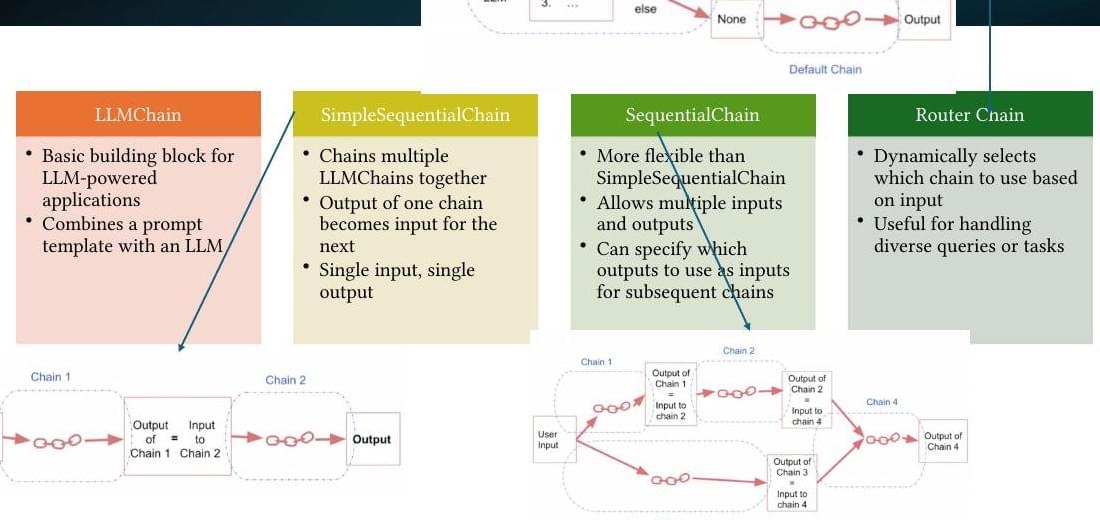
Frameworks such as LangChain package recurring application patterns. A prompt template fills variables into a reusable instruction. An output parser converts model text into a typed structure. Memory stores conversation state outside the model and inserts relevant history into later prompts. The model itself remains stateless between independent API calls unless the application resends state.
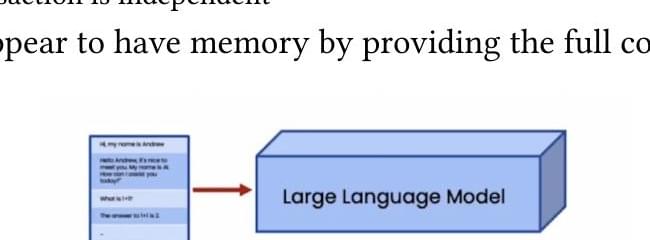
A chain connects components. A simple sequential chain feeds one model output into the next step. A more general sequential chain can combine several named inputs and outputs. A router chooses among specialized chains according to the request. These abstractions are convenient, but they do not remove the need to inspect every boundary: What exact text enters the next prompt? Can a malformed output propagate? Where are errors handled? How is latency measured?
LlamaIndex and Retrieval-Centered Systems
LlamaIndex focuses on connecting private or domain-specific data to LLM applications. Data connectors ingest documents or records. Parsers split and annotate them. Index structures—often vector indexes, but also lists, trees, or graphs—organize retrievable units. A query engine retrieves relevant context, optionally performs multi-step querying, and synthesizes a response. A chat engine adds conversational state around that retrieval process.
This is the basic retrieval-augmented generation (RAG) pipeline:
Retrieval changes the evidence available to the model; it does not guarantee that the answer uses that evidence correctly. Evaluate retrieval recall separately from answer faithfulness. A missing document is a retrieval problem; a claim contradicting a retrieved passage is a generation or validation problem. Separating those stages prevents vague “the RAG failed” diagnoses.
Putting the Whole System Together
We can now describe an LLM application without hiding any essential step:
- Define the task and acceptance criteria. Decide what counts as a correct, safe, and useful answer.
- Construct context. Gather user input, instructions, demonstrations, conversation state, and retrieved evidence.
- Call the model. Choose an appropriate model and serialize role-tagged messages or a completion prompt.
- Decode. Select greedy, beam, or sampled generation and set temperature and truncation controls for the task.
- Use tools when needed. Delegate search, calculation, databases, and actions to systems that can perform them directly.
- Parse and validate. Enforce schemas, permissions, factual support, and business rules outside the model.
- Evaluate and iterate. Record failures, revise the responsible component, and retest on a stable evaluation set.
The key is causal clarity. If outputs are repetitive, inspect decoding and prompt diversity. If labels drift, inspect demonstrations, balance, and schema validation. If facts are stale, add retrieval or tools. If arithmetic is inconsistent, use a calculator. If a multi-step plan fails too early, consider branching search or explicit checkpoints. If the answer format breaks downstream code, strengthen the output contract and parser rather than merely asking the model to “be more careful.”
This lesson began with a vector of next-token scores and ended with a complete application loop. Decoding determines how we move through the model’s distribution. Prompts and demonstrations define the local task. Reasoning patterns organize difficult inference. Tools bring in capabilities and current evidence. Frameworks help compose the pieces. Validation decides whether the result is allowed to leave the system. In the next stage, these pieces become the foundation for retrieval, agents, and larger generative-AI workflows.
- Title: LLM 3 - Decoding, Prompting, and Applications
- Author: Gavin0576
- Created at : 2026-09-25 18:00:00
- Updated at : 2026-09-25 21:30:32
- Link: https://jiangpf2022.github.io/blog/2026/09/25/LLM-3-Decoding-Prompting-and-LLM-Applications/
- License: This work is licensed under CC BY-NC-SA 4.0.