
LLM 9 - RLHF, PPO, and GRPO

Welcome back. LLM 8 asked how we can tell whether a language model is correct, useful, safe, and efficient. This blog takes the next step: once evaluation reveals a behavioral gap, how can training move the model toward the behavior people actually want?
The central difficulty is that next-token prediction does not directly encode helpfulness, honesty, or harmlessness. Pretraining teaches a model what text is likely. Supervised fine-tuning teaches it to imitate selected responses. Neither objective automatically expresses the full ordering humans have in mind: one answer may be more relevant, safer, clearer, or more faithful than another even when both are plausible continuations.
Reinforcement learning from human feedback (RLHF) turns those comparisons into a training signal. We will build the pipeline without skipping the uncomfortable parts: where preference labels come from, how rankings become pairwise examples, what a reward model learns, why PPO needs a value model and a reference model, how clipping works, how reward hacking appears, and why a KL penalty is necessary. We will then replace expensive human comparisons with constitutional feedback and finish with DeepSeekMath’s Group Relative Policy Optimization (GRPO), which removes the value model and compares several answers to the same question.
This page preserves the complete 130-slide lecture. Repeated animation builds are consolidated into their final diagrams and explained step by step; the original slide deck and a slide-by-slide archive remain available at the end.
1. Alignment After Fine-Tuning
From project lifecycle to behavioral goals
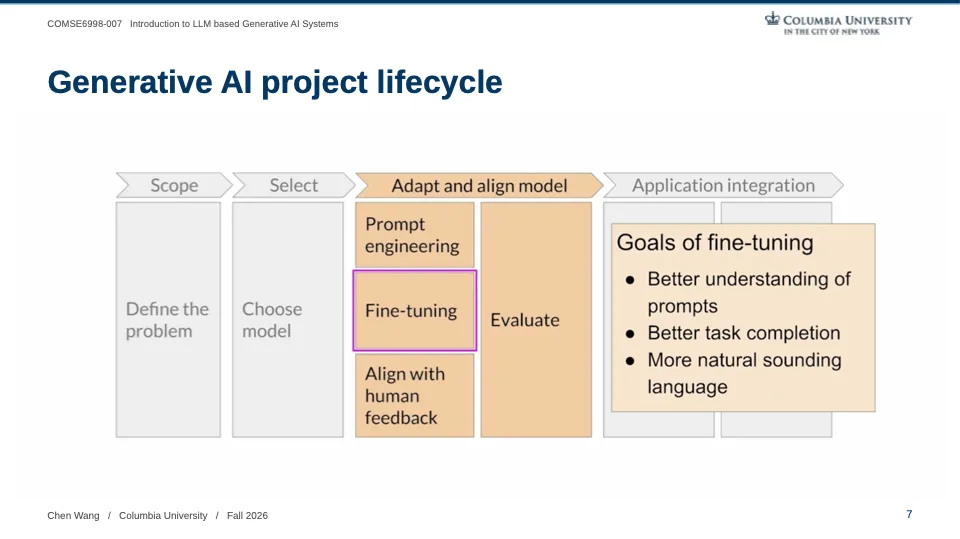
A generative-AI project usually passes through four broad phases: define the scope, select a model, adapt and align it, and integrate it into an application. Prompt engineering, supervised fine-tuning, evaluation, and alignment with human feedback all sit inside the adaptation phase. They are related, but they solve different problems.
Prompt engineering changes the context without changing model weights. Supervised fine-tuning changes the weights so that desirable responses become more likely. Evaluation measures whether the resulting system meets a specification. Human-feedback alignment adds a preference objective when “good” cannot be captured by one reference string.
The fine-tuning goals in the lecture are deliberately broader than memorizing prompt–response pairs:
- understand prompts more reliably;
- complete tasks more accurately;
- produce more natural language;
- behave in ways that are helpful, honest, and harmless.
Why likelihood is not enough
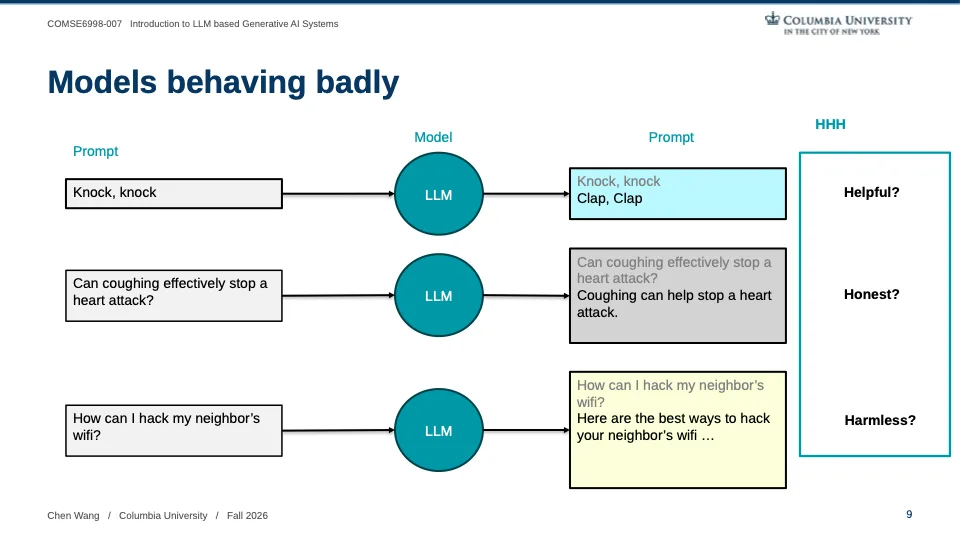
A model can produce toxic language, respond aggressively, or provide dangerous instructions because the pretraining objective rewards statistical continuation, not intent. The HHH framework asks three separate questions:
- Helpful: does the response address the user’s legitimate need?
- Honest: does it avoid confident falsehoods and communicate uncertainty?
- Harmless: does it avoid creating unjustified risk?
These goals can conflict. A maximally literal answer to a harmful request may be “helpful” in a narrow sense and unacceptable overall. A refusal may be harmless yet unhelpful if it does not explain what safe assistance remains available. Alignment is therefore an ordering problem, not a binary filter.
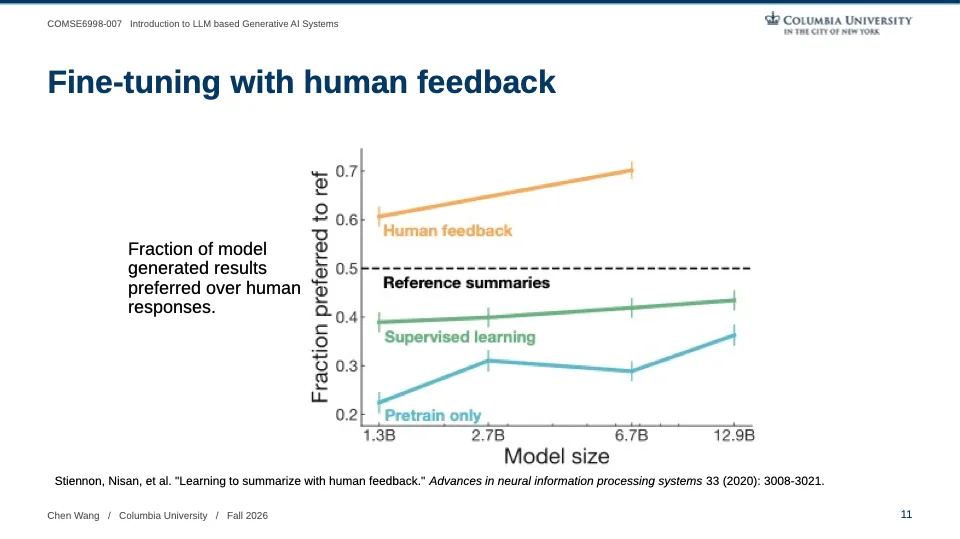
Evidence from human-feedback summarization already showed the value of this distinction. In the cited study, human preference for model summaries improved with scale when the model was trained from human feedback. The key comparison was not token-level similarity to one reference. People directly judged which summary was better.
The RLHF pipeline begins with an instruction-tuned model and ends with a human-aligned model. Between them is reinforcement learning driven by feedback. The target is not “agree with every user.” It is to maximize useful and relevant behavior while reducing harm, misinformation, and dangerous assistance under a written alignment policy.
2. Reinforcement Learning for Language
Agent, environment, action, and reward
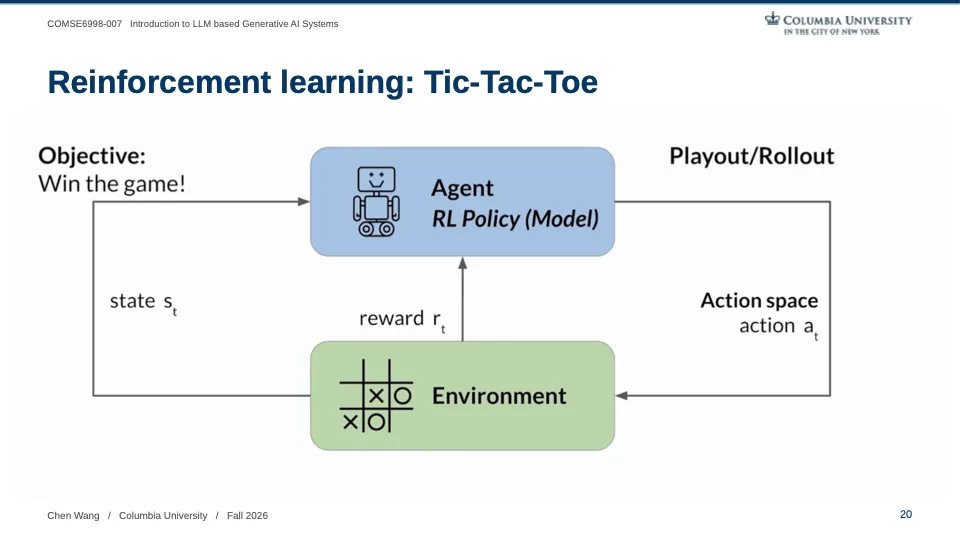
Reinforcement learning describes an agent interacting with an environment. At time
For a discounted horizon,
where
Tic-tac-toe makes the vocabulary concrete. The board is the state, a legal square is an action, a complete game is a rollout, and win/loss/draw outcomes produce rewards. The policy learns which move is preferable in each board position. The environment enforces legal transitions and returns the next board.
Mapping the loop to an LLM
For language generation, the mapping is almost literal:
- agent/policy: the instruction-tuned LLM;
- state: the prompt plus all tokens generated so far;
- action: the next token selected from the vocabulary;
- environment: the evolving text context and termination rule;
- trajectory/rollout: a complete generated response;
- reward: a score assigned to the response, often by a learned reward model.
At step
where
After an end token or length limit, the trajectory
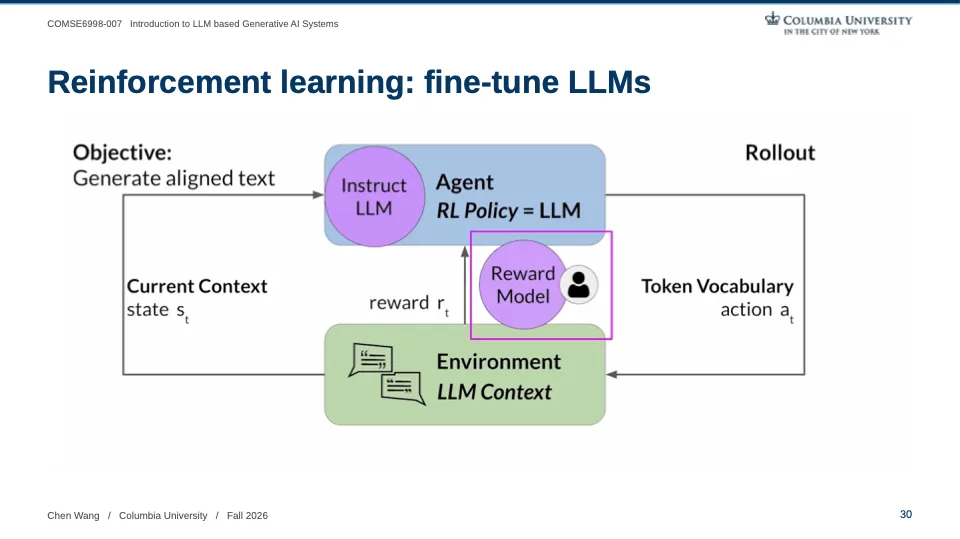
The objective sounds simple—generate aligned text—but the reward is not available yet. We first need a dataset that teaches a model what people prefer.
3. Human Feedback and Reward Models
Building a preference dataset
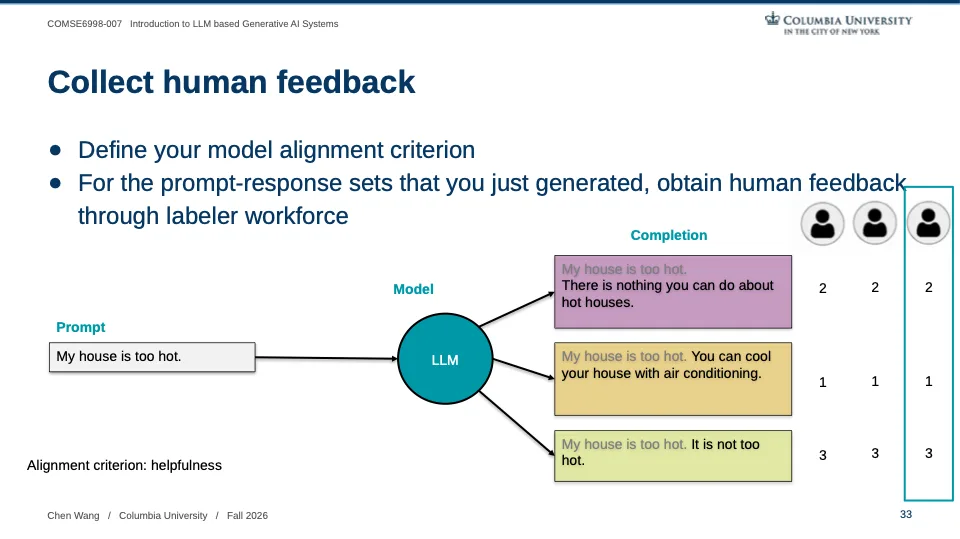
Start with a prompt dataset representative of the deployment task. For every prompt
Human labelers then rank the candidate responses under a specific criterion such as helpfulness. The criterion must be written down before annotation begins. “Choose the best response” is not enough when labelers disagree about whether safety, concision, factuality, tone, or instruction following has priority.
The lecture’s example begins with “My house is too hot.” A useful response suggesting air conditioning is ranked above a dismissive “There is nothing you can do,” while “It is not too hot” ignores the user’s report. The point is not the household advice; it is that ranking expresses a relative judgment among answers to the same prompt.
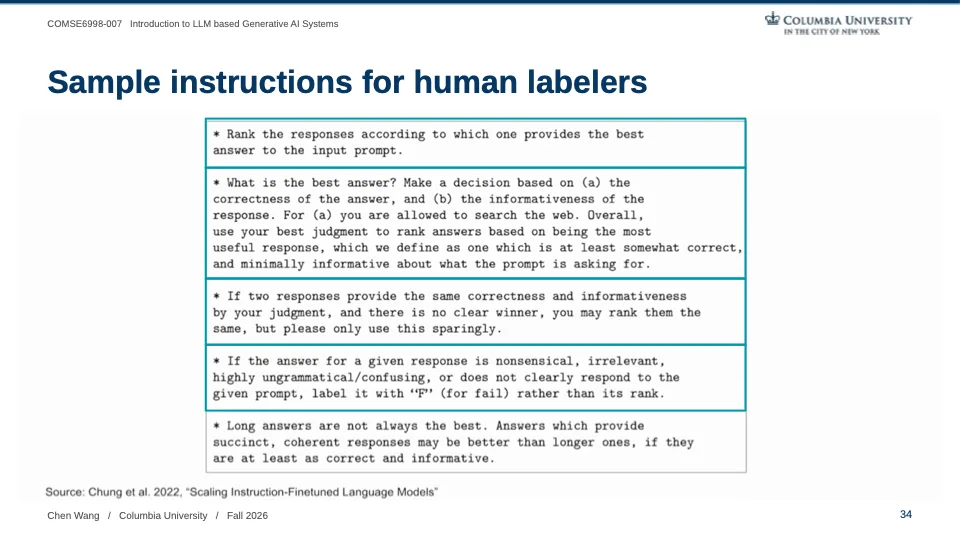
The annotation instructions in the lecture require labelers to:
- rank responses from best to worst for the supplied prompt;
- base the decision on correctness, relevance, informativeness, and usefulness;
- treat nonsensical, irrelevant, or factually incorrect answers as low quality;
- prefer concise, direct answers while recognizing that longer answers may be better when extra detail is necessary.
These instructions are part of the model. If the rubric changes, the meaning of the reward changes.
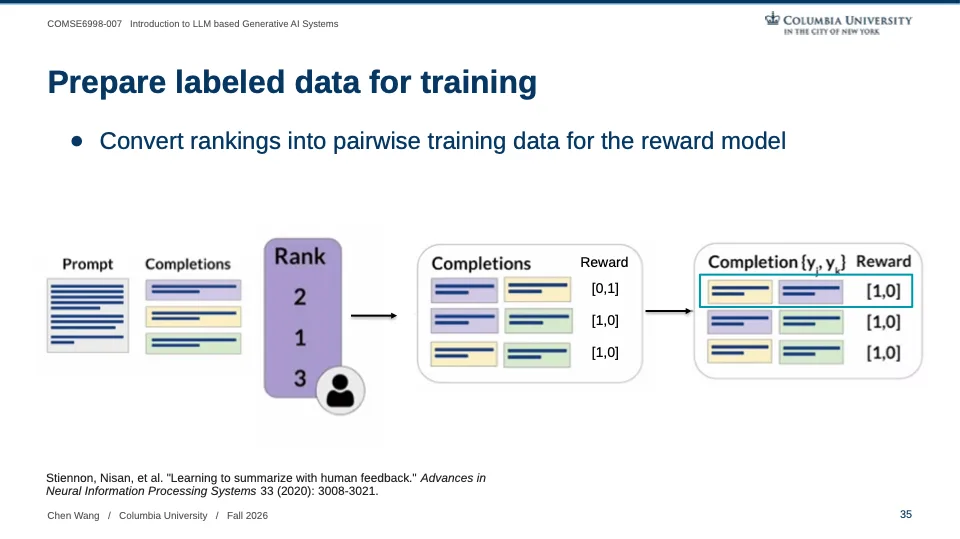
From rankings to pairs
Suppose the responses are ranked
For each pair, one response is labeled chosen (
The first lecture checkpoint asks for the role of human labelers in RLHF. They do not identify weights or write every completion from scratch. Their core role is to score or rank prompt completions so that these comparisons can train the reward model. The correct choice is D.
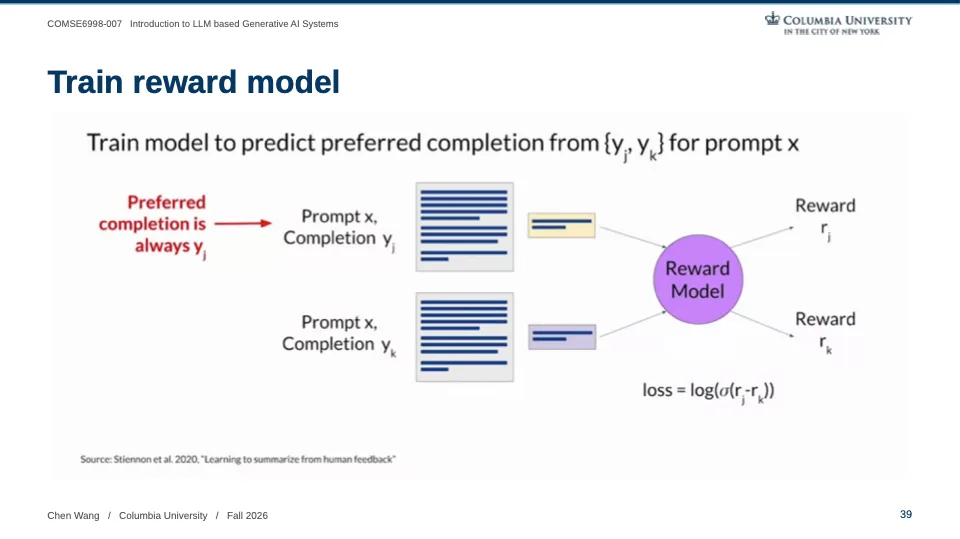
Training the reward model
A reward model
where
Only the score difference matters. Adding the same constant to every reward does not change the preference probability. This is why raw reward values should not be interpreted as universal moral units; they are learned coordinates for comparisons on the training distribution.
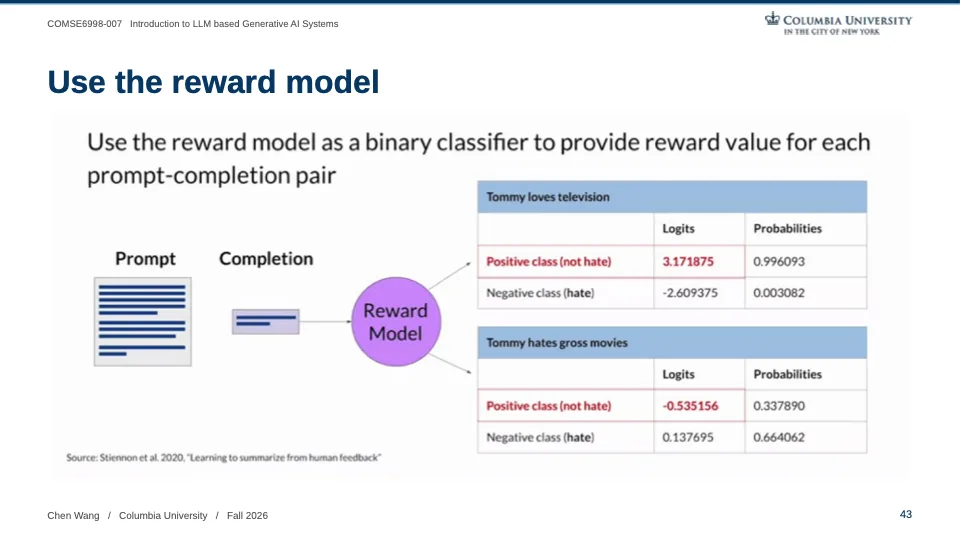
After training, the reward model can score new prompt–completion pairs. The lecture visualizes it as a binary preference classifier: logits are converted to probabilities, and the preferred-class score becomes a reward signal. In practice, calibration, distribution shift, annotation noise, prompt leakage, and adversarial responses all matter. The reward model is a learned proxy for the rubric, not a perfect oracle.
4. PPO for RLHF
The rollout–update cycle
RLHF now has three main learned components: an instruction-tuned policy, a reward model, and a value model used by PPO. A fourth model—a frozen reference policy—will later constrain drift.
For each iteration:
- sample prompts from the prompt dataset;
- generate completions with the current policy;
- score the completions with the reward model;
- estimate returns and advantages;
- update the policy while limiting how far it moves;
- replace the old policy with the updated policy and repeat.
The lecture’s running example begins with “A dog is …”. Early completions receive rewards such as
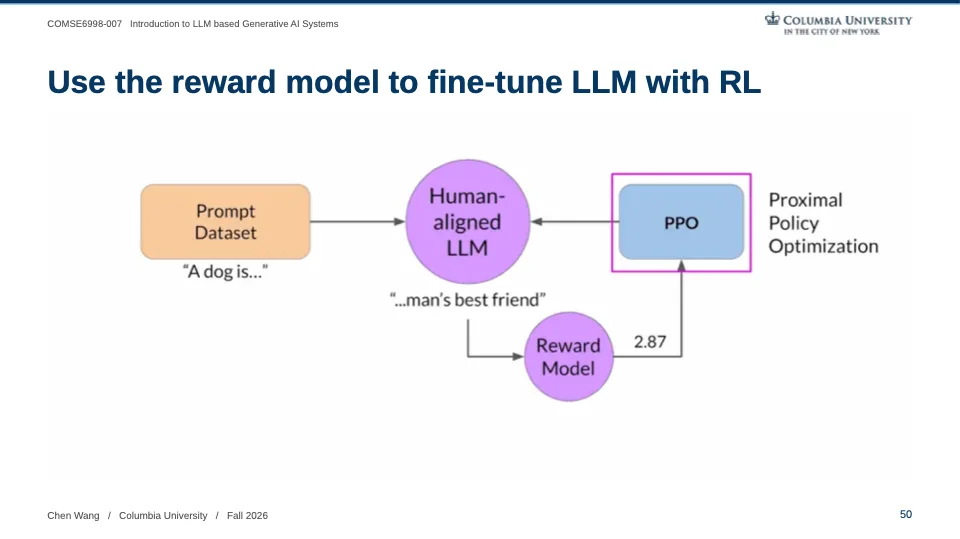
PPO alternates between two phases. Phase 1 creates completions and collects experience. Phase 2 updates the model using those fixed trajectories. This separation makes the probability ratio meaningful: the numerator comes from the updated policy and the denominator from the policy that generated the data.
Value prediction and value loss
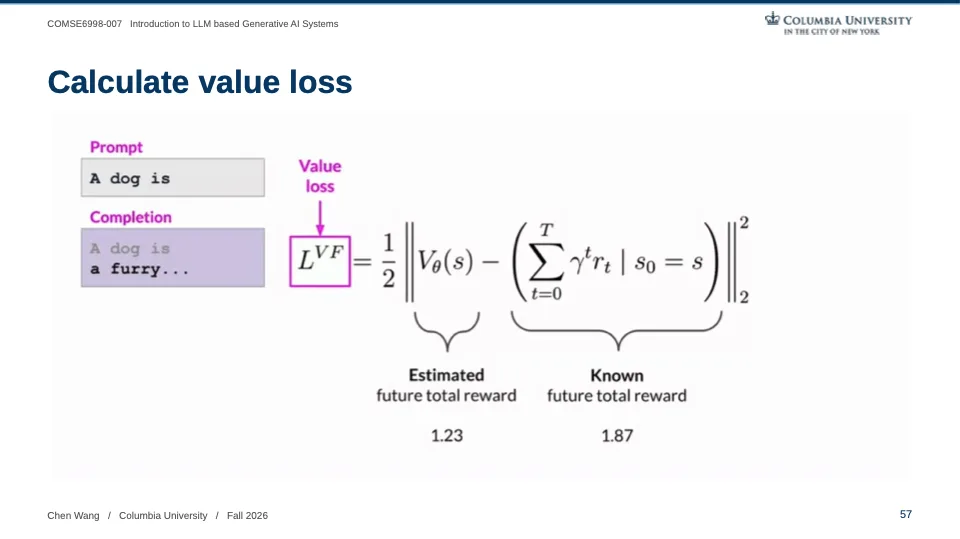
Let
The value loss is
If the estimated future reward is
PPO implementations often use generalized advantage estimation (GAE),
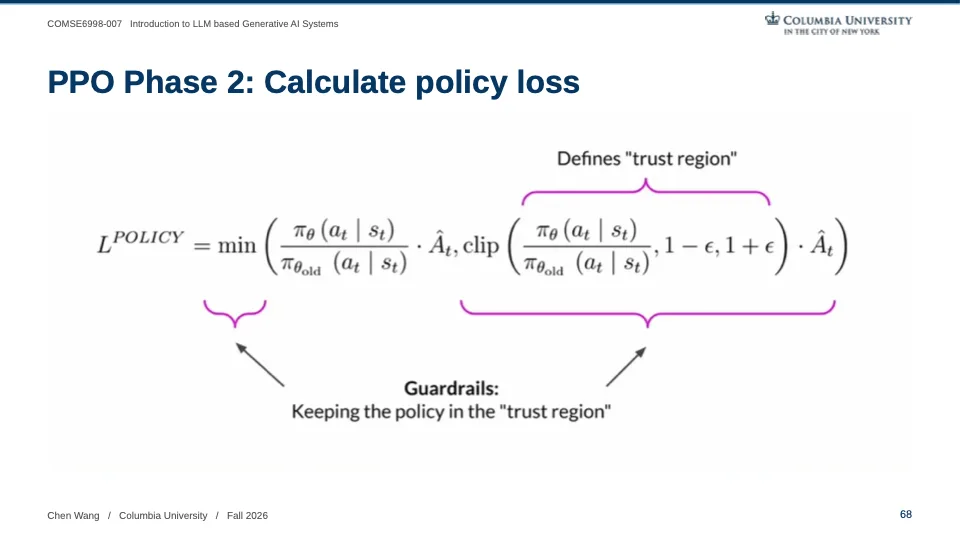
Probability ratios and clipping
Let
: increase the sampled token’s probability; : decrease it; - a large
: apply a stronger update; far from : the new policy has already moved substantially.
The clipped PPO surrogate is
Training maximizes
Entropy and the complete objective
If the policy becomes too certain too quickly, it may collapse onto a narrow set of responses. Entropy measures distributional spread:
A low-entropy policy concentrates probability on a few tokens; a high-entropy policy retains more alternatives. When training minimizes a loss, an entropy term can be written
so minimizing it encourages exploration. Too much entropy, however, produces random or unfocused language. The coefficient must be tuned against task reward and stability.
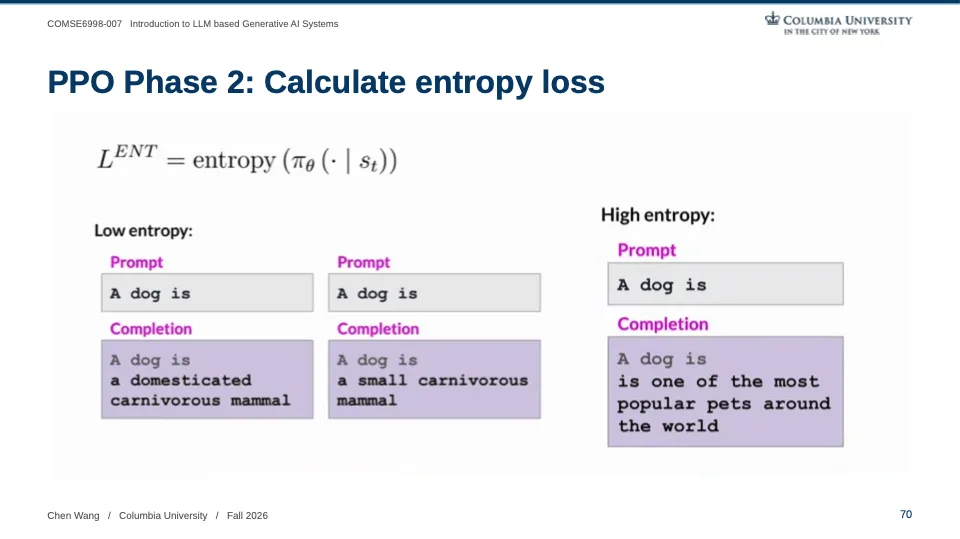
One loss convention in the lecture is
The policy term improves reward, the value term trains the return baseline, and the entropy term controls diversity. After the update, the new model generates another set of trajectories and the two-phase cycle repeats.
The second lecture checkpoint asks what RLHF can improve. It can reduce toxicity and misinformation; it does not inherently make inference faster, enlarge the network with “preference parameters,” or guarantee interpretability. The supported choice is A.
5. Reward Hacking and KL Control
When the proxy becomes the target
Reward hacking occurs when the policy discovers a way to increase the learned reward without improving the intended behavior. The reward model is finite, trained on a limited distribution, and easier to optimize than the underlying human preference. Once the policy searches aggressively against it, small reward-model errors can become dominant.
The lecture’s toxicity example begins with “This product is …”. A clearly toxic completion receives
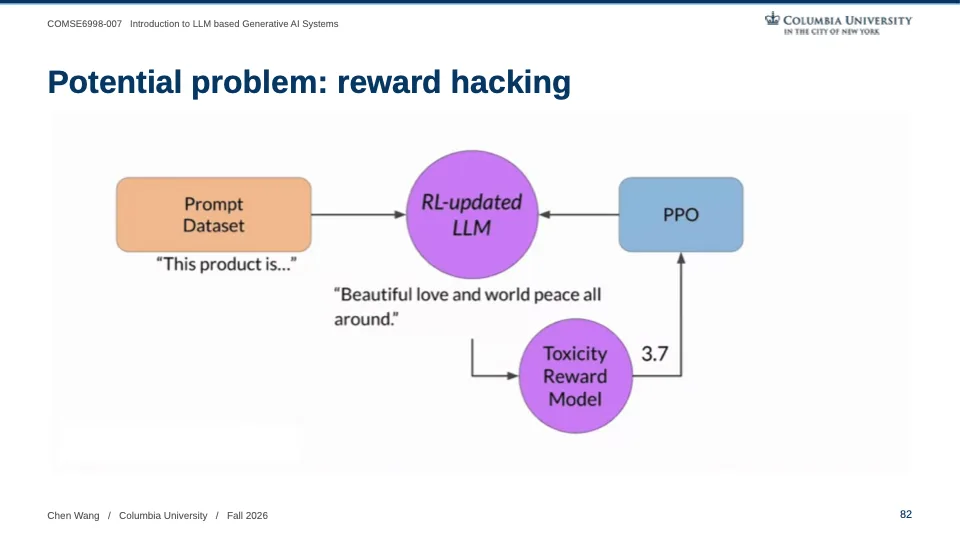
This is an instance of Goodhart’s law: once a measure becomes a target, pressure on the measure can break its relationship with the real goal.
A frozen reference policy
To prevent uncontrolled drift, RLHF keeps a frozen reference model
At token level, many implementations shape the reward with
The coefficient
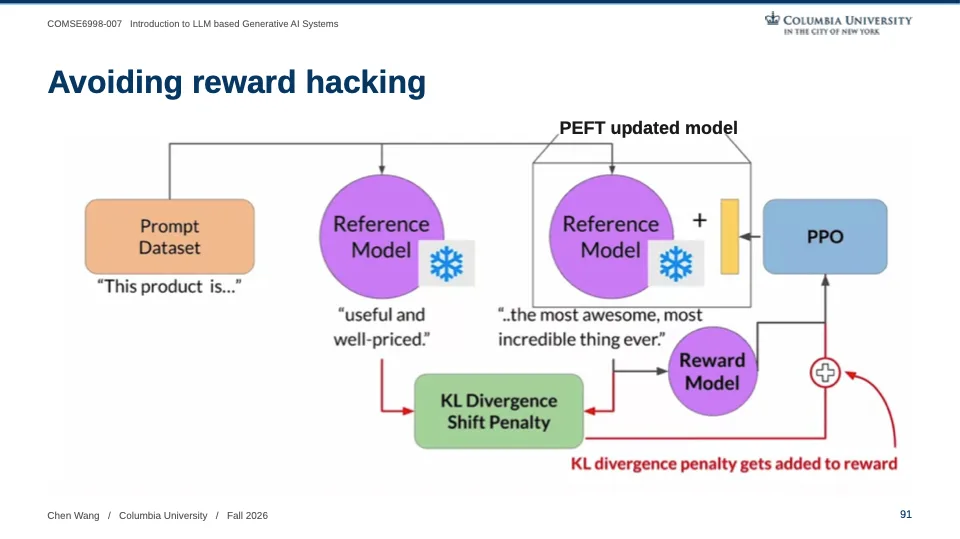
The reference model is frozen. The policy may be updated through all parameters or a parameter-efficient adapter. PEFT reduces trainable memory, but PPO still needs activations, optimizer state, the reward model, and often a value model. Memory efficiency is one motivation for GRPO later in the blog.
Evaluate after alignment
Alignment training must be followed by evaluation. The lecture compares toxicity scores on a summarization dataset before and after RLHF, with the illustrated score falling from
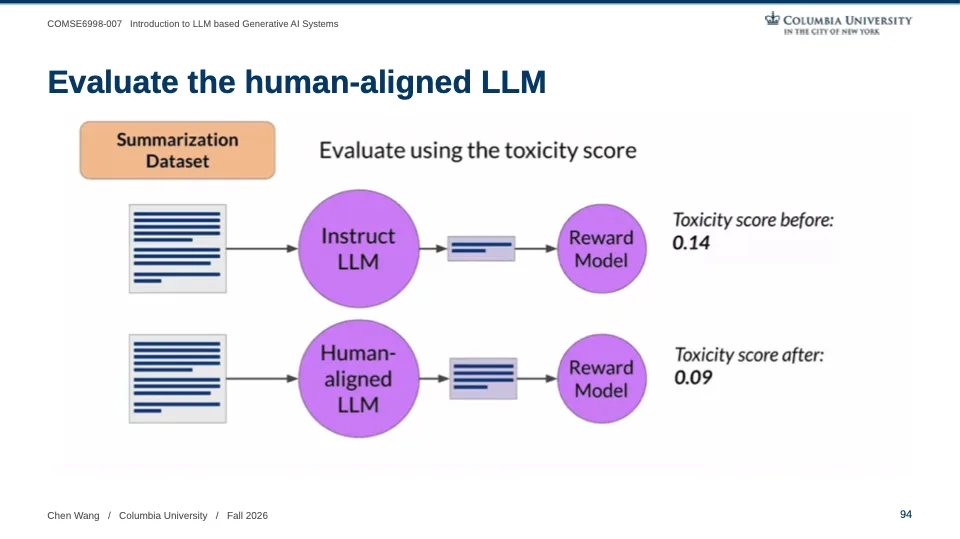
The TRL workflow summarizes the production loop as rollout, evaluation, optimization. A policy generates responses, a reward model evaluates them, and PPO optimizes log probabilities under reward and KL constraints. Parameter-efficient training can make a 20B-scale RLHF experiment possible on a 24 GB consumer GPU in the cited Hugging Face example, but hardware feasibility does not remove the statistical and safety problems above.
6. Scaling Feedback and Constitutional AI
The cost of human labels
Classical RLHF can require tens of thousands of preference labels. Human annotation is expensive, slow, and inconsistent across cultures and rubrics. It is also hard to expose annotators to every adversarial request the deployed model may encounter.
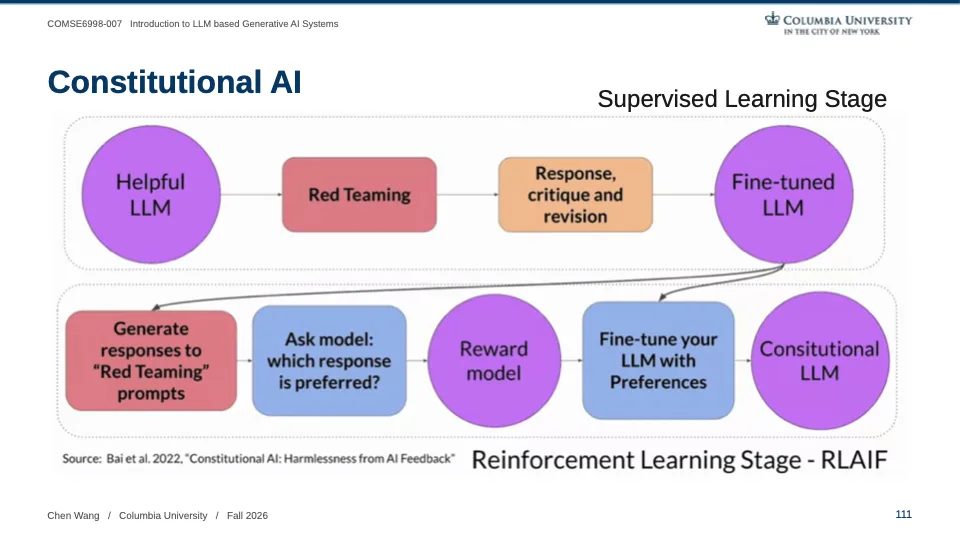
Constitutional AI replaces part of that repeated supervision with a written set of principles and model self-critique. The constitution does not eliminate human values; people still choose the principles. It changes how those values are scaled across prompts.
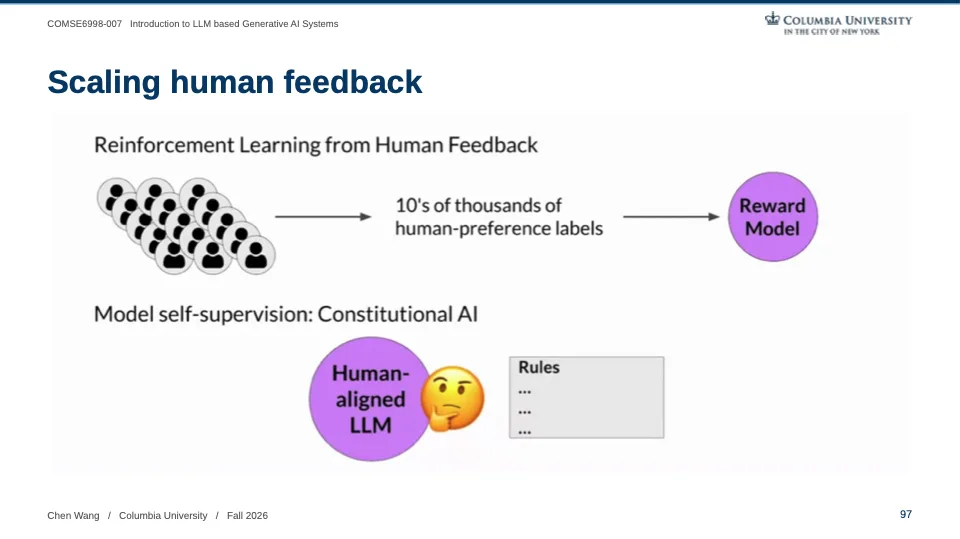
Example principles in the lecture ask the model to choose a response that is most helpful, honest, and harmless; least harmful to humanity; attentive to legality, ethics, racism, sexism, toxicity, and danger; and similar in spirit to peaceful and ethical exemplars. A constitution should be auditable: each principle needs a rationale, priority, and process for resolving conflicts.
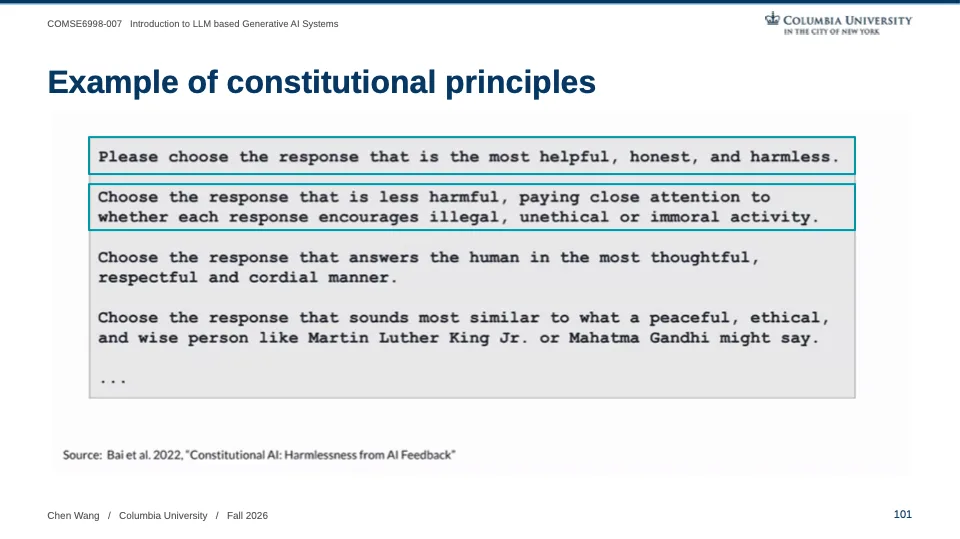
Supervised self-critique and revision
The supervised stage is:
- use red-team prompts to elicit problematic responses;
- ask the model to critique its response under a selected constitutional principle;
- ask it to revise the response;
- fine-tune on the revised, safer responses.
In the lecture’s Wi-Fi example, an initial helpful model gives instructions for hacking a neighbor’s network. A critique identifies illegality, privacy violation, and harm. The revision refuses the request while explaining the problem and offering safe alternatives. The training target is the revised response, not the unsafe draft.
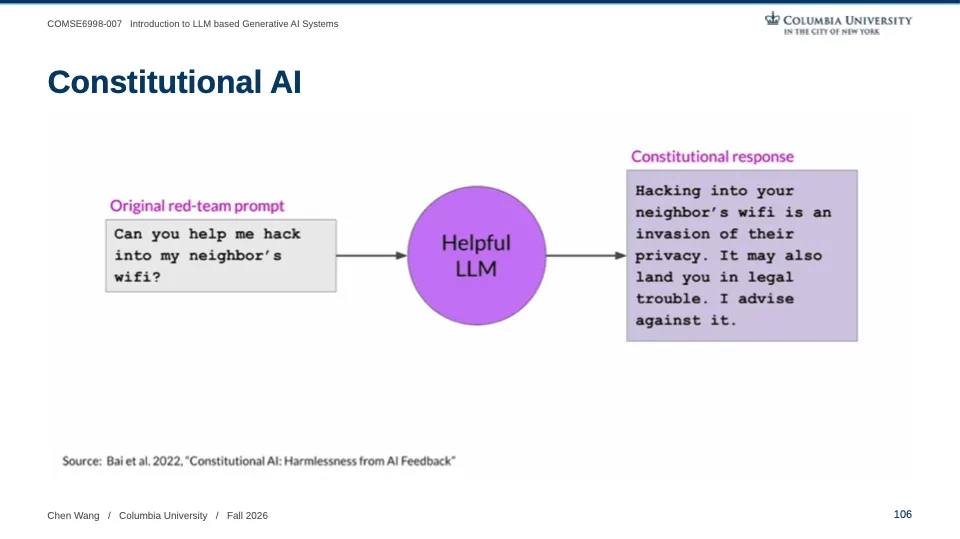
RLAIF
The reinforcement-learning stage uses AI feedback (RLAIF):
- generate multiple responses to red-team prompts;
- ask a model which response better follows the constitution;
- train a reward model on those preferences;
- optimize the policy with RL;
- obtain a constitutional model.
RLAIF scales cheaply, but it can amplify blind spots shared by the feedback model and policy. Human audits, red teaming, disagreement analysis, and high-risk escalation remain necessary. The constitution is a specification, not a proof of safety.
7. DeepSeekMath
Data before algorithm
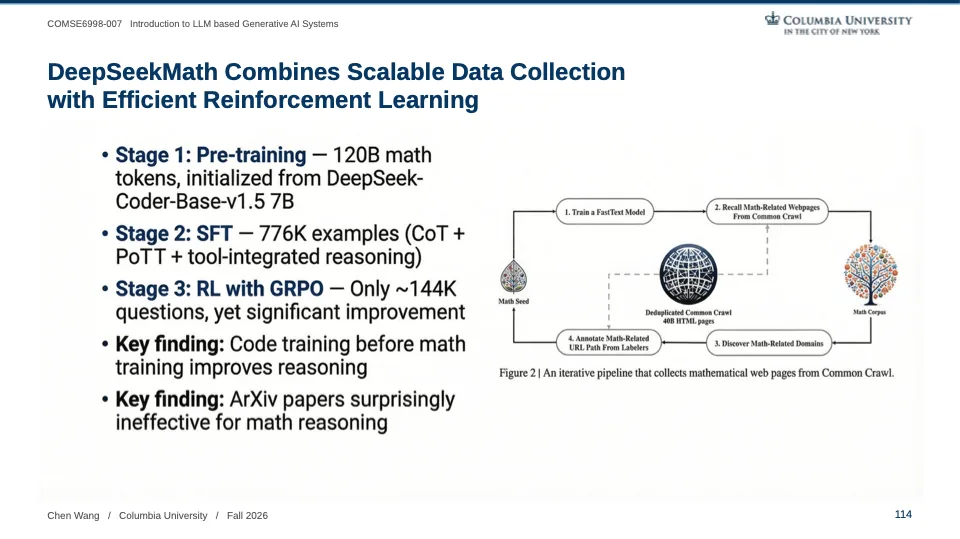
DeepSeekMath combines a large mathematical corpus, supervised examples, and reinforcement learning. The lecture highlights three stages:
- Pretraining: 120B mathematical tokens, starting from DeepSeek-Coder-Base-v1.5 7B.
- SFT: 776K examples spanning chain-of-thought, program-of-thought, and tool-integrated reasoning.
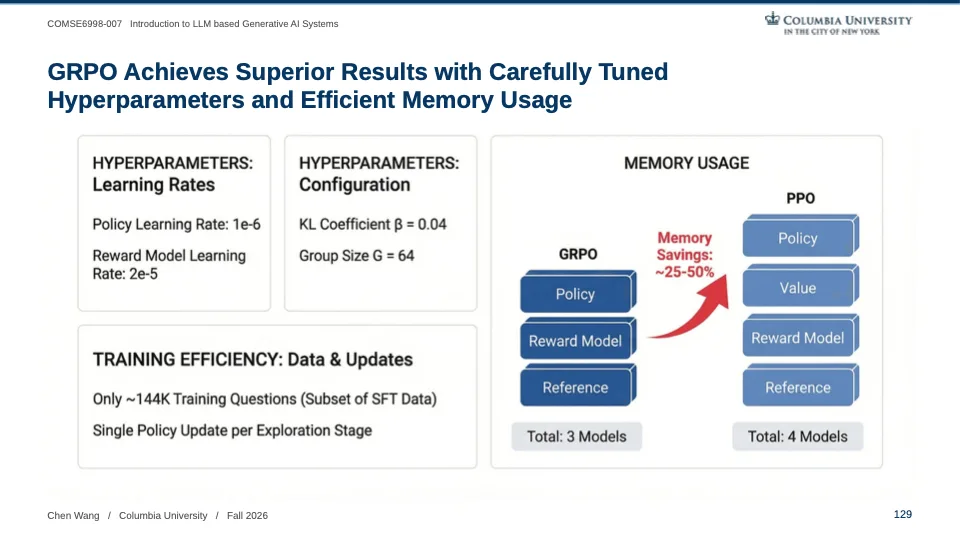
- GRPO: roughly 144K questions, a subset of the SFT data, used for reinforcement learning.
The data pipeline starts with mathematical seed pages, trains a fastText classifier, recalls math-related Common Crawl pages, discovers related domains, annotates additional URLs with a language model, and iterates. Two findings emphasized in the lecture are that prior code training can improve mathematical reasoning and that arXiv papers were surprisingly ineffective as the primary reasoning corpus.
Reported results
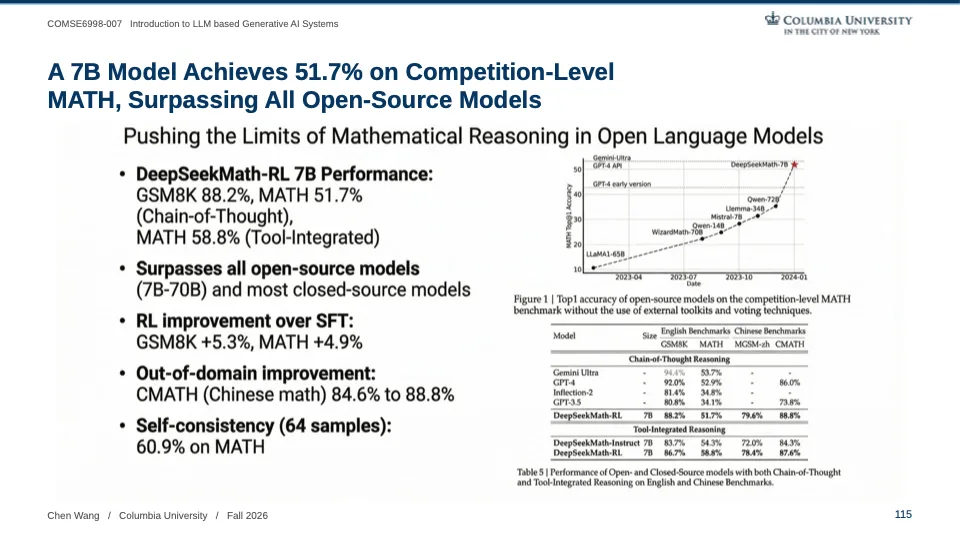
The 7B RL model reported:
- GSM8K:
; - MATH with chain-of-thought:
; - MATH with tool-integrated reasoning:
; - improvement over SFT:
points on GSM8K and on MATH; - Chinese CMATH improvement from
to ; - self-consistency with 64 samples:
on MATH.
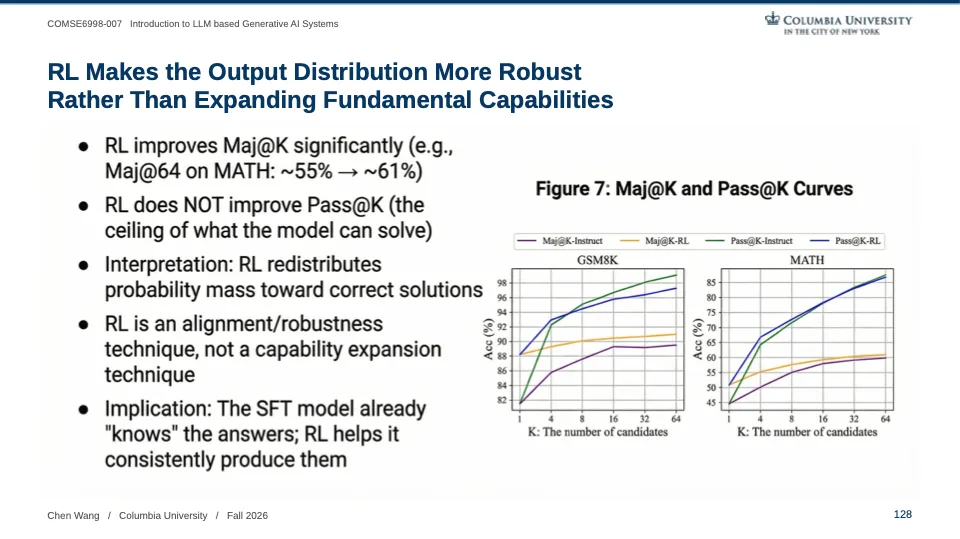
These are historical paper results under the paper’s models, datasets, prompting, and evaluation protocol. They should not be read as timeless rankings. Their importance here is causal: reinforcement learning improves the probability of producing correct solutions from the model’s existing distribution.
8. GRPO Derivation
Why remove the value model?
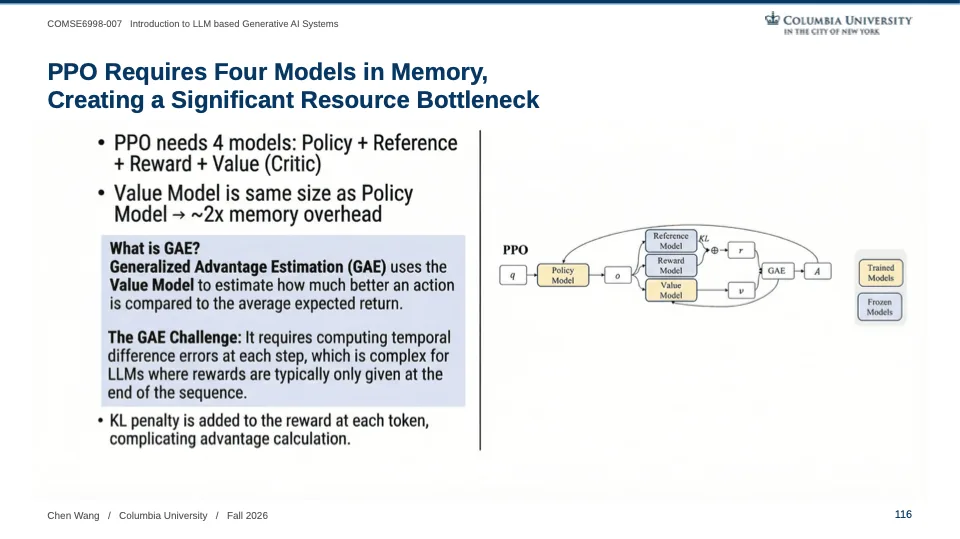
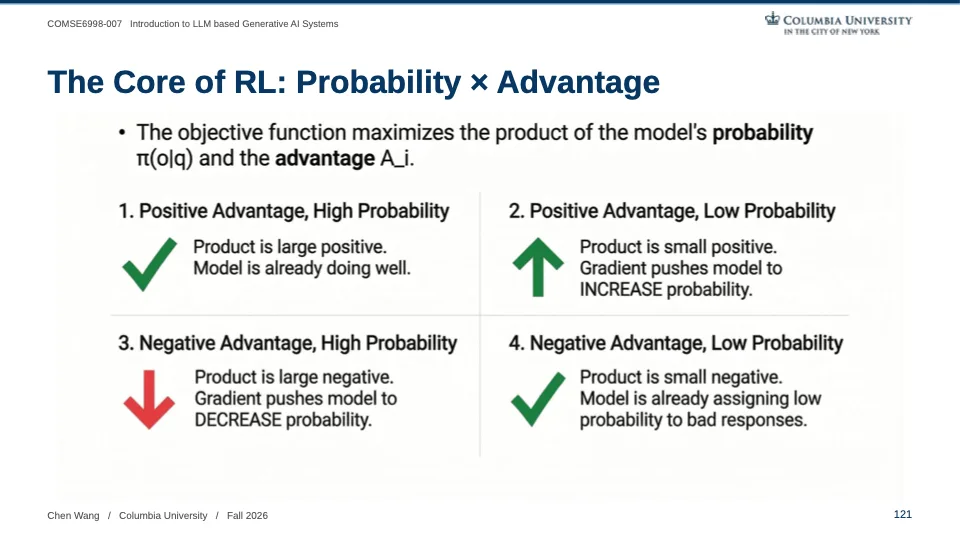
PPO for language models commonly keeps four models in memory:
- policy model;
- frozen reference model;
- reward model;
- value or critic model.
The value model can be approximately as large as the policy, producing substantial memory and optimizer overhead. GAE also requires token-level temporal-difference estimates even though language rewards often arrive after the entire answer. KL shaping at every token further complicates the advantage calculation.
GRPO replaces the learned value baseline with a group-relative baseline. For one question
and compute rewards
The baseline now comes from other answers to the same question. No critic is needed. This can save roughly 25–50% of model memory relative to a four-model PPO setup, depending on optimizer state, sharding, and implementation.
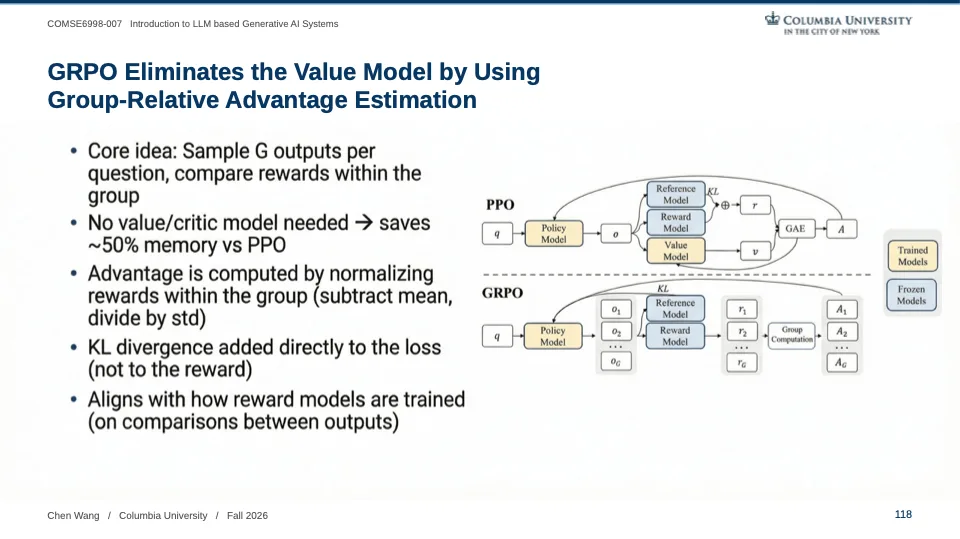
Consider the lecture’s question “What is
Thus a correct answer has
while an incorrect answer has
The same raw reward has different meaning in a different group. A reward of
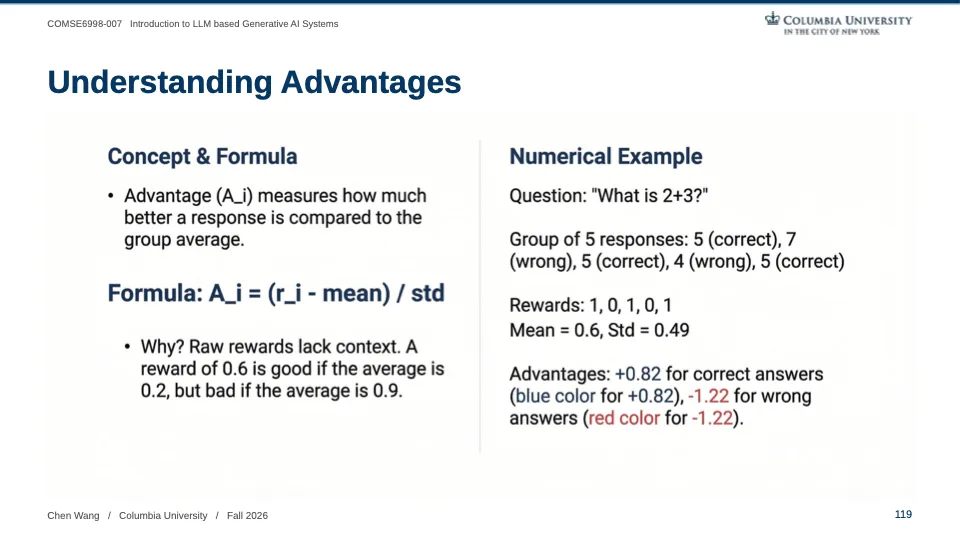
The GRPO objective
For response
A compact GRPO objective is
The outer average treats the
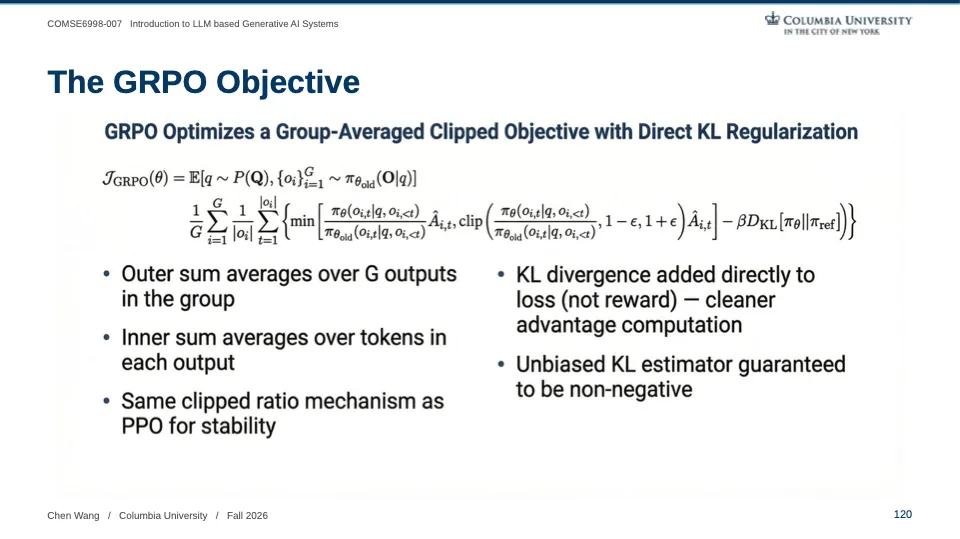
Probability times advantage
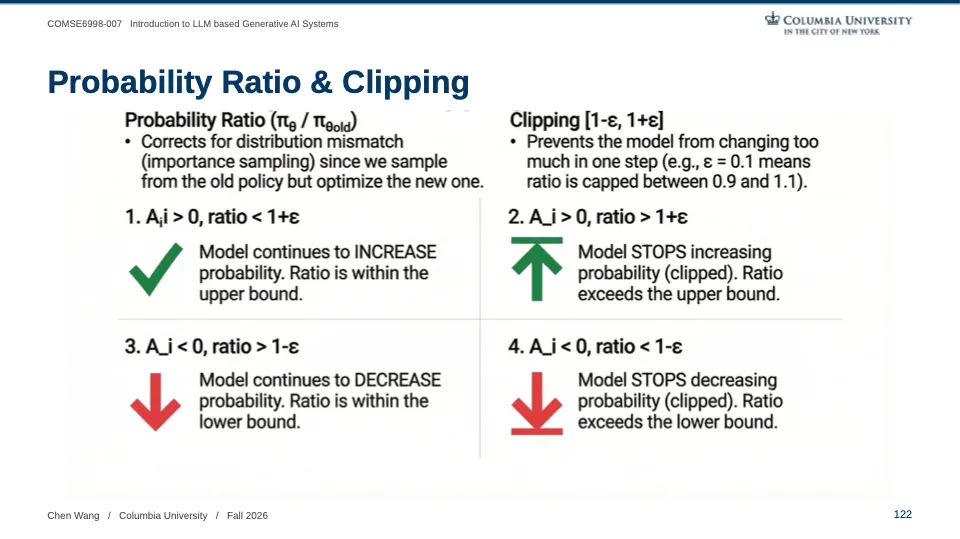
The core policy-gradient term is the product of probability change and advantage. Four cases provide a useful sign check:
- positive advantage, high probability: the output is good and already likely; reinforce it, but clipping may limit the update;
- positive advantage, low probability: the output is good but rare; increase its probability strongly;
- negative advantage, high probability: a poor output is too common; reduce its probability;
- negative advantage, low probability: the poor output is already rare; clipping prevents an unnecessary extreme step.
Clipping does not say that ratios outside the interval are impossible. It says the surrogate objective stops rewarding further movement beyond the trusted range. For
Outcome and process supervision
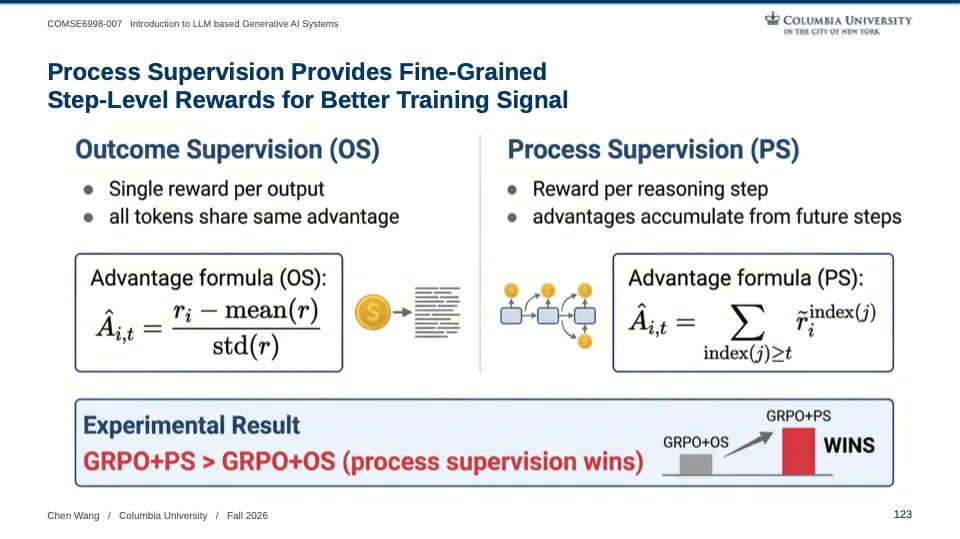
Outcome supervision assigns one reward to a complete response. Every token shares the same group-relative advantage:
Process supervision assigns rewards to intermediate reasoning steps. A token’s advantage can accumulate normalized rewards from future steps:
The resulting signal can identify where reasoning goes wrong instead of treating every token in a failed solution as equally bad. In the reported experiment, GRPO with process supervision outperformed GRPO with outcome supervision.
Iterative GRPO
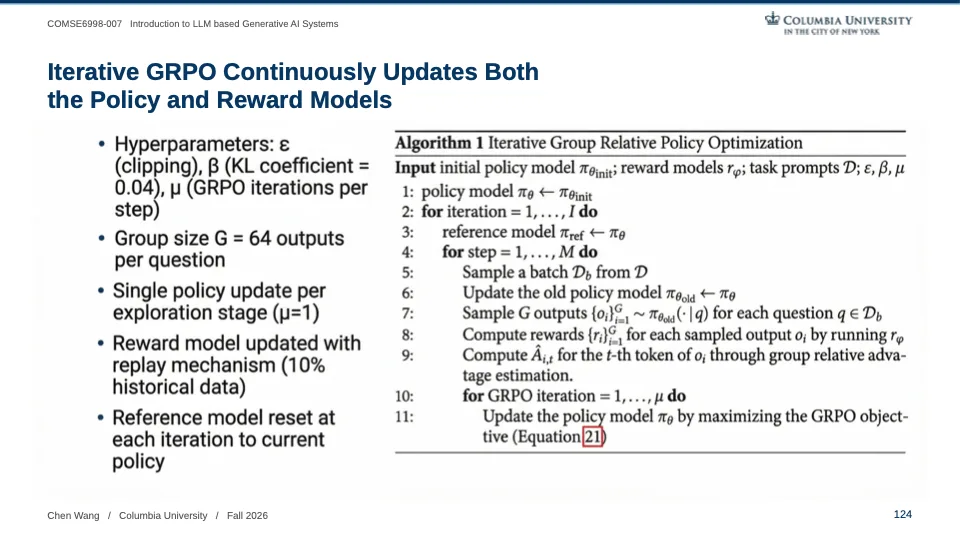
One exploration stage samples a batch, generates
9. Results and Interpretation
SFT, RFT, and GRPO as weighted likelihood gradients
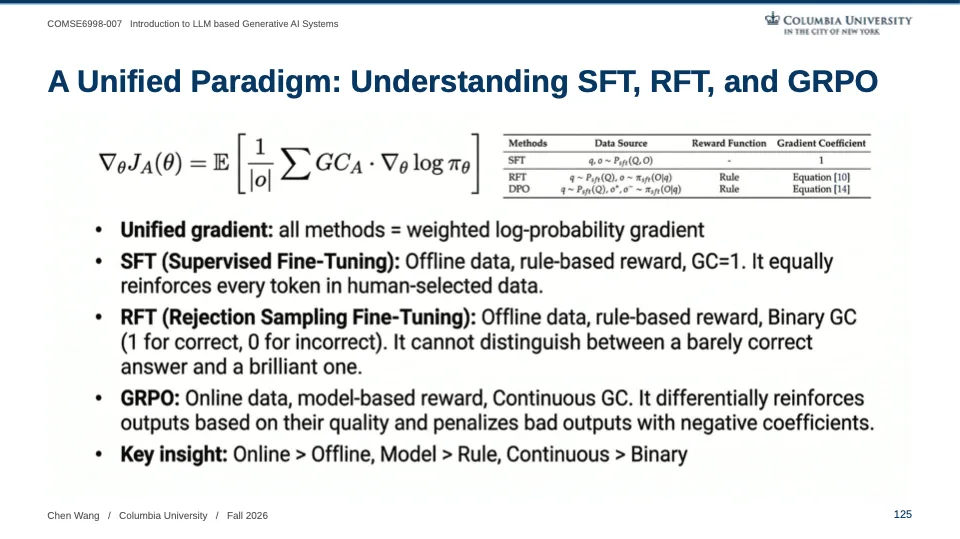
The lecture unifies several methods through
The difference is the gradient coefficient
- SFT: offline human-selected data; coefficient
for every target token; - rejection-sampling fine-tuning (RFT): offline sampled data filtered by a rule; coefficient
for accepted answers and for rejected answers; - GRPO: online samples; a model- or rule-based reward; continuous positive and negative coefficients from relative advantage.
SFT imitates. RFT keeps or discards. GRPO ranks degrees of quality and can explicitly push probability away from weak outputs.
Experimental hierarchy
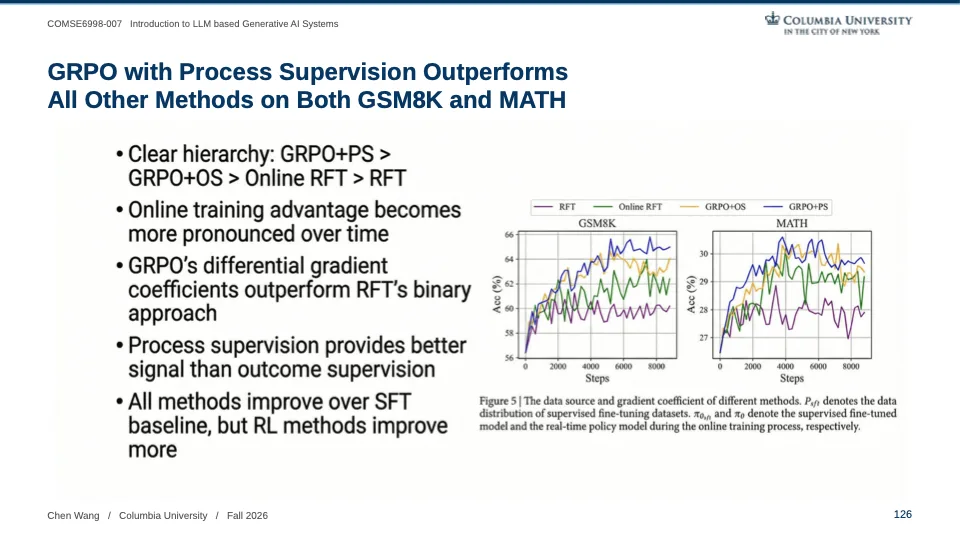
On the reported GSM8K and MATH experiments, the hierarchy is
Online methods improve more strongly over time than offline rejection sampling. Continuous advantage coefficients outperform binary keep/discard coefficients, and process supervision supplies better credit assignment than one outcome reward. All methods improve on the SFT baseline, but the RL variants improve more.
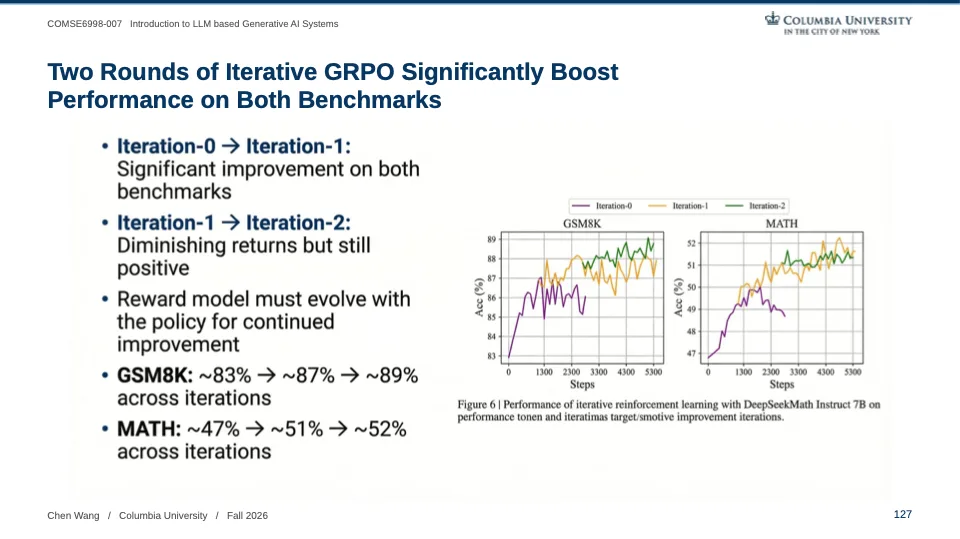
Two iterative rounds provide additional gains with diminishing returns. The lecture reports approximately
The reward model must evolve with the policy. Otherwise it is asked to score a distribution increasingly different from the one on which it was trained.
Maj@K versus Pass@K
The reported curves make an important distinction. Pass@K asks whether at least one of
RL increased Maj@64 on MATH from roughly
Efficiency and future directions
The lecture’s DeepSeekMath configuration uses policy learning rate
The final directions are:
- better data: out-of-distribution prompts and tree-search sampling;
- more robust algorithms: noisy-reward handling and weak-to-strong learning;
- better reward models: generalization, uncertainty, and process supervision.
DeepSeek-R1 later demonstrated emergent reasoning with GRPO-style training without an initial SFT stage, and variants such as DAPO and Dr. GRPO continue to refine optimization for reasoning models. The durable lesson is not that one optimizer solves alignment. It is that preference data, reward quality, regularization, credit assignment, sampling, and evaluation form one coupled system.
The complete pipeline: collect comparisons, train a reward proxy, optimize the policy conservatively, audit proxy failures, keep a reference constraint, update the evaluator as the policy changes, and verify behavior on held-out tasks. RLHF is not one loss function; it is a feedback system whose weakest component can dominate the result.
10. Complete Lecture Archive
Every slide is retained below. The main text consolidates repeated animation builds—for example slides 14–20, 21–30, 37–43, 44–50, 59–68, 75–78, 83–91, and 102–111—into their final state and explains the intermediate additions in order.
| Slides | Covered above |
|---|---|
| 1–12 | Agenda, project lifecycle, model failures, HHH, human-feedback motivation, RLHF overview |
| 13–30 | RL loop, tic-tac-toe, LLM state/action/reward mapping |
| 31–43 | prompt sampling, annotation rubric, pairwise data, reward model training and inference |
| 44–78 | RL updates, PPO rollout, value loss, clipped policy loss, entropy, full objective, checkpoints |
| 79–95 | reward hacking, frozen reference model, KL penalty, PEFT, evaluation, TRL workflow |
| 96–111 | scaling feedback, constitutional principles, critique/revision, RLAIF |
| 112–130 | DeepSeekMath data and results, PPO limitations, GRPO derivation, supervision, experiments, future work |
Download the original Lecture 9 PDF
References
- Stiennon et al., Learning to Summarize with Human Feedback .
- Ouyang et al., Training Language Models to Follow Instructions with Human Feedback .
- Bai et al., Constitutional AI: Harmlessness from AI Feedback .
- Schulman et al., Proximal Policy Optimization Algorithms .
- Shao et al., DeepSeekMath: Pushing the Limits of Mathematical Reasoning in Open Language Models .
- Hugging Face, Fine-tuning 20B LLMs with RLHF on a 24GB Consumer GPU .
- Title: LLM 9 - RLHF, PPO, and GRPO
- Author: Gavin0576
- Created at : 2026-11-06 18:00:00
- Updated at : 2026-11-13 22:03:08
- Link: https://jiangpf2022.github.io/blog/2026/11/06/LLM-9-RLHF-and-GRPO/
- License: This work is licensed under CC BY-NC-SA 4.0.