
LLM 7 - Efficient LLM Serving

Welcome back. In LLM 6 we learned how to adapt one pretrained model into many useful behaviors. That immediately creates a systems problem. A model may be accurate, but can it answer hundreds of users without making each one wait? Can several adapters share one base model? Can a long request coexist with short requests without wasting most of the GPU memory?
Serving a language model is not simply “put the model on a GPU and call generate.” Autoregressive decoding repeatedly reads a large model, appends one token, grows a key-value cache, and makes scheduling decisions while requests arrive and depart at different times. The arithmetic is familiar from the Transformer; the difficulty comes from movement, memory, and coordination.
This blog follows one central question: where does useful GPU work disappear? Static batches leave empty slots. Ordinary attention moves too much intermediate data. Contiguous KV-cache allocation reserves memory that a request may never use. Independent programs repeat common prefixes. Per-user adapters fragment memory and batching. GPU sharing can create interference unless the isolation mechanism matches the workload. Each serving system in this blog recovers one of those losses.
1. The Serving Workload
Prefill and Decode Are Different Phases
An LLM request has two computational phases. During prefill, the model processes the prompt tokens, constructs their hidden states, and fills the initial KV cache. The prompt is already known, so its token positions can be processed in parallel inside each layer. Prefill therefore resembles a large matrix-multiplication workload and can use GPU compute efficiently.
During decode, the model produces one new token at a time. Token
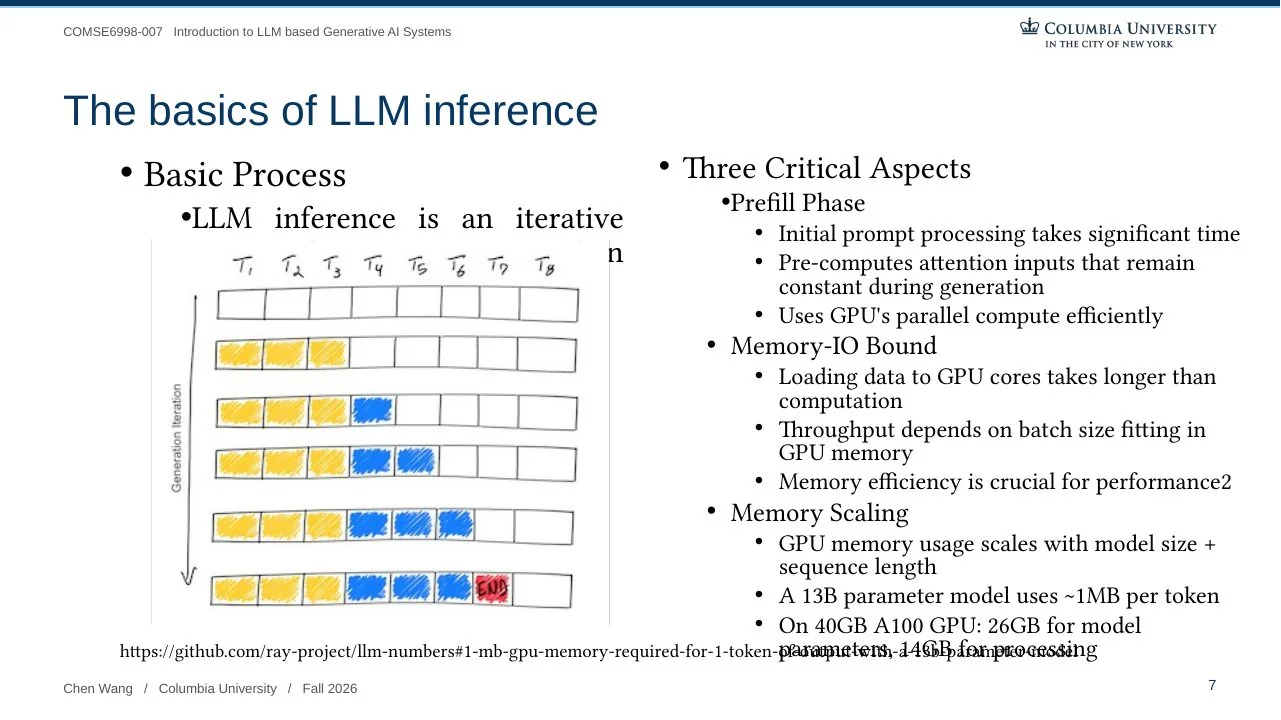
For many decode workloads, memory traffic rather than raw floating-point capacity becomes the bottleneck. A rough 13-billion-parameter example in the course material uses about 26 GB for half-precision weights. Even before the KV cache and temporary buffers, one decoding step must stream a large fraction of those weights through the device. The precise throughput depends on hardware, kernels, quantization, tensor parallelism, sequence length, and batch size; the important point is that a small decode batch may not create enough arithmetic per byte moved.
The serving objective is therefore multi-dimensional:
- time to first token (TTFT): queueing plus prefill time;
- inter-token latency (ITL): delay between successive output tokens;
- end-to-end latency: time until the complete response arrives;
- throughput: completed requests or generated tokens per unit time;
- goodput: useful throughput that still satisfies latency targets;
- cost: GPU time and infrastructure cost per successful request.
Optimizing one number can damage another. Waiting to form a larger batch may improve throughput but increase TTFT. Giving every request an enormous reserved cache may avoid reallocation but reduce the number of concurrent users. A production scheduler needs a service-level objective, not merely the largest tokens-per-second number.
Why Ordinary Static Batching Wastes Work
Suppose four requests begin together but require 20, 50, 80, and 100 output tokens. A static batch keeps its original shape until the longest sequence finishes. After the first request completes, its slot performs padding work or remains idle while the other requests continue. Near the end, one real sequence may occupy a batch designed for four.
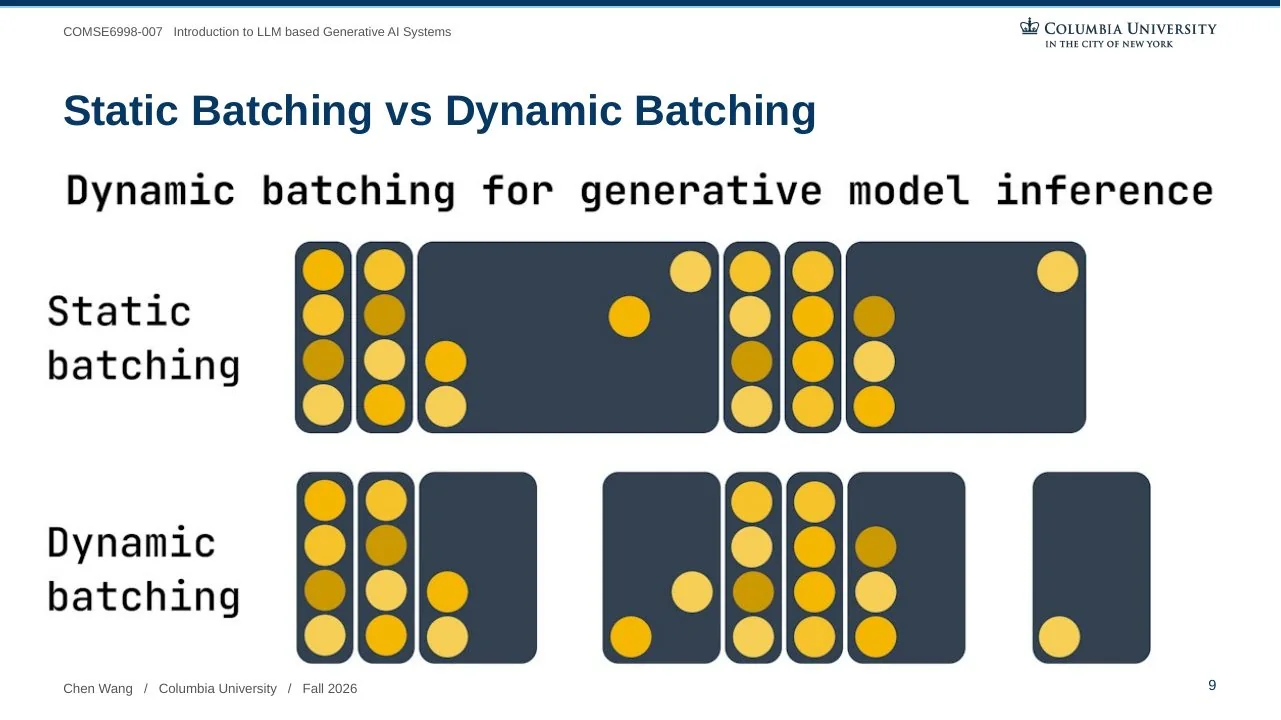
Dynamic batching collects requests that arrive within a short window, runs them together, and forms a new batch after completion. This is effective for one-shot models, but autoregressive sequences still finish at different times inside a generation batch.
Continuous batching, introduced prominently in systems such as Orca, schedules at the iteration level. When one sequence finishes, the scheduler removes it and admits another request at the next decoding iteration. The active batch changes while generation is in progress.
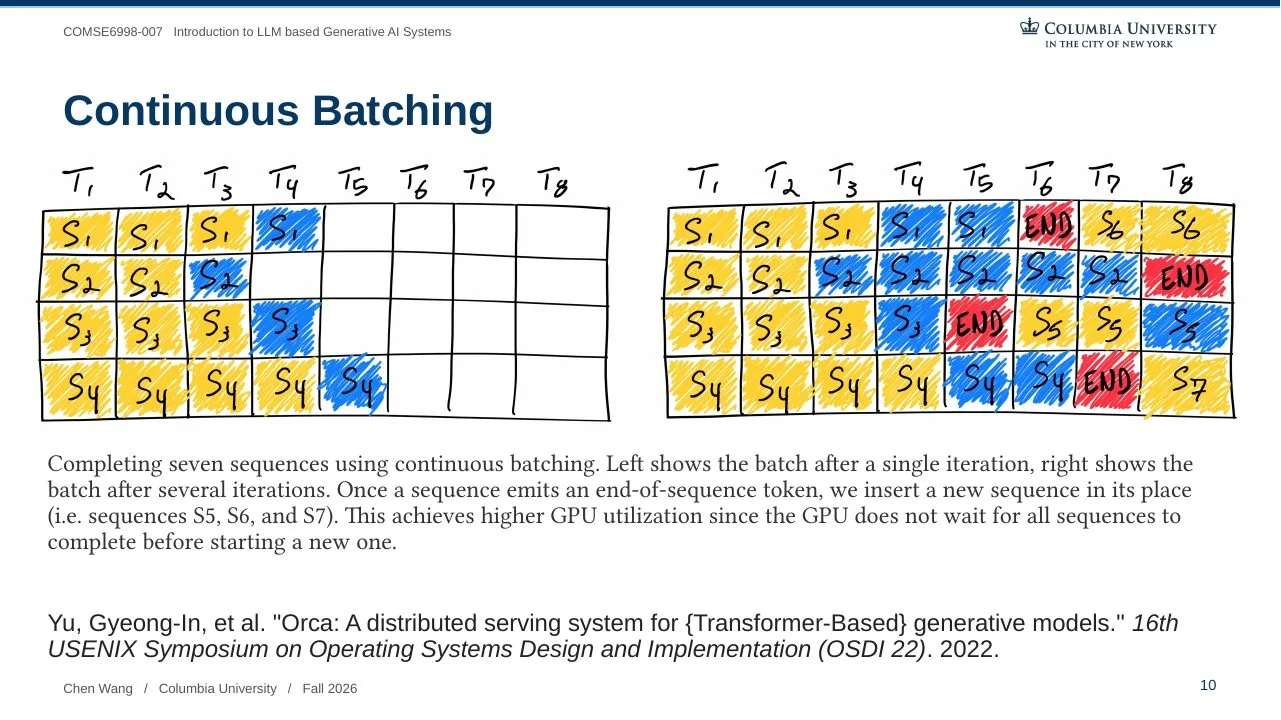
Consider active set
where
2. FlashAttention
Attention Is Simple Algebra with Expensive Data Movement
For queries
A straightforward implementation computes the score matrix
The hierarchy matters. On the hardware example used in the course, SRAM is much smaller but roughly an order of magnitude faster than HBM. Exact numbers vary by accelerator generation. The stable principle is that a kernel can become faster without reducing the mathematical FLOP count if it reduces slow memory reads and writes.
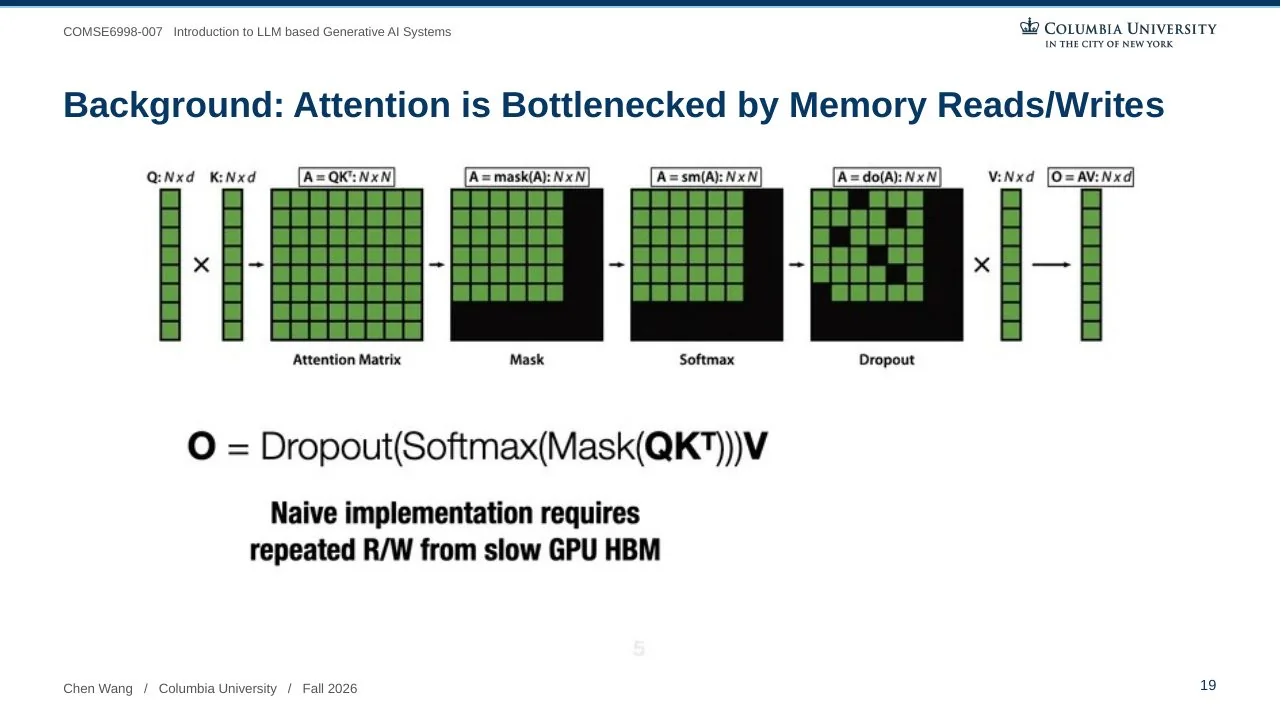
FlashAttention tiles
Online Softmax Makes Tiling Possible
Softmax appears to require the maximum and normalizer over an entire row:
The subtraction by
For block 1, let maximum
and the combined normalizer is
The output summaries combine as
The rescaling terms are the key. If the second block contains a larger logit, the first block’s previous exponentials are corrected into the new coordinate system rather than recomputed from scratch.
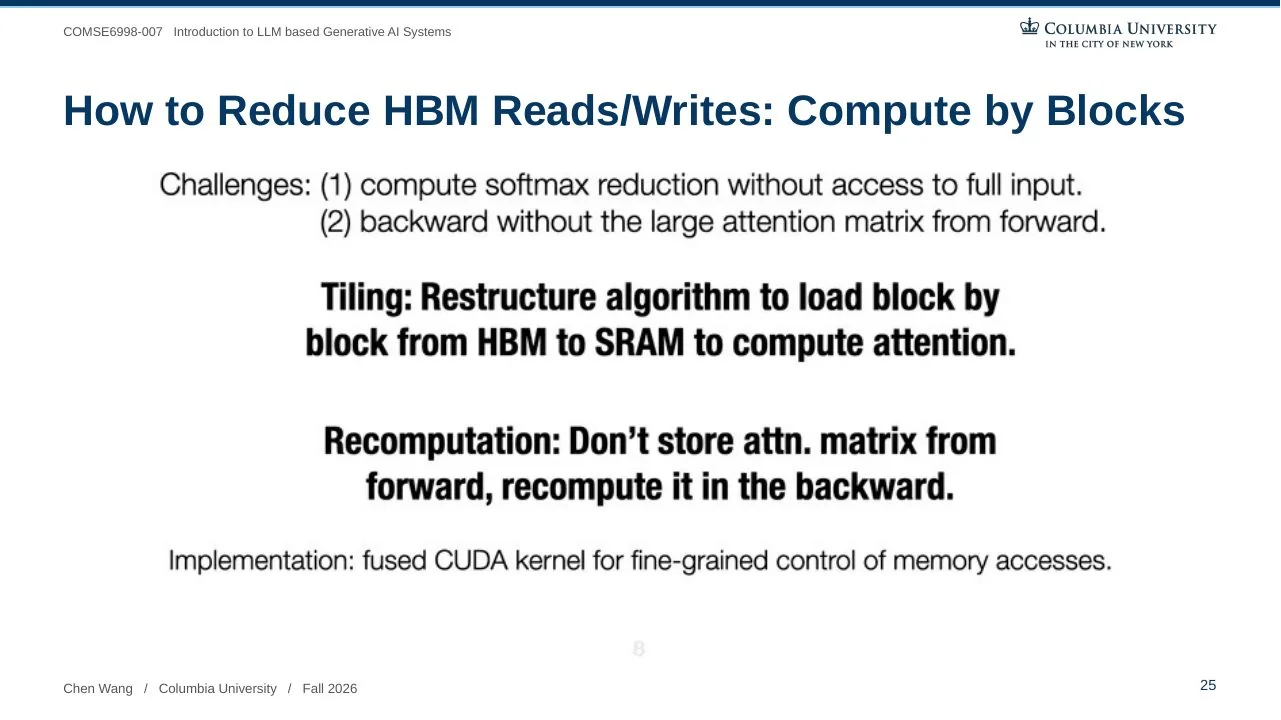
During backpropagation, FlashAttention saves compact row statistics and recomputes some intermediates instead of storing the full probability matrix. This is a deliberate compute-for-memory trade: extra arithmetic can be cheaper than HBM traffic. The technique also extends to causal masks and block-sparse patterns.
The original results reported several-fold attention speedups and large memory reductions in specific training configurations. Those figures should not be treated as universal constants; sequence length, head dimension, GPU, precision, and kernel version all matter. The durable lesson is stronger: asymptotic arithmetic complexity alone does not predict wall-clock performance. FlashAttention keeps
3. KV Cache and PagedAttention
What the Cache Stores
At decode step
For a model with
The factor 2 represents keys and values. For ordinary multi-head attention,
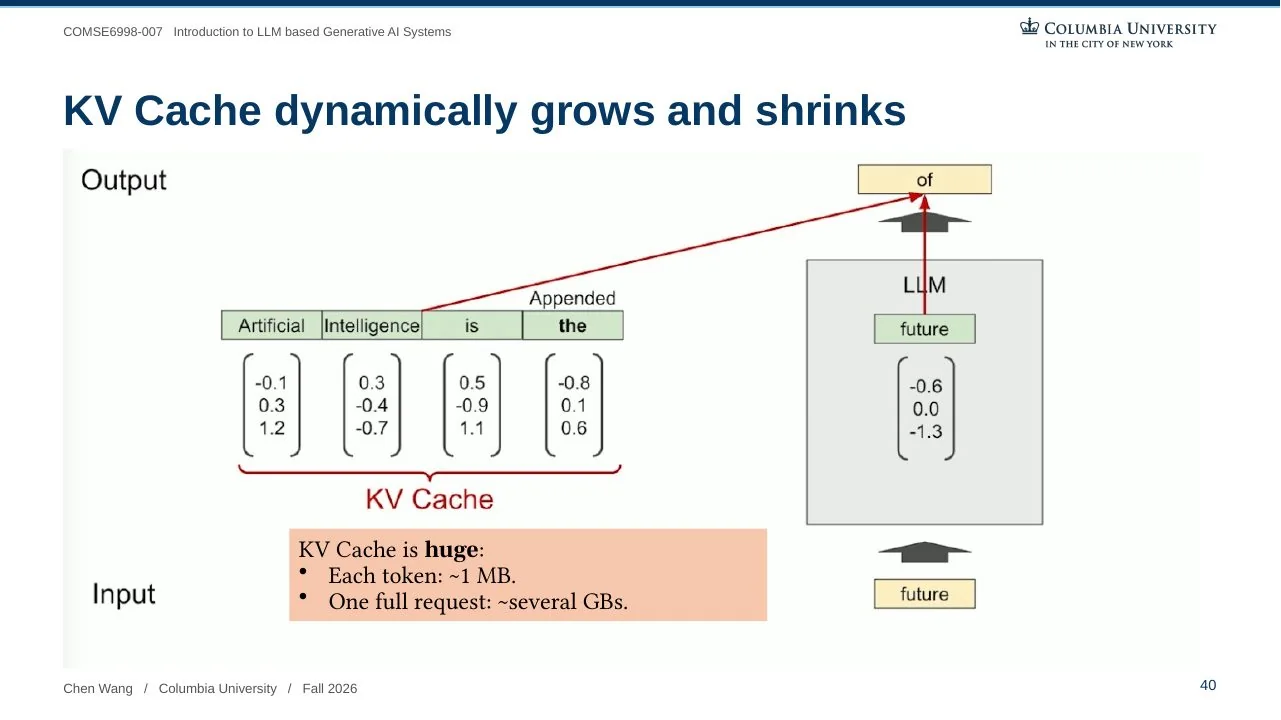
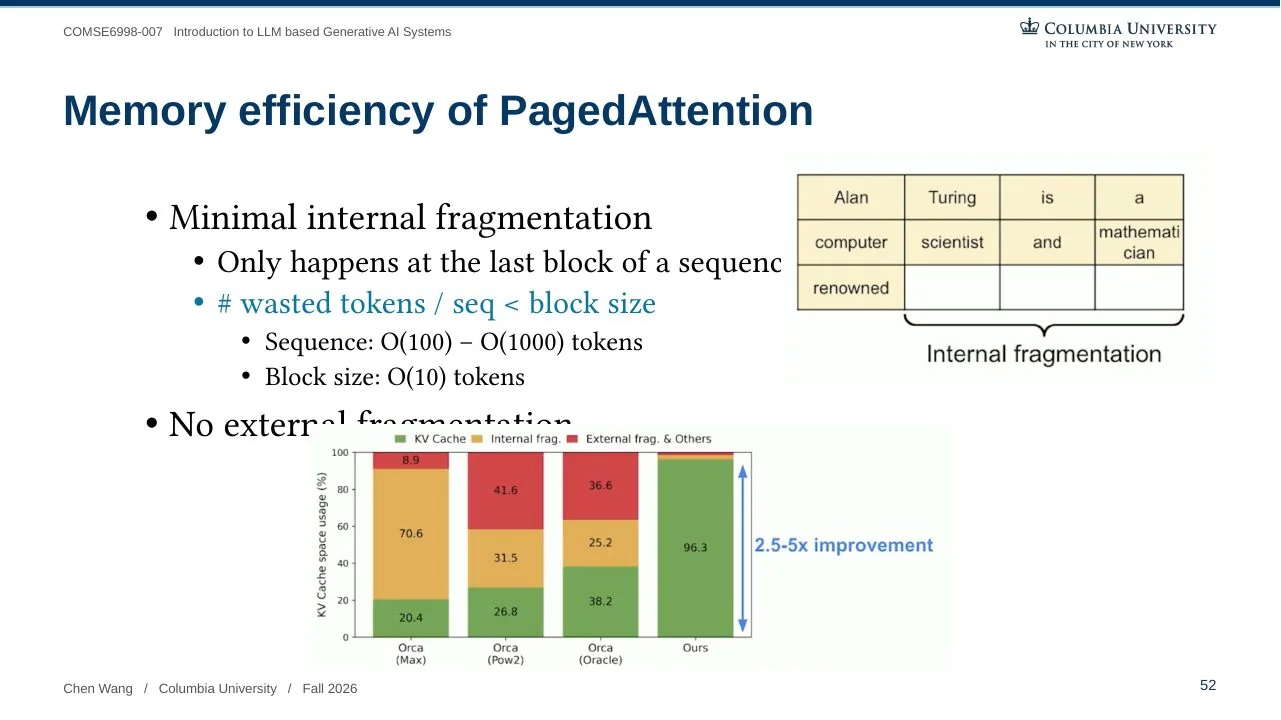
Now imagine reserving one contiguous region sized for each request’s maximum possible sequence length. A request that stops early leaves most of its reservation unused—internal fragmentation. As requests of different sizes arrive and finish, enough total free memory may exist but not as one sufficiently large contiguous segment—external fragmentation. The course cites observations in which ordinary contiguous allocation used only a minority of reserved cache capacity for real tokens.
Paging the Cache
PagedAttention borrows the virtual-memory idea. Each sequence’s logical KV cache is divided into fixed-size blocks. A block table maps logical blocks to non-contiguous physical blocks in GPU memory. Attention kernels follow that mapping while reading keys and values.
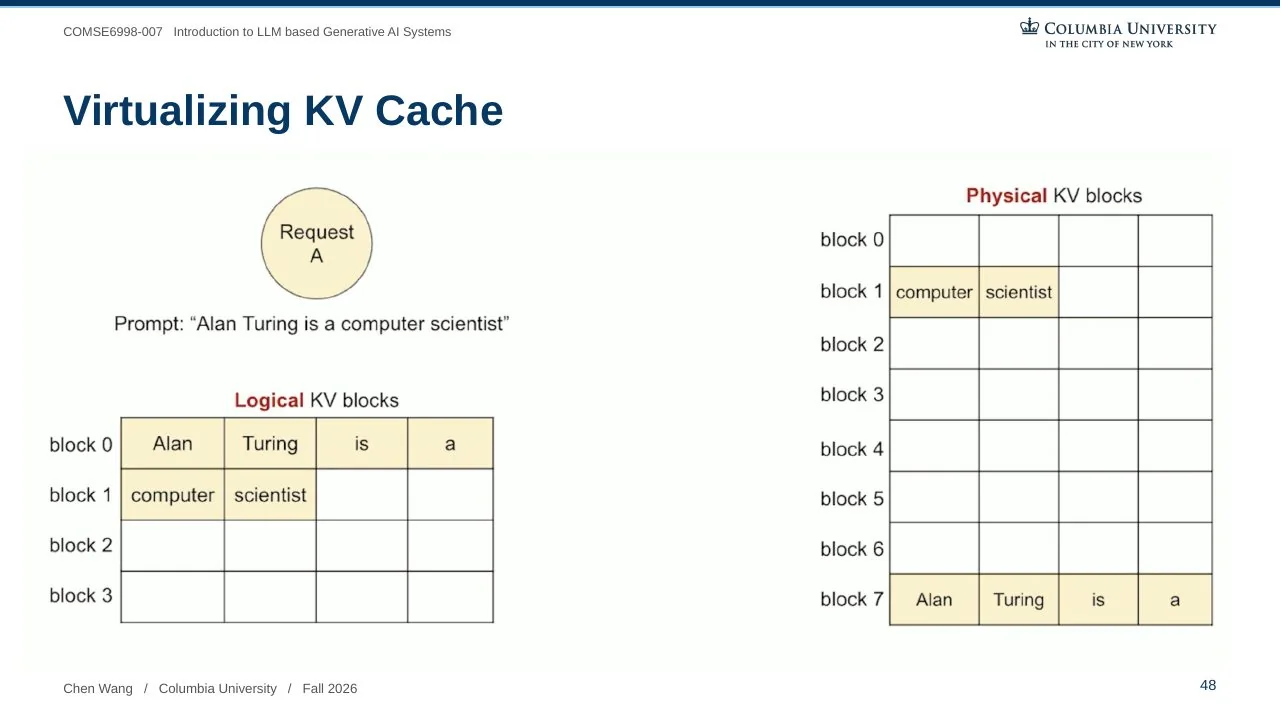
Only the final block of a sequence can be partially filled, so internal waste is bounded by fewer than one block per sequence. Physical blocks can be allocated wherever space exists, removing the need for one contiguous range. A small block reduces waste but increases block-table entries and addressing overhead; a large block simplifies mapping but wastes more capacity at sequence tails. The vLLM study found a block size around 16 tokens effective across its tested workloads, but this is a system parameter rather than a law.
Indirection adds kernel overhead—the course reports roughly 10–15% in one comparison—but capacity can improve much more. If paging allows twice as many useful tokens to remain resident, continuous batching has more requests available to amortize weight reads.
Sharing and Preemption
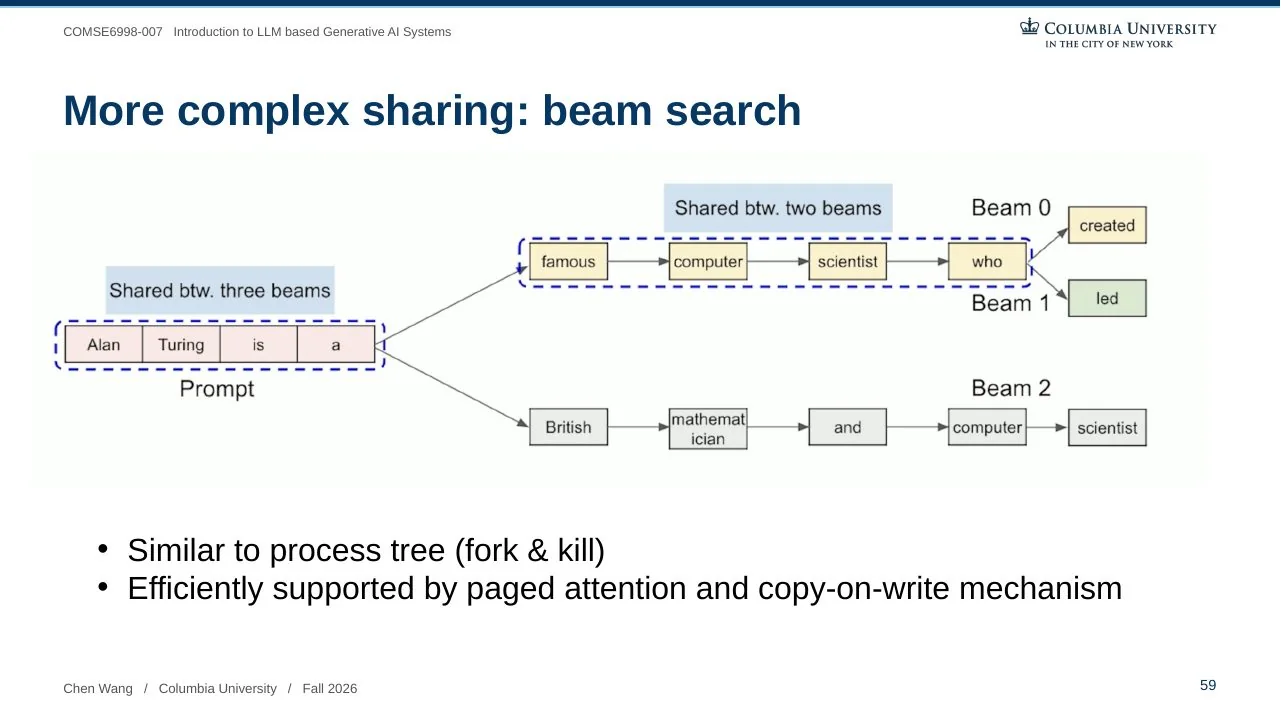
Block-based storage enables more than compact allocation. Several sequences can initially point to the same physical prefix blocks. Parallel samples, beam search, and prompts with a shared system message can reuse those cache entries. When one sequence diverges, copy-on-write gives it a private block only for the changed suffix.
If the GPU still runs out of cache blocks, the scheduler must preempt work. Two options are common:
- swap: copy KV blocks to CPU memory and later restore them;
- recompute: discard the cache and rebuild it from the token prefix when the request resumes.
Recompute is often attractive when PCIe transfer would be slower than another prefill, but the trade depends on prefix length and hardware. A first-come-first-served scheduler can preempt the most recently admitted request, preserving progress for older requests. Fairness, latency SLOs, and priority classes may require more sophisticated policies.
4. vLLM
vLLM turns PagedAttention into a complete serving engine. A front-end receives requests; a scheduler decides which sequences run in the next iteration; a block manager allocates logical and physical KV blocks; workers execute model shards; and cache engines move or address blocks on each device. Tensor parallelism can distribute one model across GPUs while each worker maintains its portion of the cache.
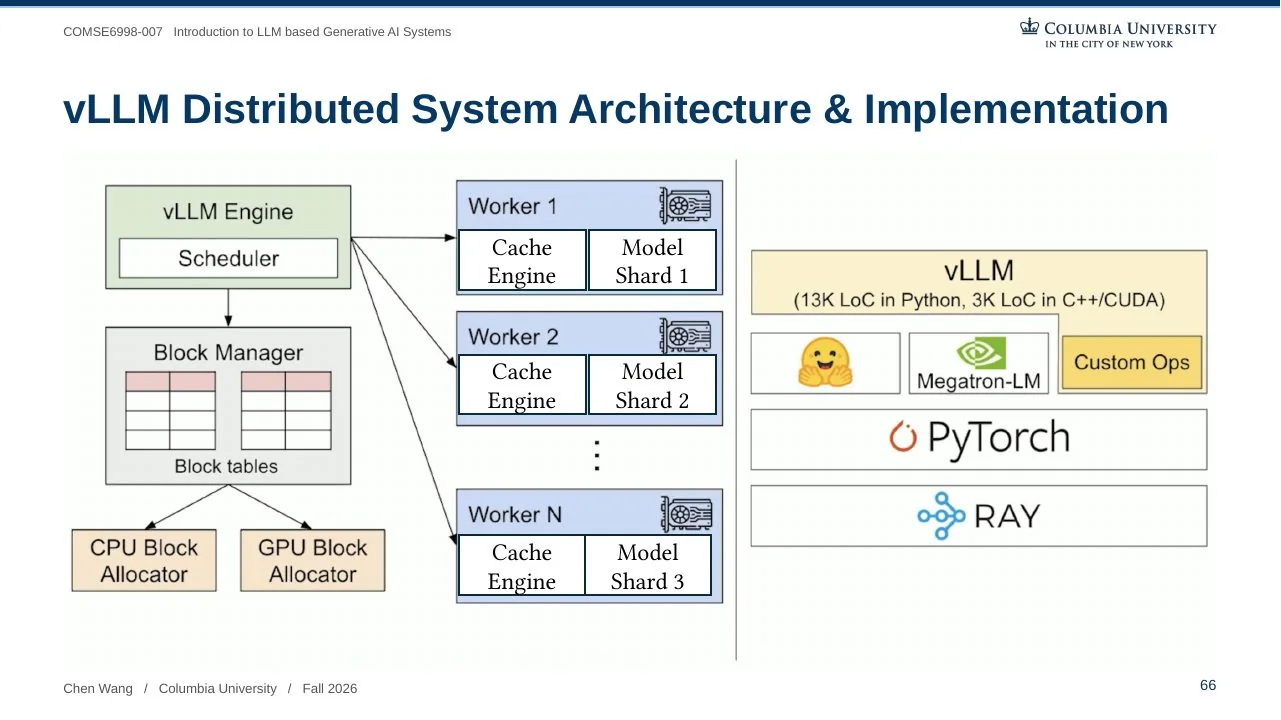
The scheduler must estimate not just batch size but required cache growth. At each step, every decoding sequence needs room for another token. A newly admitted prompt may require several blocks during prefill. If the engine admits too much work, it immediately preempts; if it is too conservative, GPU capacity remains idle.
The vLLM evaluation used instruction-like and conversation-like request distributions, and compared against systems with different batching and cache policies. Reported throughput gains were especially strong for beam search and parallel sampling because prefix sharing eliminates duplicate cache storage. Exact multiples depend on model and workload, but the causal chain is clear:
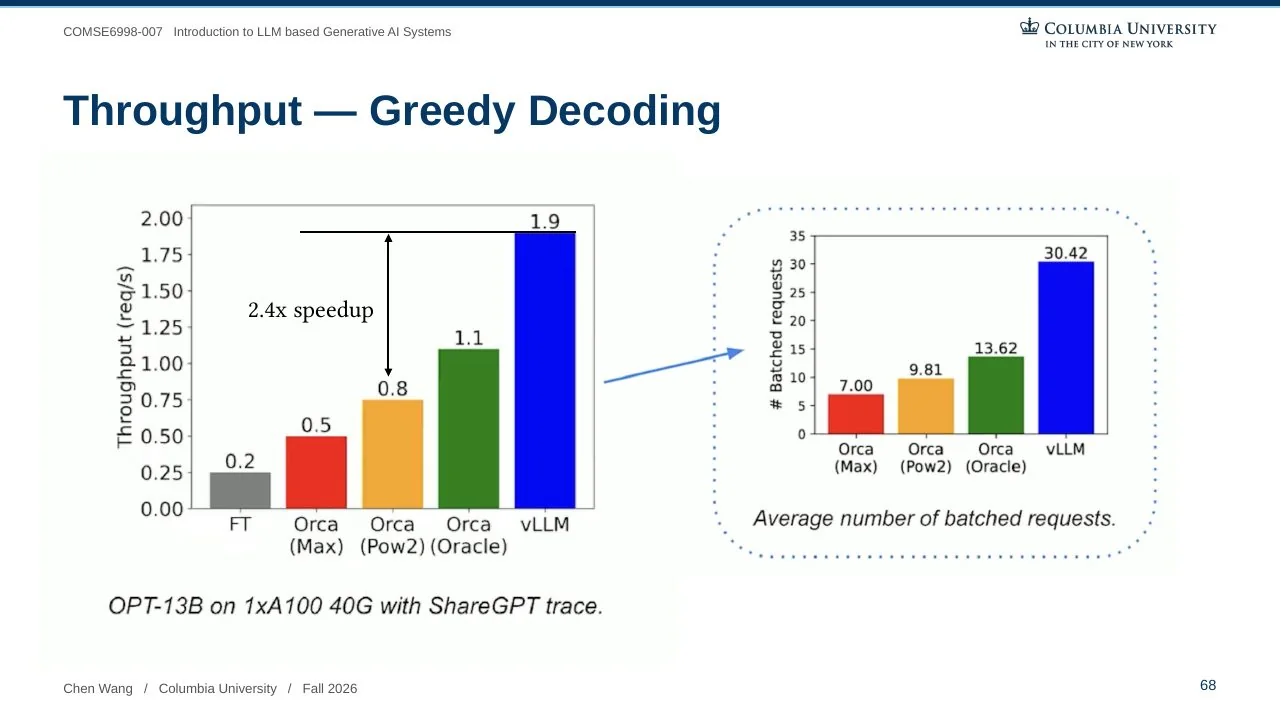
That distinction matters when benchmarking. If two servers use different quantization, maximum sequence length, sampling parameters, tokenizer, or latency target, a raw throughput ratio may not isolate the serving system. A fair experiment fixes model outputs and request traces, warms up kernels, reports percentiles, and records both latency and throughput.
5. SGLang and RadixAttention
LLM Applications Are Programs
A modern LLM application rarely makes one independent call. It may construct a system prompt, ask several questions about the same document, branch into parallel candidates, enforce JSON syntax, call a tool, and then synthesize the results. A serving API that sees only unrelated strings cannot exploit this program structure.
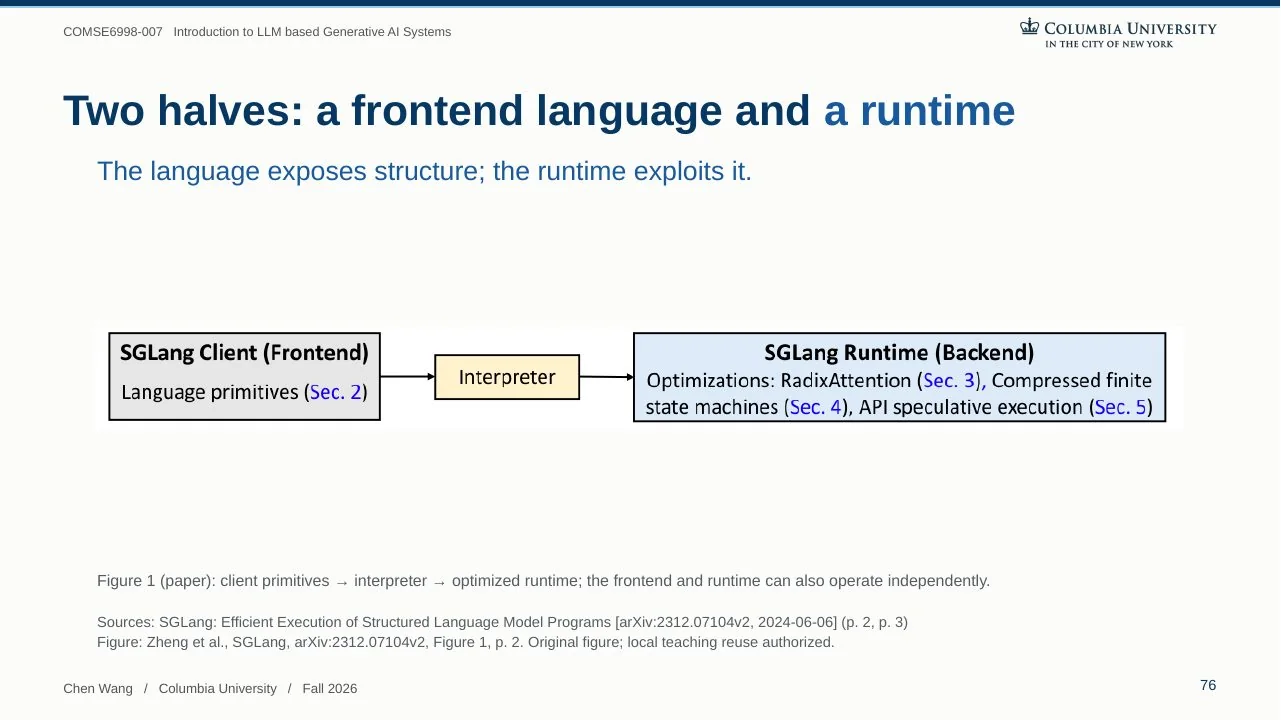
SGLang separates a structured front-end language from an optimized runtime. The program can append text to a prompt state, generate with a regular-expression constraint, choose from candidates, fork states for parallel work, and join results. The runtime sees which calls share a prefix and which output format is constrained.
Common applications repeatedly reuse prefixes:
- few-shot examples shared by many questions;
- system instructions shared across a conversation;
- a document shared across several extraction prompts;
- a tree-search root shared across candidate branches;
- retrieved context reused while testing several answers.
RadixAttention
RadixAttention stores cached prefixes in a radix tree. Each edge represents a token subsequence and each node refers to paged KV-cache blocks. A new request walks the tree to find its longest cached prefix. Only the unmatched suffix needs prefill.
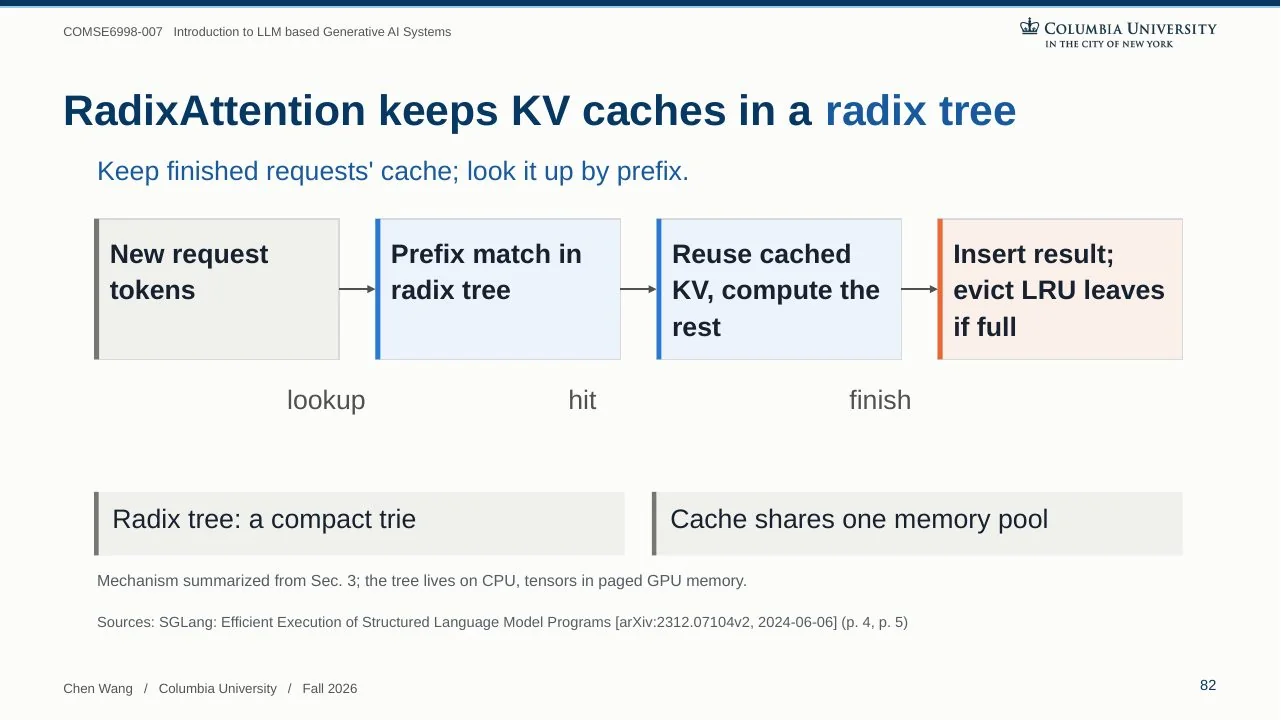
When memory is full, SGLang can evict least-recently-used leaf nodes. A leaf is safe to remove because no longer cached sequence depends on it as an internal prefix. Cache-aware scheduling prefers requests with the longest currently cached prefix; for offline workloads, this tends toward depth-first traversal, completing a subtree before evicting its shared ancestors. Under stated cache assumptions, the paper shows an optimality result for its longest-prefix-first ordering.
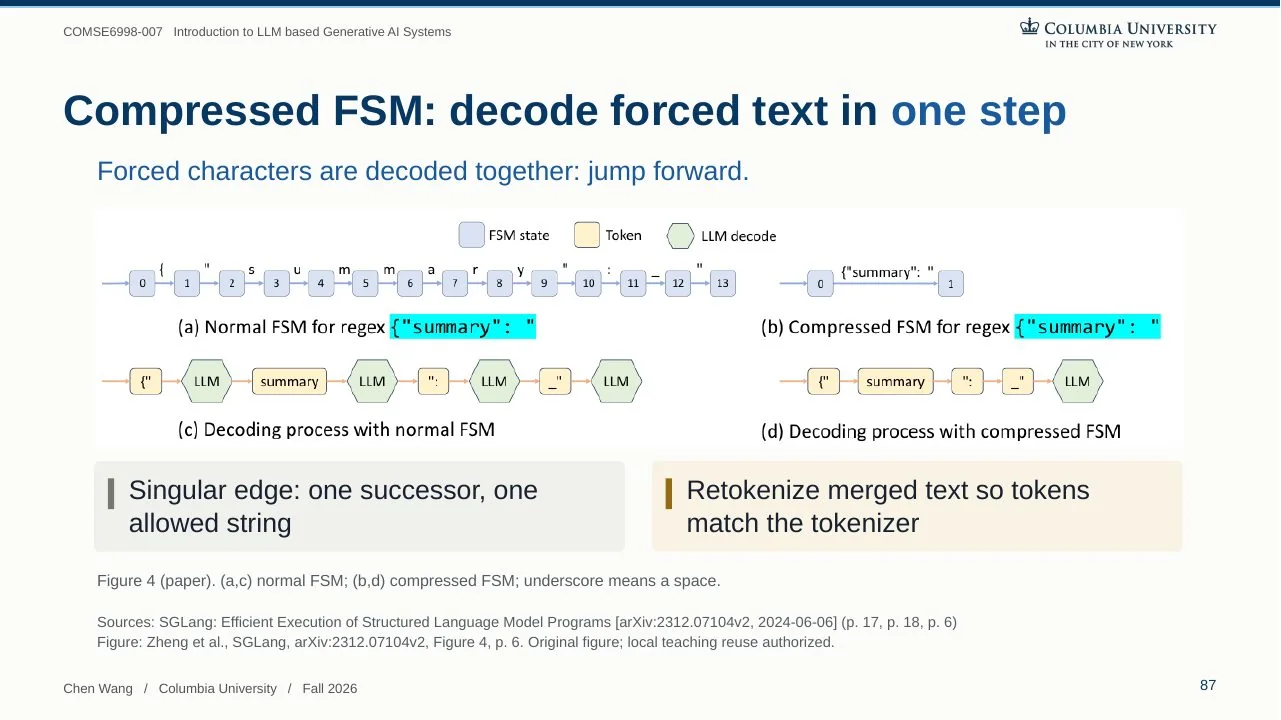
This optimization has limits. A long conversation with almost no reusable prefix across users may gain little. A greedy prefix scheduler can also starve requests with no cache match; online services need fairness or aging. Prefix identity is token-level: two semantically equivalent prompts with different token sequences do not share their cached computation.
Constrained Decoding and Jump-Forward
If the output must satisfy a regular expression or grammar, a finite-state machine can determine which tokens are legal at each step. The decoder masks illegal logits before sampling. A naive system still calls the model for every punctuation mark and fixed keyword. SGLang compresses deterministic stretches of the state machine and jumps forward through forced strings, then retokenizes the combined text to preserve tokenizer consistency.
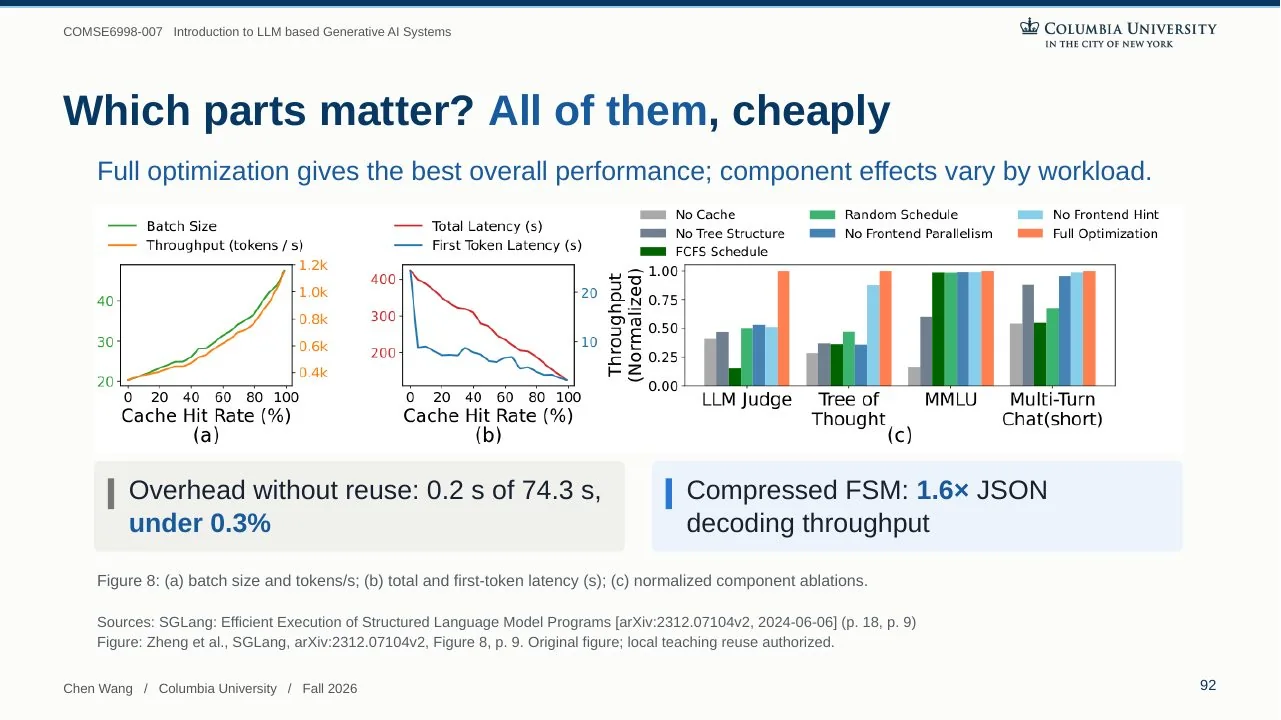
The optimization must be applied carefully when tokenization boundaries or probabilistic choices interact with the forced string. The point is broader than one implementation: the runtime becomes more efficient when it understands the application’s control and output constraints.
Across the evaluated workloads, the SGLang study reported gains up to several-fold over contemporary baselines, with the largest gains on programs containing substantial prefix reuse or constrained output. The right interpretation is not “SGLang is always
6. Serving Thousands of LoRA Adapters
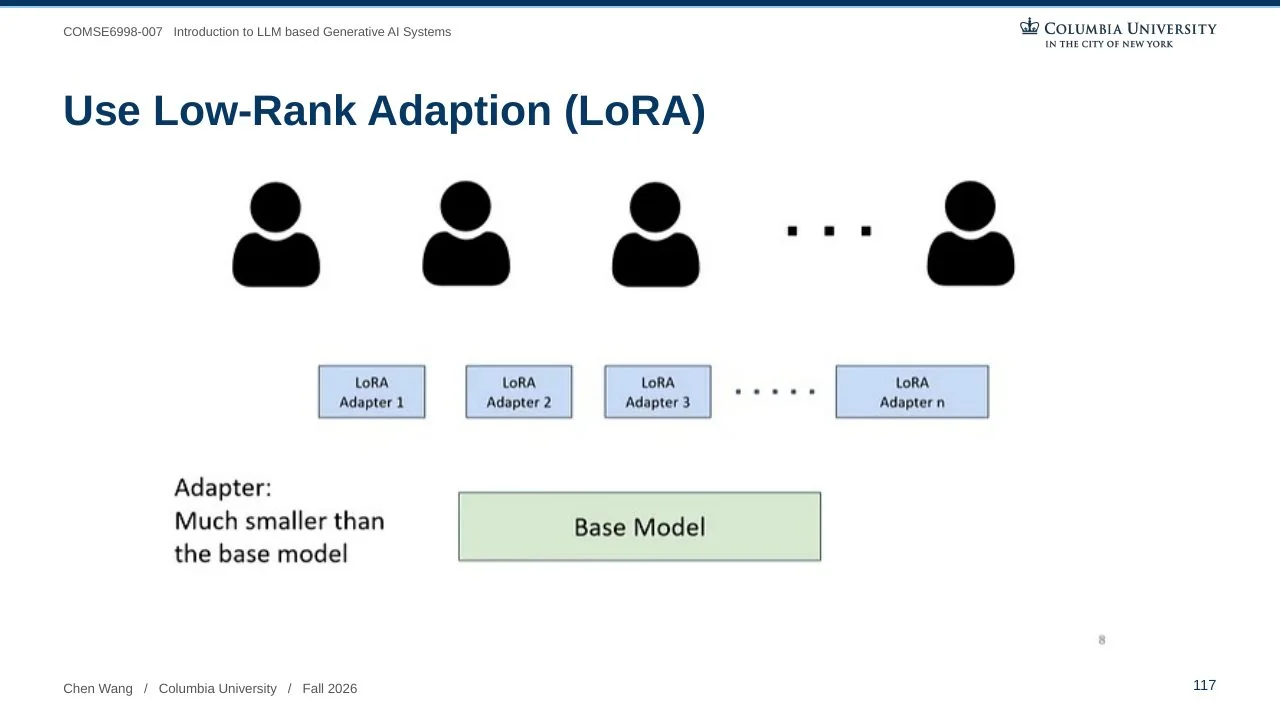
The Multi-Tenant Adapter Problem
LoRA represents a task-specific update through low-rank matrices. With one common convention,
where
One adapter is small, but a service may host thousands. Keeping every adapter on the GPU wastes scarce memory. Loading an adapter from CPU for every request introduces delay. Grouping requests by adapter improves locality but may leave users waiting and shrink batches.
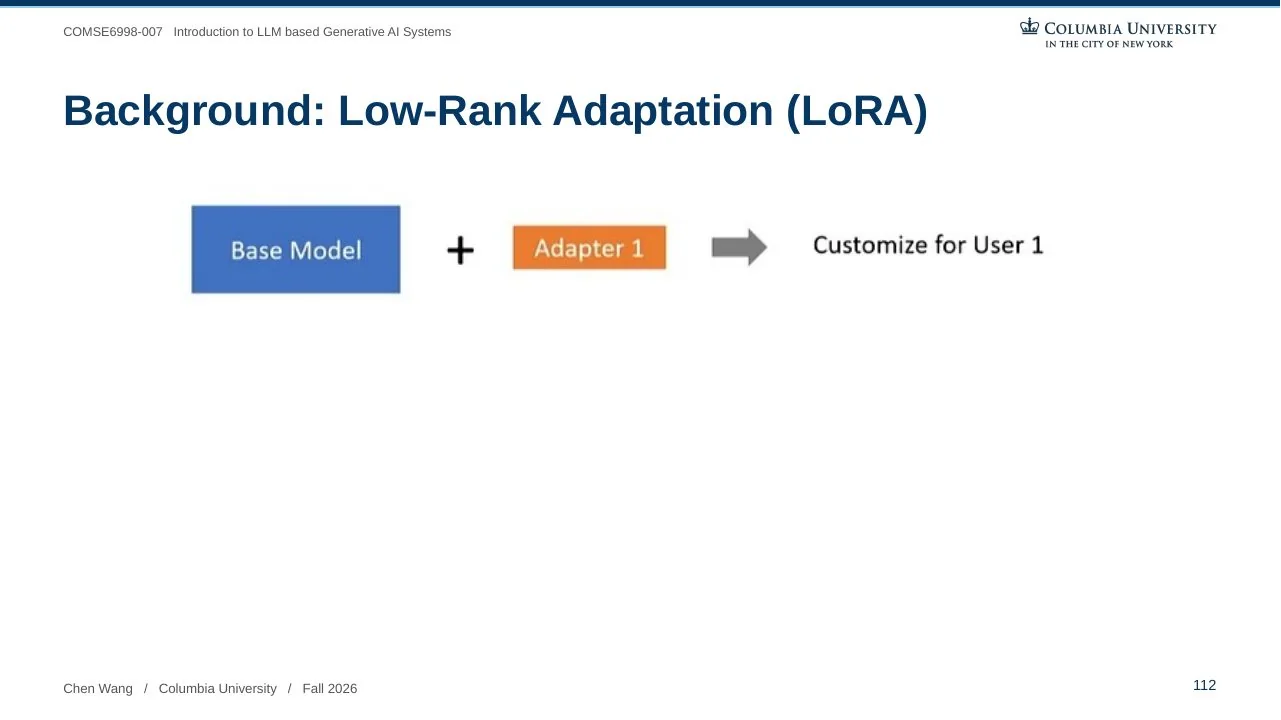
S-LoRA shares one base model and fetches only active adapters. It combines three system ideas:
- Unified paging: GPU memory is dynamically shared between KV-cache blocks and adapter tensors rather than split into fixed pools.
- Heterogeneous batching: requests using different adapters and even different ranks can remain in one batch.
- Custom kernels: the base matrix multiplication is performed for the batch, while small adapter products are gathered and applied efficiently by adapter identity.
For a batch whose examples use adapters
Running
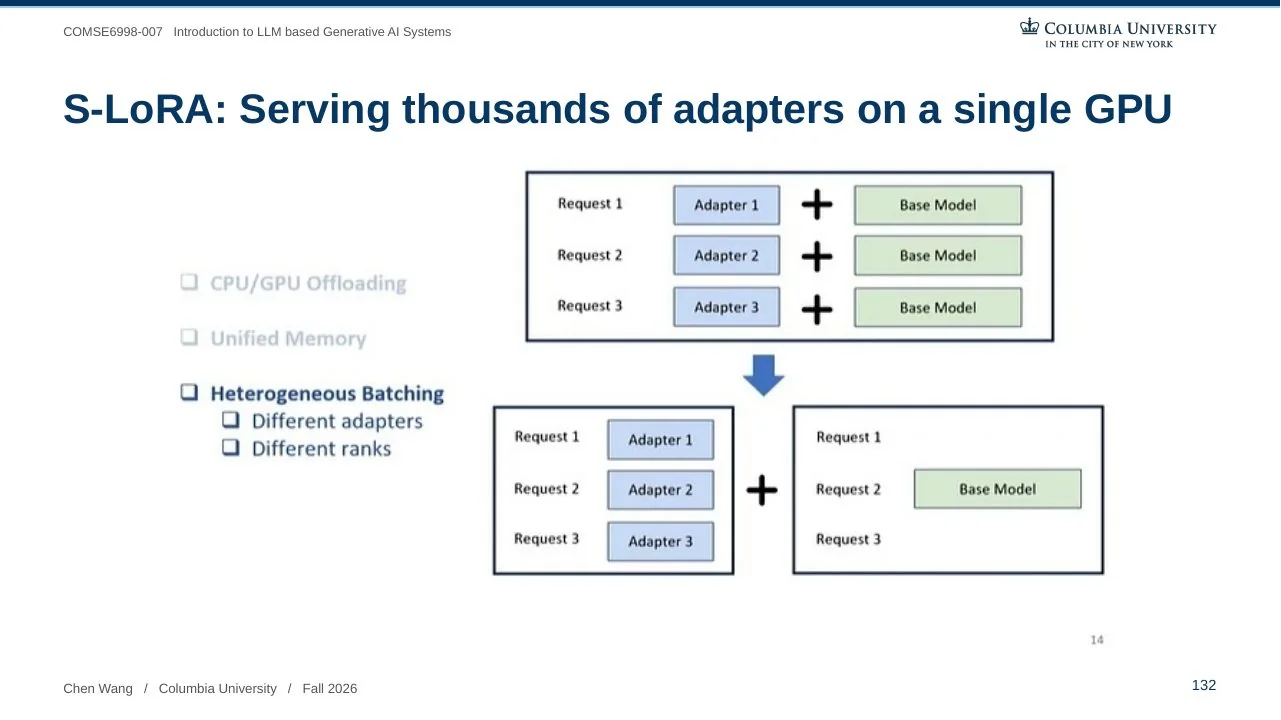
The S-LoRA evaluation reported serving orders of magnitude more adapters than simpler baselines and throughput improvements up to several-fold in its tested settings, while adding small per-token overhead. Capacity depends on adapter rank, base model, CPU memory, transfer bandwidth, popularity distribution, and request length. A production cache should keep hot adapters resident and prefetch when routing makes the next adapter predictable.
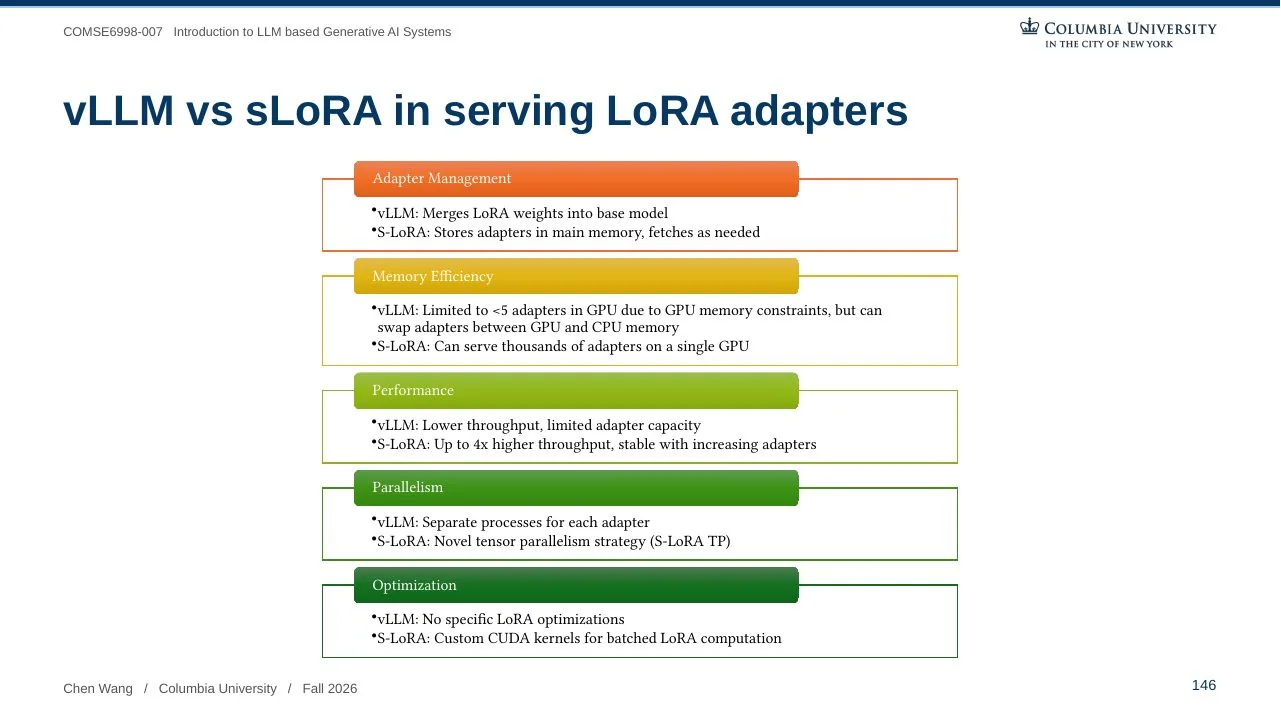
vLLM and S-LoRA solve overlapping but differently emphasized problems. vLLM’s core contribution is efficient KV-cache management for general request serving. S-LoRA specializes the memory manager and kernels for very large adapter populations. Modern systems may incorporate ideas from both rather than force an exclusive choice.
7. Sharing GPUs Safely
Space and Time Partitioning
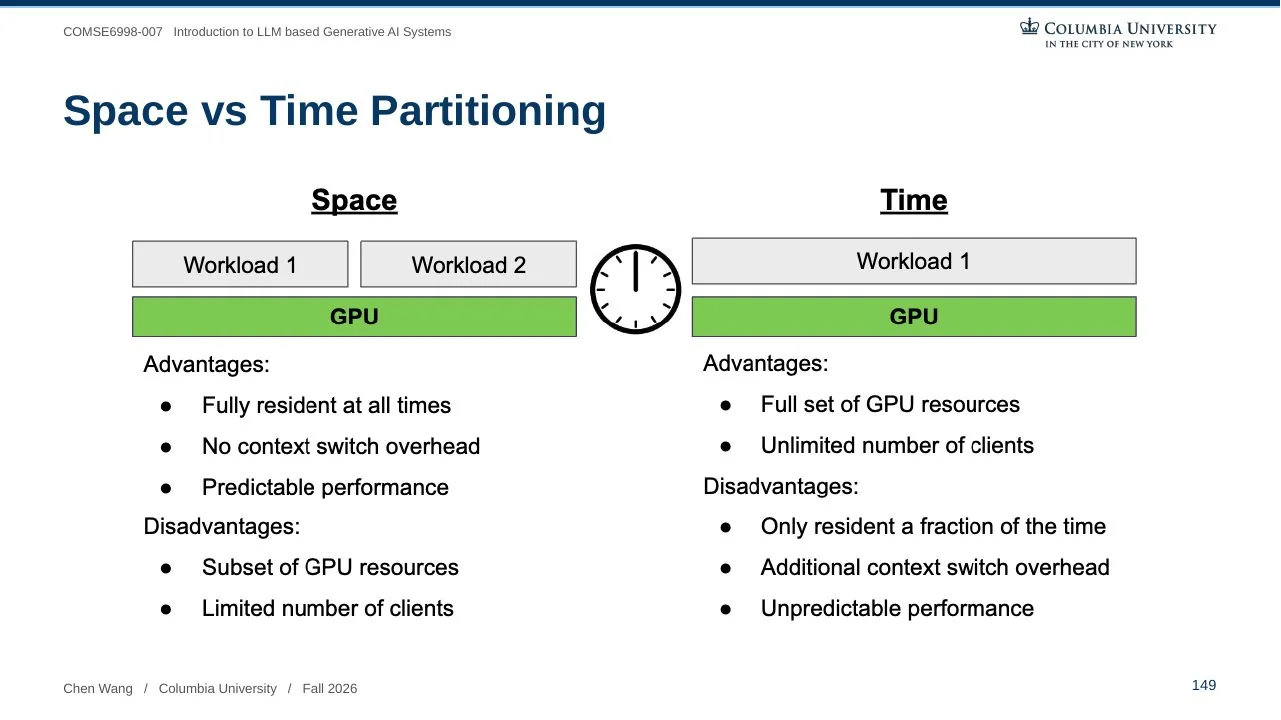
Underutilized models tempt us to place several services on one GPU. There are two fundamental strategies.
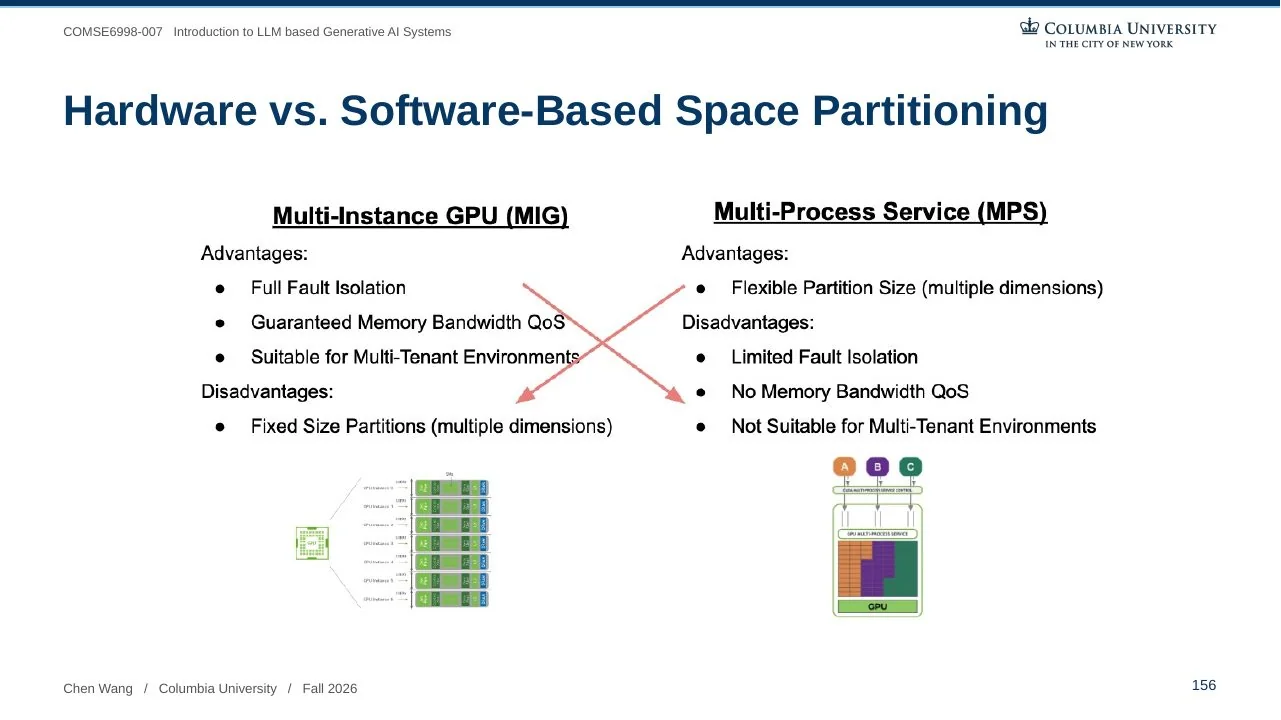
Space partitioning gives each client a subset of GPU resources concurrently. It avoids full context switches and can provide predictable isolation, but each job sees only part of the device and the number of partitions is limited.
Time partitioning gives the full GPU to one client for a time slice, then switches. It can support many clients and lets each one use the full device, but context switching and queueing create latency variation.
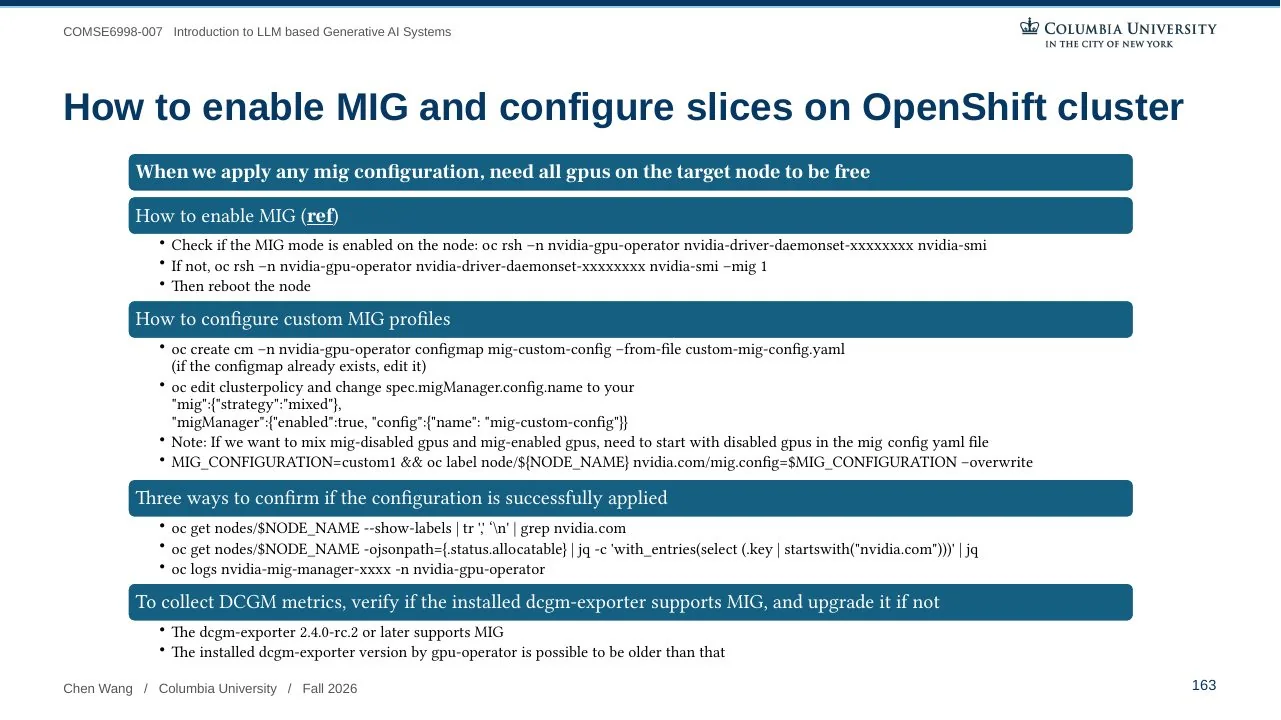
NVIDIA Multi-Instance GPU (MIG) is a hardware-backed space-partitioning mechanism. On supported devices, it creates fixed profiles with dedicated compute and memory resources and stronger fault and bandwidth isolation. NVIDIA Multi-Process Service (MPS) is a software mechanism that allows CUDA processes to share execution resources more flexibly, but provides weaker memory-bandwidth and fault isolation.
This makes the security boundary important. MPS may be reasonable for trusted services belonging to one team. Stronger physical partitioning is preferable when tenants are mutually untrusted or when predictable memory bandwidth is part of the SLO.
Partition Size Is a Queueing Decision
A small model under light concurrency may meet its latency target on a small MIG slice, freeing the rest of the GPU. As concurrency rises, the same slice creates a queue and loses throughput. Course measurements for FLAN-T5-XL and Mistral-7B illustrate the pattern: smaller profiles can be economical under light load, while larger profiles become necessary beyond particular concurrency ranges. Those thresholds are workload-specific.
A robust autoscaling policy should observe arrival rate, token lengths, TTFT percentiles, ITL percentiles, cache pressure, and preemption—not only GPU utilization. High utilization can mean efficient batching or an overloaded queue. Low utilization can mean overprovisioning or a decode workload starved by insufficient batch size.
8. Benchmarking a Serving System
Serving comparisons are easy to distort accidentally. Before interpreting a throughput graph, check:
- Same model and precision: quantization or a different architecture changes both memory and speed.
- Same input/output distribution: fixed 128-token outputs and real chat traffic stress different components.
- Same decoding policy: beam search, sampling, speculative decoding, and constrained decoding do different work.
- Same latency constraint: unlimited batching can inflate throughput while making interactive users wait.
- Warm-up and steady state: compilation, cache population, and initial transfers should be reported separately.
- Percentiles, not only means: p95 or p99 exposes queueing tails hidden by averages.
- Correctness parity: a fast system that truncates, changes sampling, or violates constraints is not equivalent.
Little’s Law provides a useful consistency check. If average throughput is
If a report claims high throughput and low latency under a fixed concurrency but these quantities are inconsistent, inspect what is being counted: tokens rather than requests, successful rather than submitted jobs, or server time rather than queueing plus server time.
For streaming generation, approximate end-to-end latency as
where
9. Design Checklist
The methods in this blog form one connected stack:
- continuous batching reuses finished batch slots;
- FlashAttention reduces attention’s slow-memory traffic;
- KV caching prevents repeated prefix computation during decode;
- PagedAttention removes most cache fragmentation and enables sharing;
- vLLM integrates paging with scheduling and distributed workers;
- SGLang exposes program structure, prefix reuse, and output constraints;
- S-LoRA serves many adapters without breaking batching;
- MIG/MPS/time sharing decide how several services share the physical accelerator.
When designing a deployment, begin with the workload rather than the framework name. Measure prompt and output lengths, concurrency, prefix reuse, adapter popularity, latency objectives, and trust boundaries. Then decide which loss is actually dominant.
The central systems lesson: LLM inference is often limited less by the number of arithmetic operations than by when data moves, where state lives, and whether unrelated requests can share useful work without violating isolation.
References
- Yu et al., Orca: A Distributed Serving System for Transformer-Based Generative Models .
- Dao et al., FlashAttention: Fast and Memory-Efficient Exact Attention with IO-Awareness .
- Kwon et al., Efficient Memory Management for Large Language Model Serving with PagedAttention .
- Zheng et al., SGLang: Efficient Execution of Structured Language Model Programs .
- Sheng et al., S-LoRA: Serving Thousands of Concurrent LoRA Adapters .
- NVIDIA, Multi-Instance GPU User Guide .
- Title: LLM 7 - Efficient LLM Serving
- Author: Gavin0576
- Created at : 2026-10-23 18:00:00
- Updated at : 2026-11-01 07:06:21
- Link: https://jiangpf2022.github.io/blog/2026/10/23/LLM-7-Efficient-LLM-Serving/
- License: This work is licensed under CC BY-NC-SA 4.0.