Robotics 1 - Rigid-Body Transformations

Rigid-body transformations describe the same point from different coordinate frames. The calculation always reduces to rotation, translation, and the order in which they are composed.
2D Transformations
Translation and Frames
A frame has an origin and orthonormal axes. If a point is written in frame
The notes write translation in its dimension-independent 3D form:
In 2D, simply remove the
Rotation Matrix
A counterclockwise rotation by
Its columns are the rotated coordinate axes. They are orthonormal, so
Planar rotations commute:
Nested Frames
Let frame
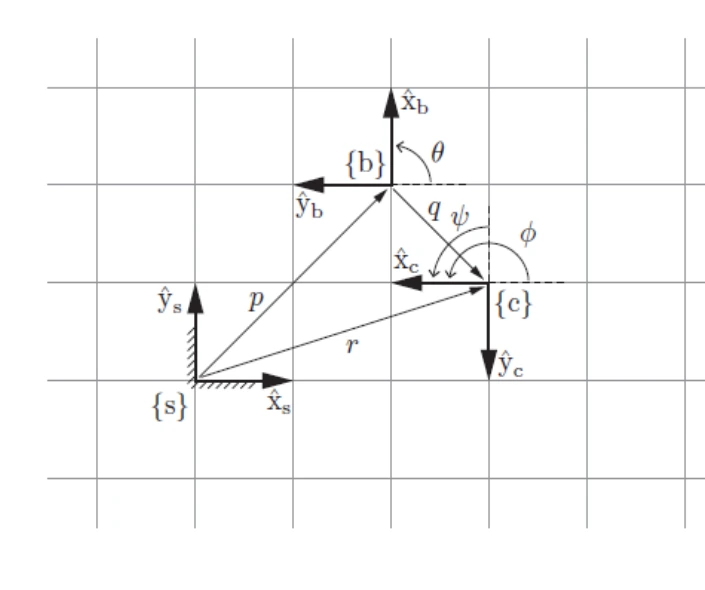
Then
The key rule is that vectors must be expressed in the same frame before addition.
Homogeneous Transform
Appending a
Thus
Composition Order
For
Reversing the order changes the translation term, so
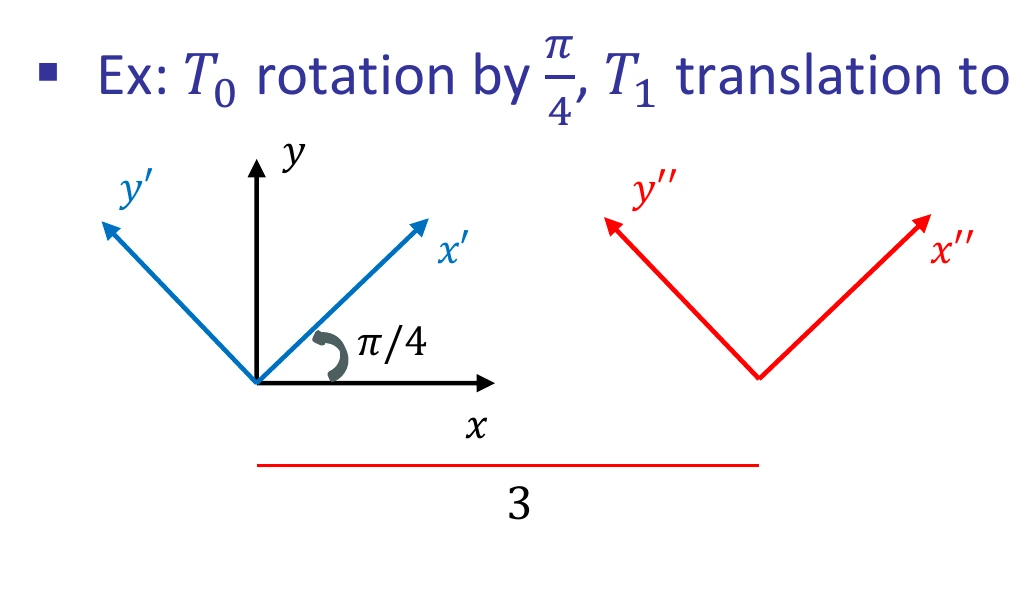
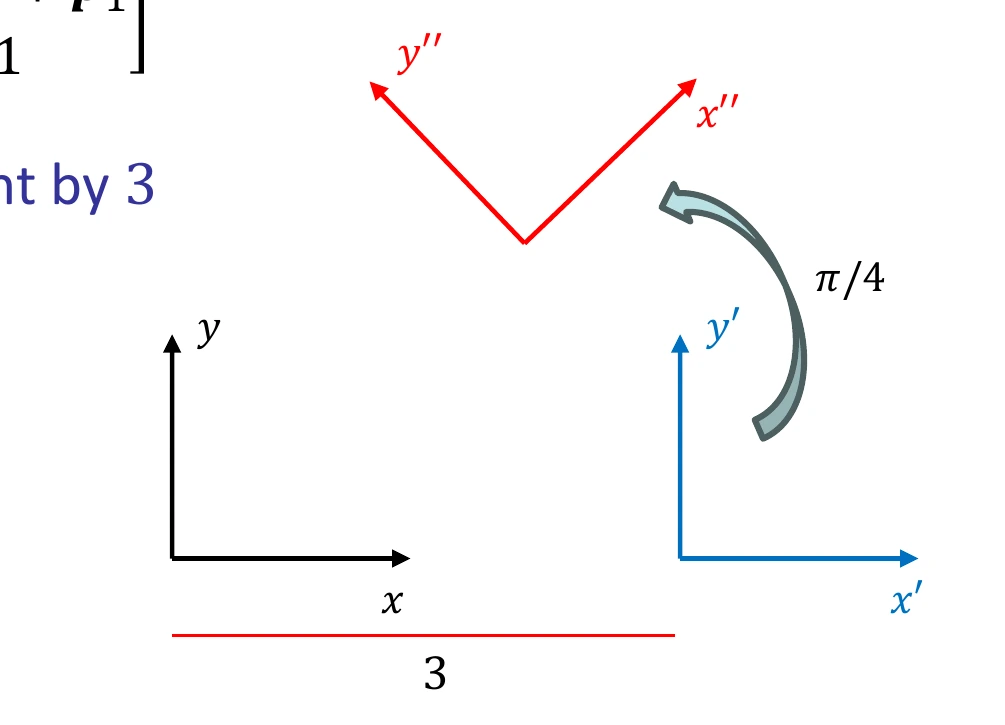
With column vectors, the rightmost matrix acts first.
3D Transformations
Principal-Axis Rotations
Using the right-hand convention,
As in 2D,
Right-Hand Rule and Order
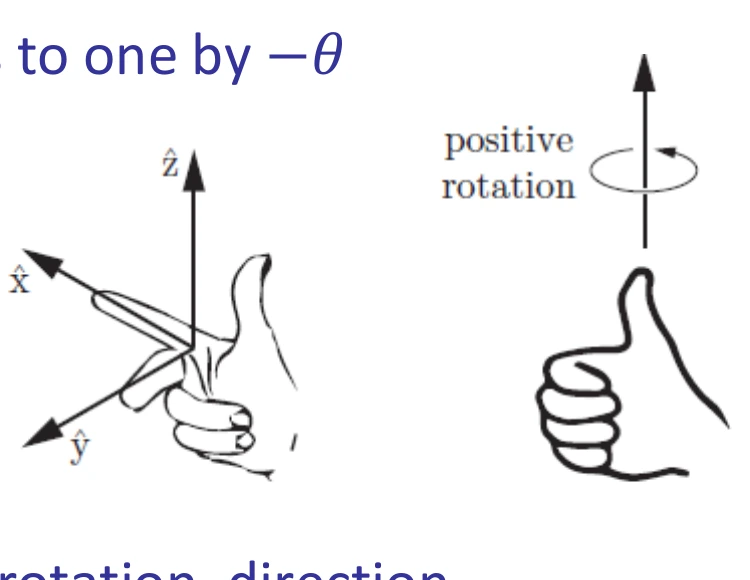
Unlike 2D rotations, rotations about different 3D axes do not commute:
Therefore a rotation sequence must specify both the order and whether the axes are fixed or moving.
Homogeneous Transform
A 3D rigid-body transform is
Applied to a point,
Again, rotation happens first and translation second.
Frame-Label Composition
Let
Valid chains cancel their adjacent frame labels:
- A new motion expressed in the fixed/world frame is pre-multiplied.
- A new motion expressed in the current/body frame is post-multiplied.
Camera–Robot–World Example
Let
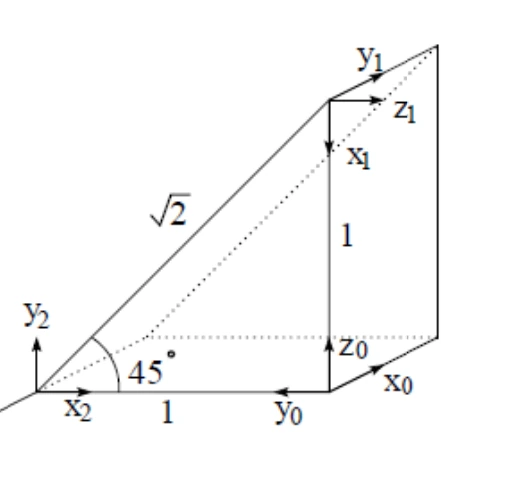
The lecture gives
The adjacent
This is the practical workflow for every frame problem: label each transform, cancel adjacent frames, and then multiply in that order.
Cover photo: Ajay Suresh / Wikimedia Commons , licensed under CC BY 2.0 . The cover has been resized for layout.
- Title: Robotics 1 - Rigid-Body Transformations
- Author: Gavin0576
- Created at : 2026-09-13 22:40:54
- Updated at : 2026-09-14 03:56:15
- Link: https://jiangpf2022.github.io/blog/2026/09/13/Robotics-1-Rigid-Body-Transformations/
- License: This work is licensed under CC BY-NC-SA 4.0.