MATH113 Introduction to Abstract Algebra

Lecture 1
Warm-up
Lecture 3
Warm-up
False,
False,?
- Describe
as a subset of .
, the last digit is in base
Notation
Z/nZ: Act II
Remark:
Proposition
Proof
claim 1
if
Let
then,
claim 2
if
We prove by contradiction:
assume
then,
According to
Since a and b are integers, we have
and since we have,
which caused a contradiction, and it should be
claim 3
Every
Proof:
By
By
(Z/nZ,+)
Q: How to “add”
A:
Proposition 2
Addtion is correctly define on
Proof:
Lecture 4
Warm-up
For which a,b holds:
2.For which a,b holds:
Groups
(Z/nZ,+)
(Z/nZ,
Warning:
Definition of Group
A group
PS: sometimes,
Q: Why “groups”?
A1:
Q: What to do now?
A2:
Homomorphism
Definition of Homomorphism
A homomorphism from
like
Lecture 5
Warm-up
1.
Ans:
2.Solve for
3.What did we cover last time in class?
Groups:Basic Properties
Proposition
Identity element e is laways unique in any group G.
Proof. By contradiction
which caused a contradiction
Proposition 3.18
Proof: By contradiction
which caused a contradiction that
Proposition 3.19
For any
Proof:
Proposition 3.20
Proof:
Cor(Prop 3.21)
For any
Proof:
Proposition 3.22
Proof:
Subgroup
Lecture 6
Warm-up
How many different ways to put
Ans:
Symmetric Groups
Definition of Symmetric Groups
Let
Operation on
“composition
Proposition
Examples:
Q:How to think about elements of
A_0: functions which are bijective.
A_1:
the first row: original set, the second row: image of
A_2: “strings”
Example:
Q: composition via strings?
“
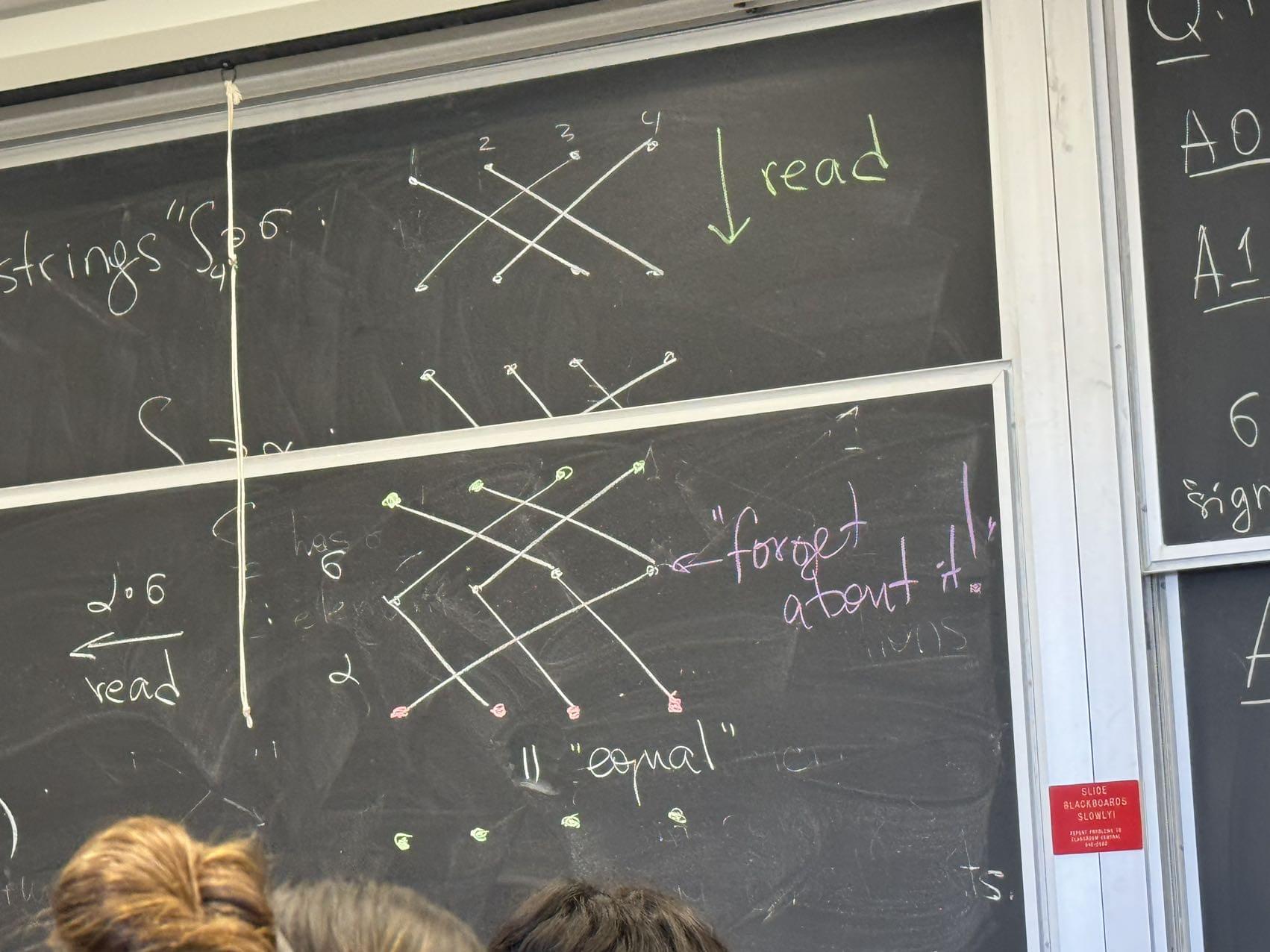
A_3: cycles presentation
Example:
Inverses
just flip it
Lecture 7
Warm-up
1.Prove that
Proof:
1.Associativity:
2.Identity:
0 serves as the identity, since
3.Inverses:
Every element have inverses. Inverse of
2.How to find new examples of groups?
We can explore new groups by identifying subgroups of existing groups. Utilizing Existing Group Structures:
By adding constraints to existing groups, such as restricting certain properties (e.g., determinant = 1 for matrices), you can form new groups. The example of
Subgroups
Definition of Subgroups
About restrictions of functions:
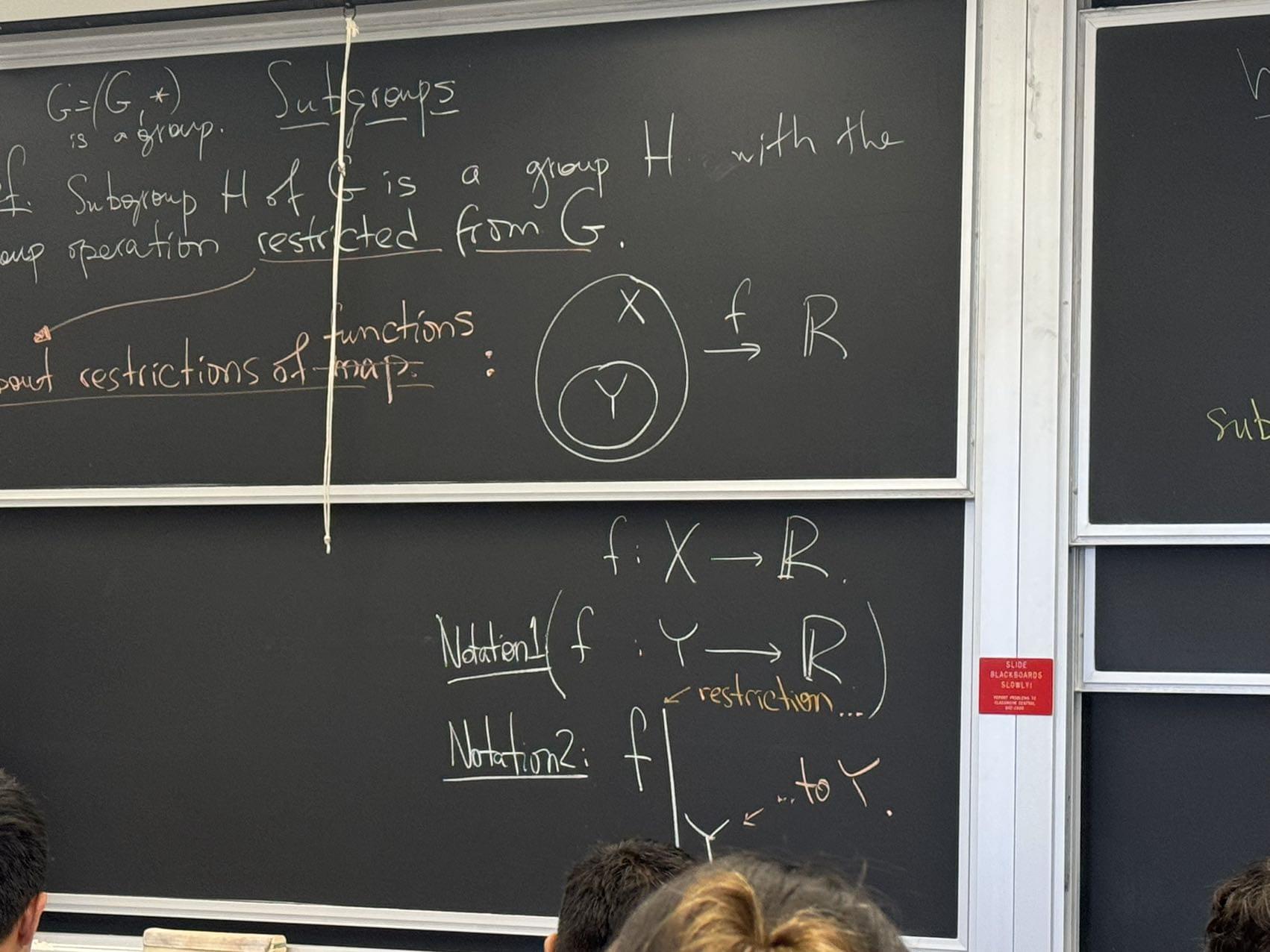
Back to Subgroups:
Examples:
For every
Definition
Subgroup diagram of a group
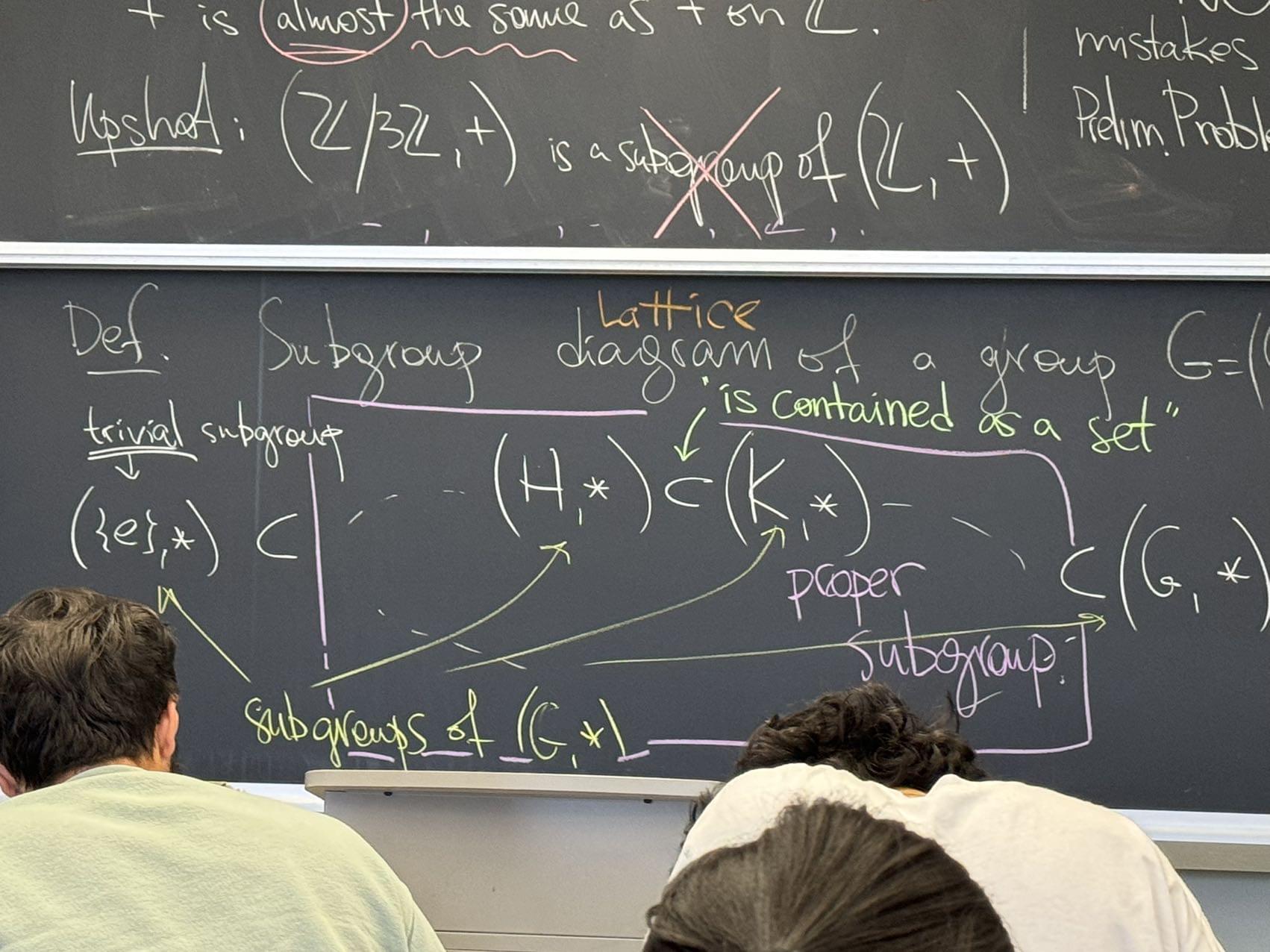
Definition of Proper Subgroups
Proper subgroup of
Proposition 3.30
1.(identity of subgroup)
2.(closure of the group operation)if
3.(closure of inverses)if
Proposition 3.31
Proof:(follows from 3.30):
Cancellation law on the right,
Lecture 8
Warm-up
Find all subgroups of 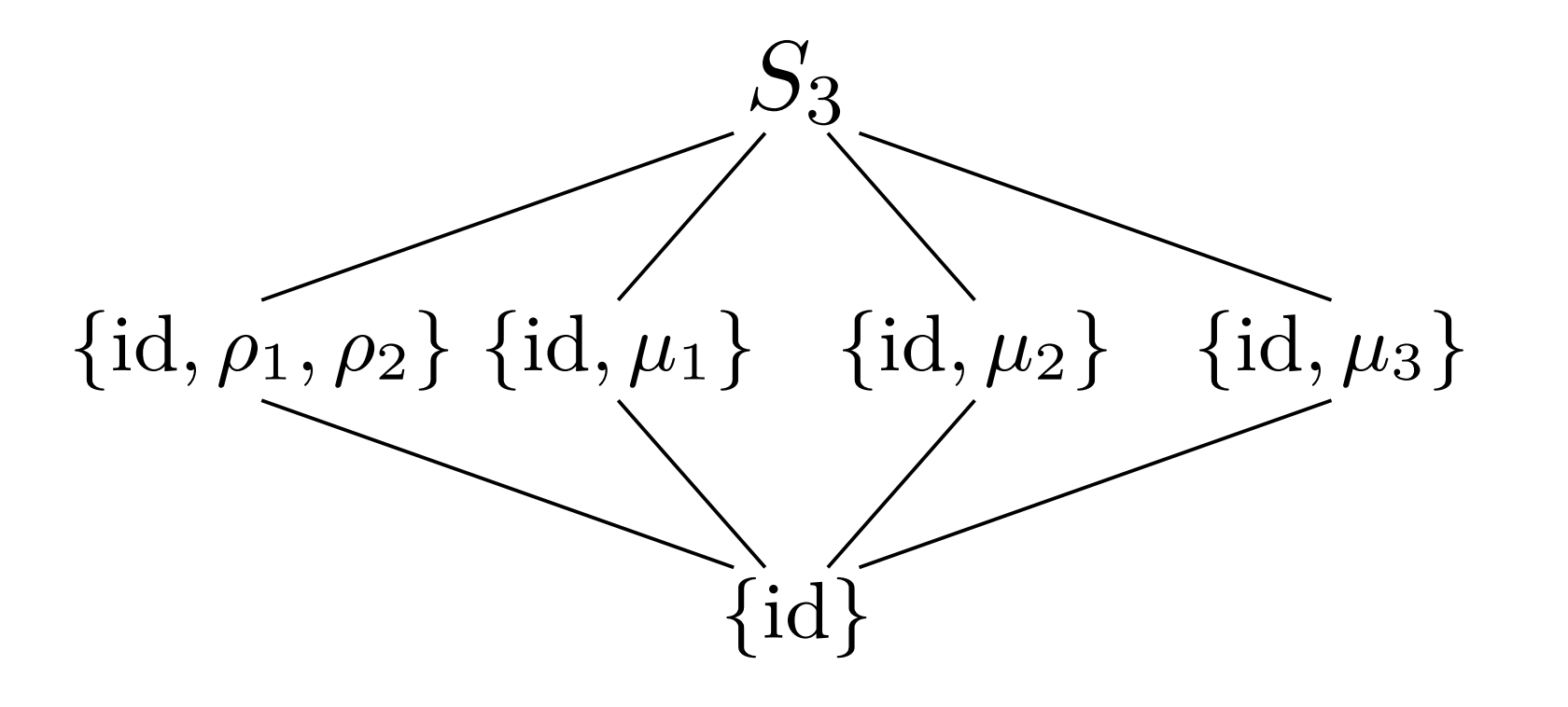
Notation
if
Cyclic Subgroups
if
Definition
Lemma
Proof. By Prop3.31
if
Theorem 4.3
Proof:
$$\forall k \in Z, a^k \in H, \text{then} \leq H$$
Therefore $
Definition
Notation:
Examples:
Definition
Example ?
Theorem 4.9
Every cyclic group is abelian,
Lecture 9
Warm-up
Maybe it’s not.
If
which is not true obviously.
Isomorphism
Definition
Isomorphism is bijective homomorphism.
Example: 
Prop 11.4
1.
2.
3.if
3’. as
4. if
Proof.
1.
2.
3.
4. Let us consider
Prop 3.31:
Definition
Kernel of
Lecture 10
Warm-up
Reformulation:
Coset
Definition
Lemma6.3
The following are equivalent(1-3 therioticallt useful, 4 griginal warm-up, 5 How to use this lemma for actual
Q: Why do we need cosets?
Theorem 6.4
H-cosets partition G: we can find
Example:
Explain Theorem 6.4 in this case: what are these
Reminder: originally,
The set of equivalence classes:
Set of equivalence classes for the equivalence relation
Theorem 6.10
Lagrange’s Theorem
Cor 6.11
Lecture 11
Warm-up
Are
Also,the number of elements in
Therefore, as isomorphic groups must have the same structure and element orders,
1.
2.
3.
Isomorphisms
Definition
Isomorphism is bijective homomorphism.
Examples:
Q:injective?
eg.
proved
Q:surjective?
Theorem 9.7+9.8
If
Thm/Prop
(External) Direct Product
Idea: every “object” is easier when it’s decomposed into smaller simple pieces.
Definition
Lecture 12
Warm-up
1.What subgroups of
every subgroup of
2.Where (0-100) the median( and average) should be for fair grading?
80
Normal Subgroups and Factor/Quotient groups
Definition
iff
Corollary
if
Proof:
Q: Why do we need the definition of normality
Idea:
such that
Problem: if
How to deal with such sits? Whether
or not.
(Remark:
First Isomorphism Theorem
Definition
if

Theorem
if
(
Sketch of Proof:
is normal,
2.To find
Lecture 13
Warm-up
Prove that
Proof.
define a map
1.injective
2.surjective
all of the elements in
3.homomorphism
Correct Proof.
By theorem9.27,
Direct Products
External:
Internal:
Definition
1.
2.
3.
Theorem
if
(
Proof.
Let’s consider
Q: is it well-defined?
A:
Q:homomorphism?
+surj+inj
Lecture 14
Warm-up
is
My answer:
No. Prove by contradiction
if it is finitely generated,
Now, consider
Ans:No
Hint: use induction on m
Abelian World
Fundamental Theorem of Finite Abelian Groups
Every finite abelian group
Examples:
Exercise: why?
Proof of the theorem from Milne,Group Theory
“Nonconstructive proofs”: “Assume the opposite” :
$x_1 \in G, Z/p_1^{\alpha_1} =
Lecture 15
Warm-up
What is a symmetry of structure? What is structure?
Structure: Structure refers to the set of rules and relationships that govern the elements within a mathematical object. Structure is typically defined by the elements themselves and the operations (such as addition, multiplication) between them, along with the axioms that these operations must satisfy. For example, the structure of a group consists of a set and a binary operation defined on that set, which must satisfy associativity,identity and inverses.
Symmetry of structure: Symmetry refers to transformations that preserve the structure of an object. These transformations are often referred to as “automorphisms,” which are bijective mappings from the object onto itself that preserve its operations. For instance, in geometry, rotating or reflecting a square preserves its shape, and this is an example of geometric symmetry. In algebra, automorphisms of a group are symmetries of the group structure, representing permutations that preserve the group’s operation properties.
Scenario1
A: 
“some situations”=”symmetric situations”
Lecture 16
Review for Midterm I for Group Theory
Groups:abelian, non-abelian
Notation:
Sets:
abelian groups:
non-abelian groups:
Lecture 16
Warm-up
what is
Ans:coordinate, usually
Then, what about
Abstract Linear Algebra
Permutation Groups
Definition
Permutation group G (on a set
Example:
for any - (last Friday Reading assignment) Cube thing,
symmetries of the cube.

Definition
Proposition
Back to Midterm: proper non-abelian subgroup of
Definition
Reminder: “
Example2:
Q:What are the
Theorem
if
Lecture 17
Warm-up
1.
My answer:
2.
My answer:
Group Actions
Definition
“
1.
2.
Examples:
Proposition
“
Proof.
bijection=injective+surjective
Claim:
assume
Proposition
intuition: “
Lecture 18
Warm-up
1.What is
2.What is
3.What is
Answer:
1.
Choice:
2.
Group Actions
Proposition
if
By First Isomorphism Theorem for (for
Back to Warm-up:
3.
Definition
Theorem9.12
Every group is isomorphic to a group of permutations
Sketch of proof:
(Same as for
Lecture 19
Warm-up
How many different colorings of a square are there?
My answer:6 or 16
Burnsides’s Lemma
Theorem
Remark:
Problem: let’s consider the same square and
a:2013 colors
b:201320132013 colors
How many different coloring do we have?
if two colorings are different by isometry(rigid motions=rotations+reflections) of the square, they’re same.
Idea:Let’s consider situation with
| Header1 | Header 2 | Header3 | Header 4 |
|---|---|---|---|
| id | Header 2 | H | Header 4 |
| n | V | ||
| Row 2 | Z | ||
| Row 3 | Y |
X=Set of al possible colorings of the square with
all:
so the
Lecture 20
Warm-up
Functions-why?How?
compute:
Motivation for Rings and Fields
Idea: Sometimes we need arithmetic not only with
| Header1 | |||||
|---|---|---|---|---|---|
| Set | |||||
| +/- | 1+1=2,2-3=-1 | 1.2+1.2=2.4 | usual addition | addition of matrices | |
| Multiplication | you disturbute them | multiplication of matrices | |||
| Division | almost never | sometimes | almost always | divisor of polynomials | ?not sure |
| Division Algorithm | division algorithm for polynomials | Do Not commute | |||
| Divisors | ? | / | divisor algorithm for polynomials | ||
| Prime Numbers/gcd | ?(ideals) | / | Irreducible polynomials | ||
| Euclidean Algorithm | gcd(a,b)=ca+db | ?(ideals) | / | Euclidean algo for polynomials |
Lecture 21
Last Lecture
Arithmetic,sets+operations
polynomials:division of polynomials.some results from
HW.Problem1
Rings and Fields
Definition
Ring is a set
Reformulation:
Example:
Q:
for
for
Definition
Field is a ring
Lecture 22
Warm-up
units of
Definition
A unit
Definition
Definition
A Zero divisor is an element a s.t.
Proposition
For any ring R,
Proof,
on the contrary,
Goal:
| R | Unit of R | Zerodivs of R | else |
|---|---|---|---|
Proposition 16.15
If
Theorem 16.16
finite
integral domain
field
Exer:
Lecture 23
Question: find a ring
My answer:
- det(M)=1
invertible - 0
- non-zero but not invertible
Answer:
Division Algorithm for Integral Domains
Theorem 1.1
For any
eg. 51=6*8+3(a=bq+r)
Theorem 1.2
For any
Example.
Cor(Euclidean Algorithm)
You can compute gcd of 2 polynomials using Thm1.2
Gaussian Integers
Theorem 1.?
for
example:
Lecture 24
Homomorphisms and Ideals
First Isomorphism Theorem:
First Isomorphism Theorem:
Definition
Isomorphism
Examples:
Prove that
Proof.
Definition
(analog of a normal subgroup in Group Theory)
Ideal:
a.additive subgroup
b.
Intuition:
Therefore ,
By axioms,
for b:Fact:
Q for First Isomorphism Theorem for rings: what is
Definition
A quotient of
(12)(45)(37)
LCM(2,3)=6,LCM(2,3,4)=12,LCM(2,5,8,10)=40
Lecture 25
Warm-up
prove that
are rings but not fields.
My answer:
- abelian group
- associative for
- distributivity
- identity for “+” and units for “
”
Answer:
1.
but it is not field(
2.Z[-5]
Z[-5]- integral domain
Lemma
there no
Proof1.
Assume there exists
Proof2.
Lemma
Proof.
Opposite:
Geometric idea:
Proposition
Units in
so we have
Definition
(
Definition
(
(only divisors of
Lemma
3 is not a prime in
3 is irreducible in
Proof.
Then we assume
Lecture 26
Burnside’s Lemma
Problem1
Q:How many orbits? via Burnside’s Lemma.
$\frac{1}{24}(4+62+81)=1$
Problem2
Q:How many orbits? via Burnside’s Lemma
$\frac{1}{24}(16+64+81)=2$
Lecture 27
Homomorphisms and Ideals
| Group Theory | Ring Theory | |
|---|---|---|
| First Homomorphism Theorem | ||
| What is this isomorphism | ||
| Operation | ||
| Why do I talk about equivalent classes | ||
| functions | ||
| Corollary:Canonical Decomposition of Homomorphisms | ||
| {Kernels of homomorphisms of groups}={normal subgroups} | {Kernels of homomorphisms}={ideals} |
Proposition
Proposition
what is happening here?
1.
2.
Lecture 28
Warm-up
Is
Ans:
Homomorphisms and Ideals III
Reminder:First Isomorphism Theorem for rings:
fix
Question for 11/13:
When
Question for 11/15:
When
Proposition
Proof. Let’s
if
if
Reminder: from definition of ideal,
from Preliminary Problem 1, if
so we have
proved
Definition
Theorem 16.35
Idea: the key tool is Second Isomorphism Theorem.
Second Isomorphism Theorem(16.32)
if
So the field
Example:
Proposition
Proof. opposite
for
Lecture 29
Warm-up
1.Why
2.What is
3.If
My Answer:
1.
2.
3.
Step1: Take
Step2: As
Homomorphisms and Ideals IV
Reminder:
Lemma
Definition
Proof of the Lemma:
Theorem16.38
Proof:
$[0]{R/I}=I=0_R+I
Corollary
Every maximal ideal is prime. However, in general,
Example:
Last time:
Lemma
Lecture 30
Warm-up
1.Find all ideals
2.Find all ideals
3.Why
Ans:
- additive subgroup and
, where
ideals ingraph TD; id2["(2)"] --> id6["(6)"]; id2["(2)"] --> id10["(10)"]; id3["(3)"] --> id6["(6)"]; id3["(3)"] --> id15["(15)"]; id5["(5)"] --> id10["(10)"]; id5["(5)"] --> id15["(15)"]; id6["(6)"] --> id30["(30)"]; id10["(10)"] --> id30["(30)"]; id15["(15)"] --> id30["(30)"];
Homomorphisms and Ideals V
Definition
Remark: if in
Definition
Example:
Proposition
a.
b.
proof. 2 for a:
1 for a :
Definition
Notice that
However, here the definition of multiplication of ideals,
Proposition
- $
\cdot = $
Lecture 31
Warm-up
why ideals are not scary?
1.Find
2. When $ \subseteq <b,c>?
Ans:
, the only condition is for some for some
Arithm
Lecture 28:toward gnosis
Lecture 29:kairos of arithmetic
- Hw10: Arithmetic Epiphony
Lecture 30: Arithmetic in Rings V and Arithmetic Metanoia
Lecture 2/09.04
Lecture 20/10.21
Arithmetic in Rings: Division Algorithms and Euclidean Algorithm lead to Fundamental Theorem of Arithmetic
Lecture 22/10.25
Units and Zero-Divisors: 1. Why do arithmetic on “else”.2.Units stand “in front “in Fundamental Theorem or Arithmetic
Lecture 23/10.27
Fundamental Theorem of Arithmetic for
Lecture 25/11.01
Lecture 29/11.18 and Hw10
$a\cdot c=c \leftrightarrow \cdot=
Lecture 32
Vector Spaces or Linear Algebra in Abstract Algebra
Definition
A vector space
- an abelian group
- a multiplication by scalar
here,
Examples:
Definition
- homomorphism of abelian groups
Definition
A basis of
are linearly independent.
is a vector space over . - Find basis for
Lecture 34
Warm-up
1.Find multiplicative inverses for
2.Find multiplicative inverses for
3.Find multiplicative inverses for
Fields I
Definition
Field F is 1-8 s.t.
Examples:
Definition
Extension of fields:
Example:
subfield=subset+same structures
usually drawn as
Lemma
- abelian group
- scalar multiplication
degree ofTheorem 21.17
, is a field (vector space over Q) , but where
Lecture 35
Warm-up
Find a minimal polynomial for
Do you remember about minimal/characteristic polynomials in Linear Algebra?
My ans:
from preliminary problem 1 from last lecture,
like
However, like
if
Field I
| (finite extension)
let
So let us choose
|
Any
Lemma
Remark:
“Proof:”
Q1: what is
Lemma
Reformulation:
Lecture 36
Field II
Proposition
We know that
Q:How did we prove maximality of
79A: Assume
assume
By Euclidean Algorithm for
So
Theorem
Why would this be useful?
Example0:
Example:
- Title: MATH113 Introduction to Abstract Algebra
- Author: Gavin0576
- Created at : 2024-09-07 02:03:13
- Updated at : 2026-10-23 19:41:29
- Link: https://jiangpf2022.github.io/blog/2024/09/07/Abstract-Algebra/
- License: This work is licensed under CC BY-NC-SA 4.0.